
The Discourse on Anāthapiṇḍika: Purified by Deeds, Not by Clan or Wealth
Etena maccā sujjhanti na gottena dhanena vāOne night the deva Anāthapiṇḍika visits the Buddha and speaks verses praising Jeta's Grove, saying that people…


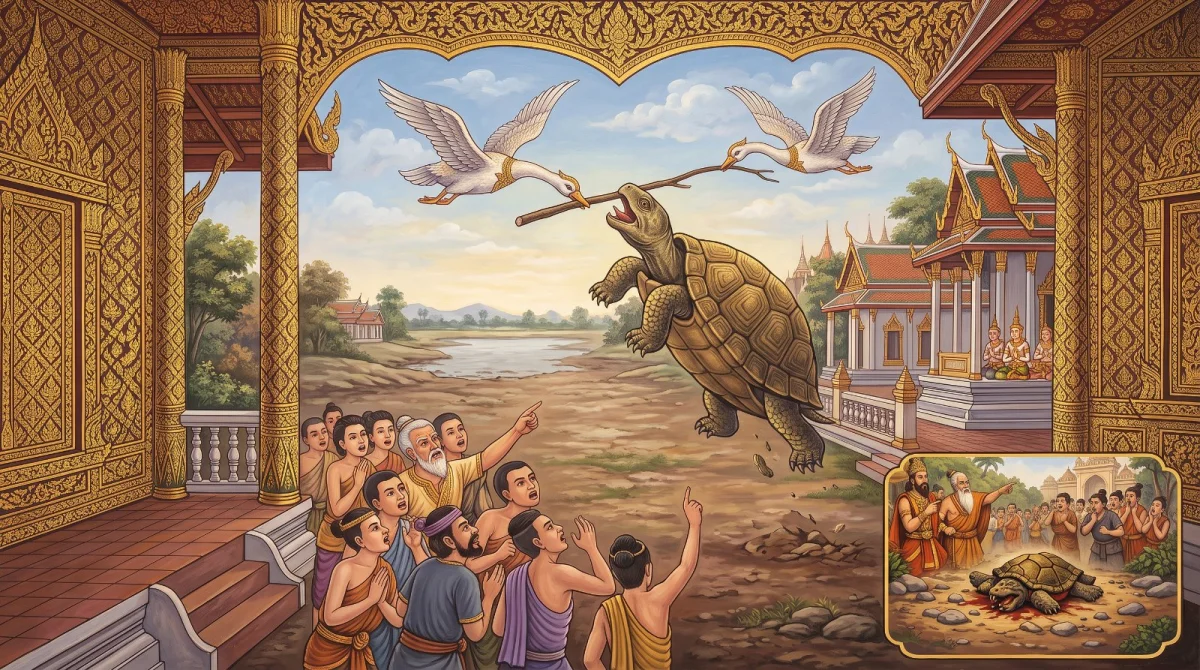
Kacchapajātakaṃ
A tortoise held a stick firmly in its mouth, but opened it to speak, fell and was killed. The verses teach speaking only what is good, and not beyond the proper time.
In the Kacchapa Jātaka of the Duka Nipāta, in the Jātaka of the Khuddaka Nikāya (the fifth story of the Bīraṇatthambhaka Vagga, different from the Kacchapa Jātaka about the tortoise in the mud in the Kalyāṇadhamma Vagga), the first verse says that the tortoise, uttering speech, killed itself: holding the stick firmly, it slew itself by its own words. The second, addressed to a king, says that seeing this, a wise person should utter speech that is good and not beyond the proper time — see the tortoise brought to ruin by talking too much.
The details of the story come from the commentary. It relates that a tortoise befriended two geese, who invited it to their home. They had the tortoise bite the middle of a stick while they held its two ends and flew off, warning it not to speak. As they flew over a town, children saw them and shouted mockingly. The tortoise wanted to answer back, opened its mouth, fell and was killed.
The commentary goes on to say that the king in the story talked so much that no one else could speak. His minister, the Bodhisatta, used this event to admonish him with the second verse, and from then on the king spoke less.
The tortoise held the stick firmly; its whole safety depended on keeping its mouth shut. Speaking at that moment meant letting go of what was holding up its life.
At critical times — during negotiations, while awaiting interview results, or in a legal matter — know what your "stick" is, hold on to it, and don't say what isn't needed.
No one pushed the tortoise; it was undone by its own words. The verse stresses that this danger came from within, not from the children shouting.
Before sending a message while angry, set it aside for ten minutes and read it again.
According to the commentary, the tortoise opened its mouth because it wanted to answer those mocking it, not because it had something necessary to say. Taunts are just noise from below; not answering costs us nothing.
When you meet provocative comments online, ask what answering would really achieve. If nothing, let it pass.
The second verse doesn't say to stop speaking, but to utter good speech — wholesome, beneficial words that harm neither oneself nor others.
Before speaking in a meeting, briefly ask yourself whether these words will make the work or the relationship better.
Nātivelaṃ means not going beyond the proper limit or time. Even good words become a burden for the listener if they run on too long.
Practise saying something important within one minute, then let the other person ask more.
The verse closes by asking us to see the tortoise ruined by much talking. Talking a lot increases the chance of saying something wrong or revealing what shouldn't be revealed, and it lightens the weight of our important words.
In today's conversations, notice how much you speak and how much you listen. If you speak more than half the time, try listening more.
The second verse is addressed to a king. The commentary says the minister waited for an event everyone could see, then admonished the king without criticising him directly. Advice given this way is easier to accept.
When you need to caution a boss or an elder, point to an event or data you have both seen, rather than saying they are wrong.
The tortoise and the stick applies directly today. Much damage comes not from actions but from words or messages sent in a moment of emotion, especially when mocked or provoked.
Note that the tortoise didn't want to say anything important; it wanted to hit back at those mocking it. Knowing we needn't answer every remark is itself a form of self-protection.
The jātaka doesn't teach silence at all times. The verse says to speak what is good and in due measure. Saying what needs saying, plainly, is still good.
Tap to read the actual passage on the page cited.
One night the deva Anāthapiṇḍika visits the Buddha and speaks verses praising Jeta's Grove, saying that people…

When an old monk rejoiced at being free of restrictions, Mahākassapa called on the Saṅgha to recite the Dhamma…

Five things that block the mind from settling and wisdom from arising — name the one you have and the remedy b…

Keṇiya offered drinks, which led to the allowance of eight kinds of drink. Roja the Malla welcomed the Buddha …