
Puggalapaññatti: Three Persons Like Patients
Gilānūpamā puggalāSome patients don't recover whether or not they get medicine, some recover either way, and some recover only w…


Kumbhajātakaṃ
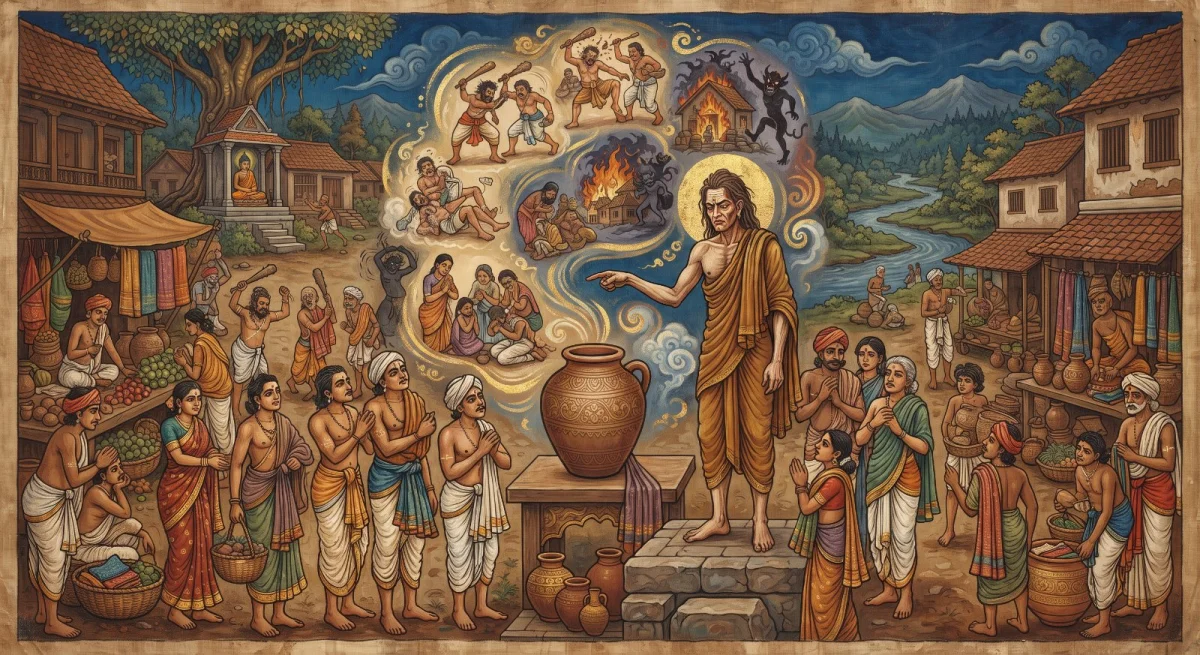
Sakka, disguised as a brahmin, appears with a jar of liquor before a king who is about to drink and calls on him to buy it. But instead of praising his wares, he lists the dangers of liquor one by one: losing mindfulness, quarrelling, losing wealth, abusing one's parents and telling lies. The king sees that this person truly wishes him well and accepts the teaching.
In the Kumbha Jātaka of the Book of Thirties (Tiṃsati Nipāta) in the Jātaka, Khuddaka Nikāya, the verses begin when the king sees a radiant figure standing in mid-air calling on people to buy a jar, and asks who he is and what the jar is for. The figure replies that this is not a jar of ghee, oil, molasses or honey, and asks him to hear the many faults of what is inside. He then describes them one by one, each ending with the ironic refrain: buy this jar full of liquor.
The dangers mentioned include: after drinking, stumbling into pits and wells, eating what should not be eaten, singing and dancing helplessly, saying things that should not be said in an assembly, thinking oneself greater than a king, starting quarrels, bringing wealthy families to ruin, abusing one's parents, telling lies though normally no amount of money could buy a lie, being unable to handle urgent work, the modest becoming shameless, and misconduct by body, speech and mind. The king replies: you are neither my father nor my mother, yet you are compassionate and wish me the highest good; I will do as you say. He offers villages, servants, cattle and chariots as a teacher's fee. The figure reveals that he is Sakka, declines the gifts, and urges the king to delight in Dhamma.
In the Tipiṭaka the Jātaka consists only of verses. The commentary tells that liquor first appeared when a forester named Sura found water in a tree hollow where fruit and grain had fallen and fermented, making the birds that drank it drunk. He drank it with an ascetic named Varuṇa, and the two sold it from city to city until several cities declined. When King Sabbamitta of Sāvatthī was about to start drinking, Sakka saw that if the king drank the realm would be ruined, and came down to warn him. Afterwards the king gave up drinking, had the liquor vessels destroyed, and kept the precepts and gave gifts. The commentary says the Teacher told this story after a group of Visākhā's friends drank during a festival and then came to hear the Dhamma.
The figure with the jar says this is not a jar of ghee, oil, molasses or honey; the faults of what is inside are many, so listen. A later verse repeats that there is no curd or honey in this jar; know this, and only then buy.
Before accepting a drink at a party because of the atmosphere, ask yourself plainly what the drink in your glass gives you and what it takes from you, then decide based on the answer.
The verses say that one who drinks stumbles into wells, pits and cesspits, eats what should not be eaten, wanders like a helpless ox, lies asleep until burned by fire, and ends up imprisoned or losing wealth.
If you drink, never drive a car or ride a motorbike. Agree with friends before leaving home who will not drink and will drive, or call a ride home.
The verses say that after drinking a person becomes excited and red-eyed, thinking the whole earth belongs to him and that not even a king ruling to the four seas is his equal. Liquor breeds excessive pride, quarrels and slander, and is the gathering place of rogues.
If you know you get loud or pick fights when you drink, make a rule for yourself not to discuss contentious topics or send important messages after drinking.
The verses say that prosperous families with thousands in wealth have been left without an inheritance because of liquor; grain, wealth, silver, gold, fields and cattle are all destroyed. Liquor cuts off the wealth of families.
Try recording your spending on alcohol for a month, including snacks and transport, then multiply by twelve to see the figure clearly.
The verses say that one who drinks becomes coarse, abuses his father and mother, and does things that should not be done to members of his own family.
If people at home have ever said they feel afraid or uneasy when you drink, treat that as an important signal. And if you are the one being harmed by someone who is drunk, get out of the situation and seek help.
The verses say that someone who normally would not tell a lie even if offered a great deal of money will lie after drinking; the modest display shamelessness, the steady talk too much, and when urgent work arises, they cannot understand what they are asked.
Don't make decisions about money, work or relationships while alcohol is in your system, and if you have something important the next day, don't drink the night before.
The king replies: you are neither my father nor my mother, yet you are compassionate and wish me the highest good; today I will do as you say. He offers five villages and other wealth as a teacher's fee. Sakka declines and urges the king to delight in Dhamma. The commentary tells that the king gave up drinking, had the liquor vessels destroyed, and kept the precepts and gave gifts.
When someone close to you warns you about your drinking or risky behaviour, answer with thanks rather than defending yourself. The person willing to say something unwelcome is the one who truly wishes you well.
This Jātaka uses a clever storytelling device: the seller tells the whole truth about his product. Imagine if alcohol advertising had to list every harm like this; would as many people want to buy?
Many of the dangers in the verses match what we still see every day: accidents, quarrels at home, debt, and words we regret having said. The fifth precept is not a distant rule.
A caution: for people who have been drinking heavily for a long time, stopping suddenly can bring dangerous withdrawal symptoms. It is best to talk with a doctor to plan quitting safely. Admitting that you need help takes courage; it is not weakness.
Tap to read the actual passage on the page cited.
Some patients don't recover whether or not they get medicine, some recover either way, and some recover only w…

The Buddha's answer for working people with families — work hard, protect what you earn, keep good friends, li…
Five worthwhile uses for wealth honestly earned — from supporting yourself to supporting what is good, so ther…

On a full-moon night a monk questions the Buddha step by step: what the five aggregates subject to clinging ar…