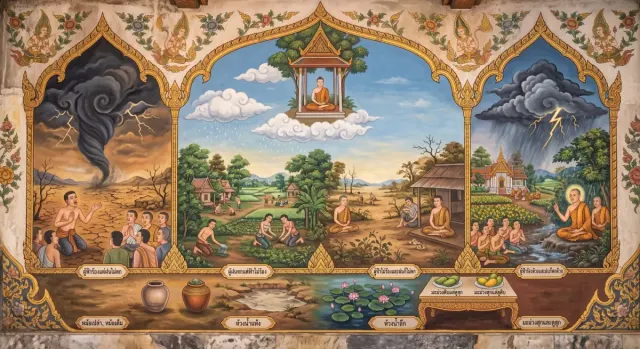
Four Kinds of People: Clouds, Pots, Pools and Mangoes
ValāhakavaggoSome people talk but don't act; some look fine but are empty inside — a set of similes from the Book of Fours …



Kare sarikkho athavāpi seṭṭho
One should make friends with equals, superiors and inferiors alike, because when misfortune comes such friends can help, just as the deity of a clump of kusa grass saved the tree of a powerful deity.
In the Kusanāḷi Jātaka of the Ekanipāta in the Jātaka, Khuddaka Nikāya, there is a single verse: whether equal, superior or inferior, one should make friends, for in misfortune such friends can do the highest good, as the tree deity and the deity of the kusa grass were friends.
The story comes from the commentary. A king needed timber for a palace pillar, and the carpenters found no suitable tree except the auspicious tree in the royal park, home to a powerful deity. The deity wept at losing its home, and the deities it knew could think of no way to help. The Bodhisatta, a deity of little power living in a clump of kusa grass, turned himself into a chameleon, went in at the foot of the tree, climbed up inside and popped out at the top, making the tree look hollow. The master carpenter concluded the tree had no heartwood and left it.
According to the commentary, the Buddha told this when Anāthapiṇḍika's friends and relatives objected to his closeness with a friend of lower standing. The merchant kept trusting that friend and was helped by him in protecting his property.
The commentary explains that even those equal in birth and standing should be befriended. Friends at the same level understand each other and can share burdens.
Look after classmates or colleagues at your own level rather than seeing them as rivals.
Even those higher in birth and standing should be befriended. This is not flattery but sincere friendship with people in a different position from ours.
When you get to know someone more experienced or senior, relate with respect and sincerity, not only in hope of benefit.
Even one humbler in birth and standing should be treated as a friend. The commentary concludes that all of these should be made friends, and that in friendship one need not weigh equality or superiority.
Greet and respect everyone at work, from cleaners and security guards to new staff. Such relationships are worth more than you might think.
The verse gives the reason: in misfortune such friends can do the highest good. The commentary expands that they share the burden and free their friend from suffering of body and mind.
Measure friendship by hard times, not parties, and be the first to reach out when a friend is in trouble.
In the commentary, the deity of the ruca tree admits that despite great power it was not skilled in means and could not end its own distress. Only by relying on the kusa-grass deity, of little power but wise, was it freed.
When facing a problem, ask people on the front line or younger colleagues. Sometimes the answer lies with someone you never thought to ask.
The commentary says Anāthapiṇḍika's friends and relatives repeatedly objected that this friend was not his equal, but he did not heed them and left that friend in charge of his property when he travelled. The Buddha said that the ability to keep faith as a friend is the true measure in friendship.
When someone tells you to drop a friend because of their status or background, look instead at the honesty and goodwill they actually show you.
Society often measures people by status, position or income, and chooses to befriend only equals or those above. This Jātaka shows that the most important help may come from someone we least expect.
In the story, the powerful deity admits that it had great power but not enough wisdom, while the friend of little power had the wisdom to find a way out. Workplaces are similar: frontline staff may understand a problem better than executives.
The Jātaka does not say to befriend everyone indiscriminately. The criterion the commentary stresses is the ability to keep faith as a friend, not status.
Tap to read the actual passage on the page cited.
Some people talk but don't act; some look fine but are empty inside — a set of similes from the Book of Fours …

The resultant triplet separates states that are results, states that produce results, and states that are neit…

Bhaddā Kuṇḍalakesā tells her life: falling in love with a thief about to be executed, surviving him through qu…

Nine verses of the Elder Bhūta, each ending with the same line: one finds no greater delight than this. They c…