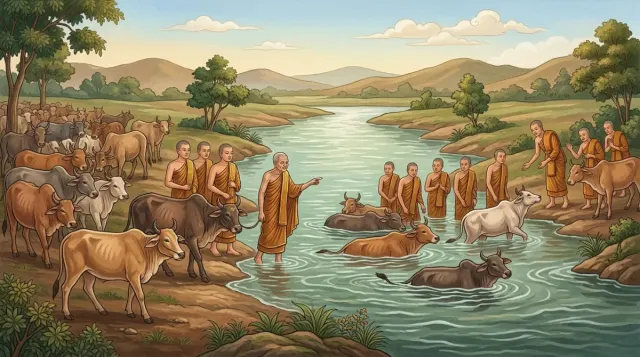
The Shorter Discourse on the Cowherd: The Herd Crossing the River
CūḷagopālakasuttaṃA wise cowherd sends the leading bulls across first, then the strong cattle, until even a newborn calf crosses…


Kuṭidūsakajātakaṃ
A bird asks a monkey out in the rain why, with a head, hands and feet like a human's, it has no home. The monkey admits it lacks wisdom, and the bird advises it to change its old ways and build a shelter from the cold and wind. According to the commentary, the angry monkey then destroys the bird's nest.
In the Kuṭidūsaka Jātaka of the Catukkanipāta, Khuddaka Nikāya, the canonical text consists of only four verses, a conversation between a bird and a monkey. The bird asks: your head, hands and feet are like a human's, so why do you have no house? The monkey answers that its body may be like a human's, but the wisdom counted as best among humans it does not have.
The bird then says that one whose mind is unsteady and fickle, who betrays friends and whose conduct is never constant, has no happiness. It advises the monkey to show what it can do, go beyond its old habits, and build a hut as protection from cold and wind.
The part Thai readers remember, where the monkey, angry at being lectured, tears the bird's nest apart, comes from the Jātaka commentary and gives the Jātaka its name, "the destroyer of the dwelling". The commentary also gives the occasion as a pupil who, after being admonished, bore a grudge and burned his teacher's hut. These details are not in the verses.
The bird asks the monkey: your head, hands and feet are like a human's, so why do you have no house? It has the limbs needed to build one, but has not done so.
Look at what you already have, such as time, health or knowledge, that you haven't yet used to make your life more secure, and choose one thing to start.
The monkey replies that its head, hands and feet are indeed like a human's, but the wisdom the wise call best among humans it does not have. The difference is not in the body but in thinking and planning.
When you think you lack money or opportunity, ask whether you really lack resources, or lack a plan for using what you already have.
The bird says that one whose mind is unsteady and fickle has no happiness. A monkey that changes its mind every moment never finishes building anything.
If you tend to start new projects and drop them halfway, set a small goal you can finish within a week, and complete it before starting something new.
In the same verse, the bird says that one who betrays friends and whose conduct is never constant has no happiness. Someone who harms those who wish them well will find fewer and fewer people willing to help.
When a friend or family member warns you and you feel annoyed, separate the annoyance from the person, and don't retaliate by damaging the relationship.
The bird advises the monkey to show what it can do and go beyond its old habits. Knowing what you lack is not enough; you have to be willing to change long-standing patterns.
Choose one habit you know keeps your life insecure, such as spending everything each month, and change it bit by bit, for example by setting savings aside before spending.
The bird advises the monkey to build a hut as protection from cold and wind. According to the commentary, the monkey, displeased at being taught, tears the bird's nest apart and the bird has to fly away.
Build your life's shelter while times are still good, such as an emergency fund, health insurance or looking after your body. And when you give someone advice, check whether they're ready to hear it.
This Jātaka works from two sides. The first is the side of the one receiving advice. The monkey knows what it lacks, but when someone points out a solution, it feels humiliated. Feeling embarrassed when your shortcomings are pointed out is normal, but if that turns into destruction, you lose both a friend and an opportunity.
The second is the side of the one giving advice. The bird's words are right, but according to the commentary they are spoken to someone not ready to listen, at a moment when he is cold and irritable. Checking whether the person in front of you is ready to listen before you speak protects both you and the relationship.
The advice to build a hut against cold and wind applies directly to life: prepare your shelter in advance, whether savings, health, skills or people you can trust.
Tap to read the actual passage on the page cited.
A wise cowherd sends the leading bulls across first, then the strong cattle, until even a newborn calf crosses…
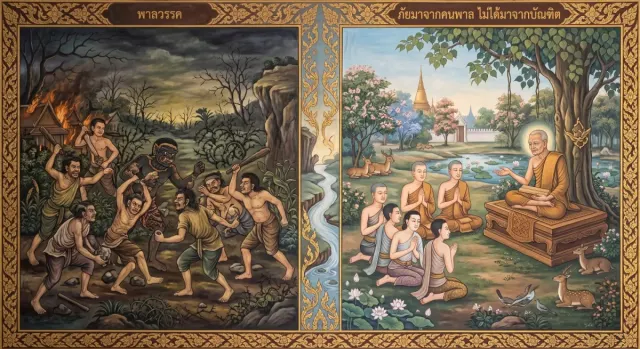
All fears, dangers and troubles arise from the fool, not from the wise, like a fire from a hut of reeds that b…

Mahānāma the Sakyan invites the Saṅgha to ask him for medicines for four months, then four more, then for life…

Seven things that keep a community growing rather than declining — the Buddha's answer when a king was plannin…