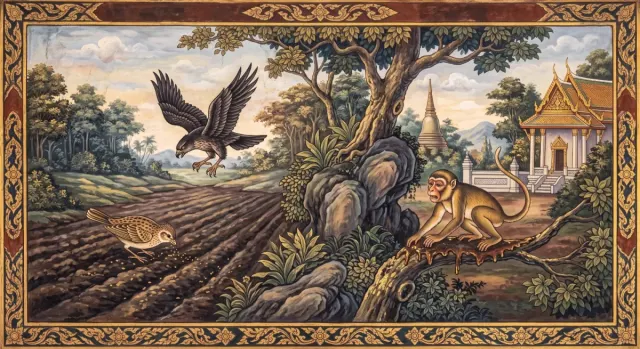
The Hawk and the Monkey Trap: Staying in Your Own Territory
Gocare bhikkhave caratha sake pettike visayeA quail that strayed from its range was seized by a hawk, but escaped once back in its own ploughed field. A g…


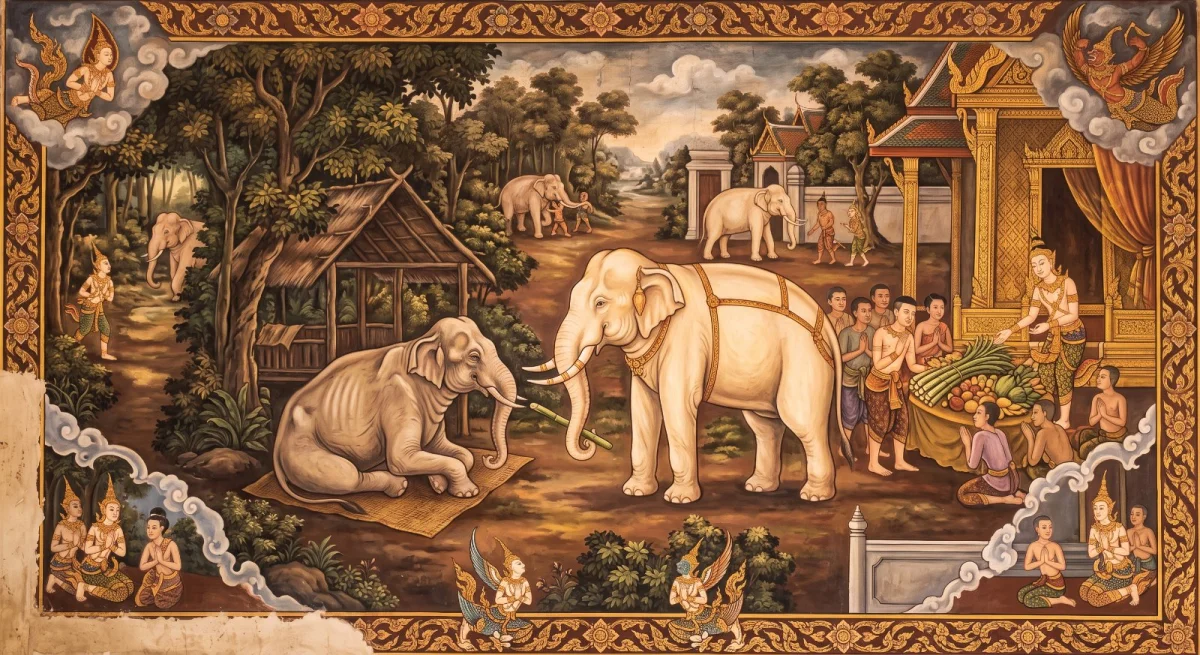
Mātuposakajātakaṃ
An elephant who looks after his blind mother is captured to be a royal elephant, but will not take food because he is worried about his mother, who has no one to guide her. When the King of Kāsi learns why, he orders him set free. The verses teach gratitude towards those who depend on us, and using power with kindness.
In the Mātuposaka Jātaka of the Book of Elevens in the Jātaka, Khuddaka Nikāya, the verses open with a lament: now that the great elephant is gone, the trees and grasses he used to eat are growing freely; somewhere, no doubt, noble people adorned with gold are feeding him with balls of rice so that a king or prince can ride him into battle.
The king then urges the elephant to take a mouthful and not waste away, for there is much royal work to do. The elephant replies that a blind, forlorn she-elephant with no one to guide her must be stumbling against tree stumps at Mount Caṇḍoraṇa. When the king asks what she is to him, the elephant answers that she is his mother. The king orders him released. The elephant goes to the lotus pond he knew, draws up water with his trunk and sprinkles his mother. She grumbles about rain falling out of season now that the son who cared for her is gone, and he tells her: get up, mother, your son has come back. The mother then blesses the king who set her son free with a long life.
The Jātaka in the Tipiṭaka consists only of verses. The story above comes from the verses; other details come from the commentary: that the first two verses are the mother's lament; that the Buddha told this story about a monk who supported his mother; that the elephant had once guided a lost forester out of the forest, only for that man to tell the king where to capture him; that the elephant was strong enough to fight but chose not to be angry; and that he refused food in the royal stable for several days.
The king urges the elephant to take a mouthful and not waste away, for there is much royal work to do, but the elephant answers out of worry for his blind mother. (The commentary says he resolved not to accept food because his mother had no one to feed her.)
When a good opportunity comes, such as a better-paid job in another city, plan first for who will look after those who depend on you.
The elephant describes her: forlorn, blind, with no one to guide her, surely stumbling against stumps at Mount Caṇḍoraṇa. What he pictures is not his own hardship but the hardship of the one he used to care for.
Call parents or older relatives who live alone regularly, and ask about small things: are they taking all their medicines, is there still food in the house?
When the king asks what the blind she-elephant is to him, the elephant answers: great king, she is my mother. This short answer is what changes the king's decision.
If you need leave or flexible hours to care for your parents, tell your manager honestly and clearly. People are often ready to help once they understand the reason.
The king says: release this great elephant who supports his mother; let him be with his mother and all his kin. He gives up a valuable elephant because he sees its virtue.
If you manage people, when someone on your team has family care duties, ask what flexibility you can offer rather than applying every rule to the letter.
As soon as he is freed, the elephant rests only a moment, then goes to the lotus pond he knew, draws up water with his trunk and sprinkles his mother, saying: get up, mother, your son has come back. The first thing he does with his freedom is care for his mother.
Gratitude doesn't need to wait for a big occasion. When you get home, help your parents with things they find hard, like reaching high shelves or lifting heavy things.
The mother blesses the king with a long life and a flourishing kingdom of Kāsi, because he freed her son, who always honoured his elders. The son's goodness brings blessings to the one who helped him too.
When someone makes it possible for you to care for your family, such as a colleague covering your work, thank them sincerely and look for a chance to return the favour.
This story is short but vivid. A son given the best food in the palace cannot eat because he knows the one who depends on him is suffering. Gratitude here is not just words; it is a choice about what matters more than one's own comfort.
In real life many people work far from home and leave ageing parents behind. The story doesn't say to quit at once, but it invites the question: who is "guiding" them now, and have we made sure they are looked after?
The refusal to eat is the language of a tale, not something to imitate. Long-term care for parents also requires looking after your own health, and it is fine to ask siblings or elder-care services for help without feeling guilty.
Tap to read the actual passage on the page cited.
A quail that strayed from its range was seized by a hawk, but escaped once back in its own ploughed field. A g…

A hundred years after the Buddha's final passing, the Vajjian monks of Vesālī declared ten points allowable, i…
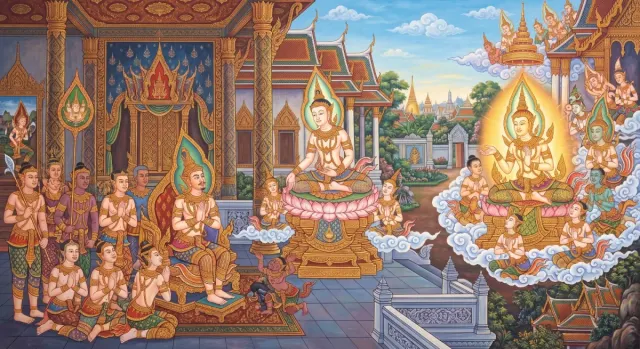
King Aṅgati listens to a naked ascetic who teaches that good and bad deeds bear no fruit, and abandons his dut…

Deities in the Vimānavatthu tell what they gave as human beings, and the gifts are very ordinary: a dry cake w…