
The Five Aggregates
PañcakkhandhāThe five heaps that combine into what we call "me" — look at them one at a time and no single heap turns out t…


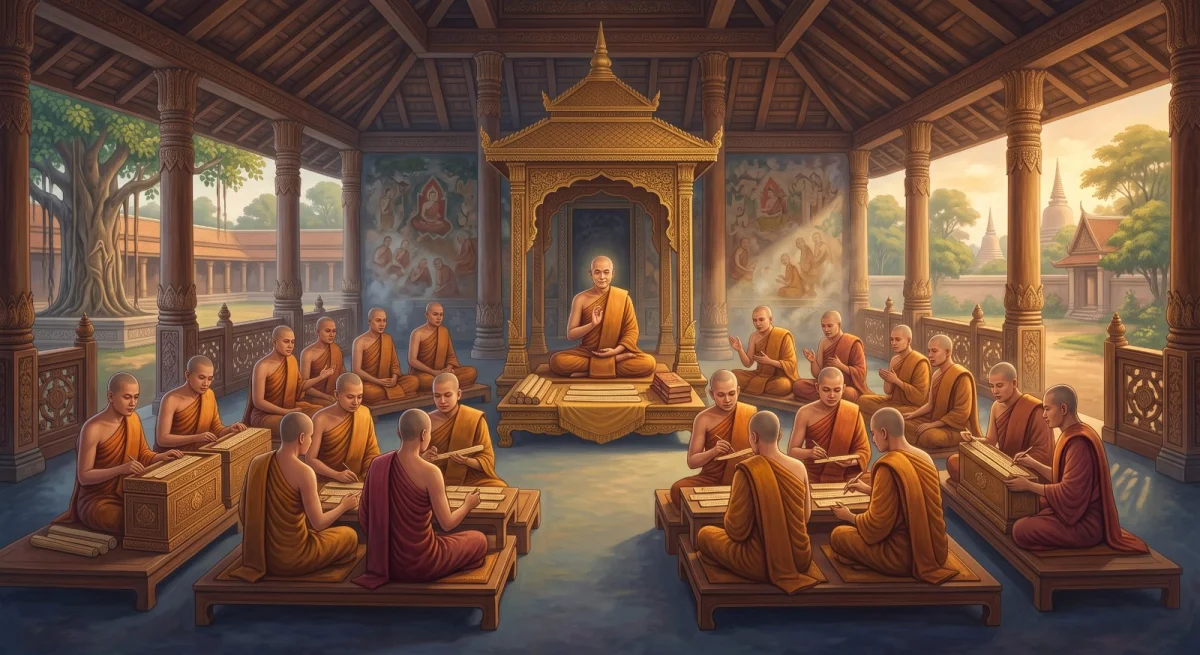
Sattasatikakkhandhakaṃ
A hundred years after the Buddha's final passing, the Vajjian monks of Vesālī declared ten points allowable, including accepting gold and silver. Yasa Kākaṇḍakaputta objected and sought out elders learned in the Vinaya, and when the full assembly could not agree, the Saṅgha appointed a committee of four monks from each side to decide point by point until the matter was settled. Seven hundred monks took part.
In the Sattasatika Khandhaka, the last khandhaka of the Cullavagga, Vinaya Piṭaka, is the record of the second council. Its name comes from the seven hundred monks who took part in this recitation of the Vinaya.
A hundred years after the Buddha's final passing, the Vajjian monks of Vesālī declared ten things allowable, such as carrying salt in a horn to season food, eating when the sun's shadow is two finger-breadths past noon, separate observance ceremonies in residences within one boundary, carrying out a formal act with an incomplete Saṅgha and getting approval afterwards, drinking weak, unfermented liquor, and accepting gold and silver.
The heart of the khandhaka is the process the elders used: gathering experts, consulting the most senior elder, appointing a committee, and deciding each point with its source. The account of King Kālāsoka supporting the council and the later split into schools comes from later works such as the commentaries and chronicles, not from this khandhaka.
The Vajjian monks of Vesālī declared ten points allowable. On the observance day they set a bronze bowl filled with water in the middle of the Saṅgha and urged the lay followers who came: give money to the Saṅgha, a kahāpaṇa, a half, a quarter or a māsaka; the Saṅgha will need it for requisites.
Notice small exceptions that are becoming custom at work, at home or in your own habits, and review them before they become a new standard no one intended.
Yasa Kākaṇḍakaputta told the townspeople not to give money, since gold and silver are not allowable for ascetics who are sons of the Sakyan. They gave anyway. The next day the Vajjian monks divided the money by the number of monks and brought Yasa his share. He replied that he had no share in money; he did not consent to money.
If benefits are being shared out in a way you know is wrong, decline politely and clearly, even if everyone else in the group accepts.
The Vajjian monks accused him of reviling faithful lay followers and imposed an act of reconciliation requiring him to apologise. He asked for a companion monk, as the Vinaya provides, and explained to the townspeople that he had only called what is not Dhamma not Dhamma and what is Dhamma Dhamma. He cited the discourse on the four defilements of ascetics and brahmins, the story of the village headman Maṇicūḷaka, and the training rule laid down on account of Upananda. The townspeople understood and said that he alone was a true ascetic, a son of the Sakyan.
When accused of harming others, go and explain to those affected directly, citing principles or facts that can be checked, rather than arguing only within your own circle.
When the Vajjian monks moved to suspend him, he went to Kosambī and sent messengers to the monks of Pāvā, Avantī and the southern region to come and take up the dispute. He went to Sambhūta Sāṇavāsī, and the elders went after Revata, who was learned, knew the Dhamma, the Vinaya and the summaries, and had conscience and love of the training. Yasa asked Revata about each point in turn; Revata said none was allowable, except that following what one's preceptor or teacher did is sometimes allowable and sometimes not.
In a dispute over principles, consult people who truly know the subject and are impartial, not just people who agree with you.
The Vajjian monks also wanted Revata on their side and brought him bowls, robes and other requisites. Revata refused, saying his set of robes was complete. They then went to Uttara, his attendant, and pressed him until he took one robe, then asked him to get Revata to declare that since Buddhas arise in the eastern regions, the eastern monks speak the Dhamma. Revata said, "Monk, are you urging me to what is not Dhamma?" and sent Uttara away.
If you are judging or advising on a matter, don't accept gifts from those involved, and don't let people close to you become a channel for accepting them.
When the elders went to Vesālī, Revata stayed in the same dwelling as Sabbakāmī, an elder of 120 years since ordination and a pupil of Ānanda. That night neither lay down: Revata out of consideration because the old elder had not lain down, and Sabbakāmī because the tired visitor had not. Towards dawn Sabbakāmī asked in which abiding he mostly dwelt. Revata said he dwelt mostly in loving-kindness; Sabbakāmī said he dwelt mostly in emptiness.
Even when preparing for a hard negotiation, you can still show consideration and gentleness to the person in front of you. Firmness in principle and kindness go together.
Revata proposed settling the dispute in Vesālī, where it arose, so no one could reopen it later. When the Saṅgha met, there was endless talk and not a single statement's meaning could be understood. Revata proposed settling it by referral to a committee. The Saṅgha chose four eastern monks, Sabbakāmī, Sāḷha, Ujjasobhita and Vāsabhagāmika, and four from Pāvā, Revata, Sambhūta Sāṇavāsī, Yasa Kākaṇḍakaputta and Sumana, and appointed Ajita to prepare the seats. The committee met at the Vālika Park, which was quiet and free of noise.
When a large meeting turns into a shouting match, set up a small group with equal representatives from each side, let them talk somewhere quiet, and bring the conclusions back.
At the Vālika Park, Revata asked Sabbakāmī about each point: is it allowable, where was it forbidden, and what offence does it entail. For gold and silver, Sabbakāmī answered: not allowable, forbidden at Rājagaha, found in the Suttavibhaṅga, an offence entailing confession. When all ten points had been judged contrary to the Dhamma and Vinaya, Sabbakāmī said the dispute was settled, but asked to be questioned again in the midst of the Saṅgha so that all the monks would know.
When deciding a matter with many issues, take them one at a time, record the reasoning and sources for each, and report the results openly to everyone involved.
Every organisation faces the day when its standards are relaxed one point at a time, until what was once forbidden becomes normal. The Second Council shows that upholding principles need not mean fighting, but it does need facts, knowledgeable people and a process all sides accept.
A method you can use right away: when a large meeting argues until no one can follow, set up a small working group with equal representatives from each side, let them consider one issue at a time in a quiet place, make sure each conclusion has a reference, and then report back to the full meeting.
The story also warns against accepting gifts from interested parties in a matter you must give an opinion on, and shows that even in the middle of a conflict we can keep a kindly heart.
Tap to read the actual passage on the page cited.
The five heaps that combine into what we call "me" — look at them one at a time and no single heap turns out t…

Venerable Yamaka believes an arahant is annihilated at death, and his fellow monks cannot talk him out of it. …
A man who lost his only son refused to believe love brings suffering, until Queen Mallikā questioned King Pase…

The Vinaya sets out what kind of monk may give full ordination, give dependence and take a novice as attendant…