
The Apadāna of Sela: Merit a Whole Street Made Together
SelattherāpadānaṃA street chief in Haṃsavatī gathered his whole neighbourhood — cooks, dyers, smiths, water-carriers, cake-sell…


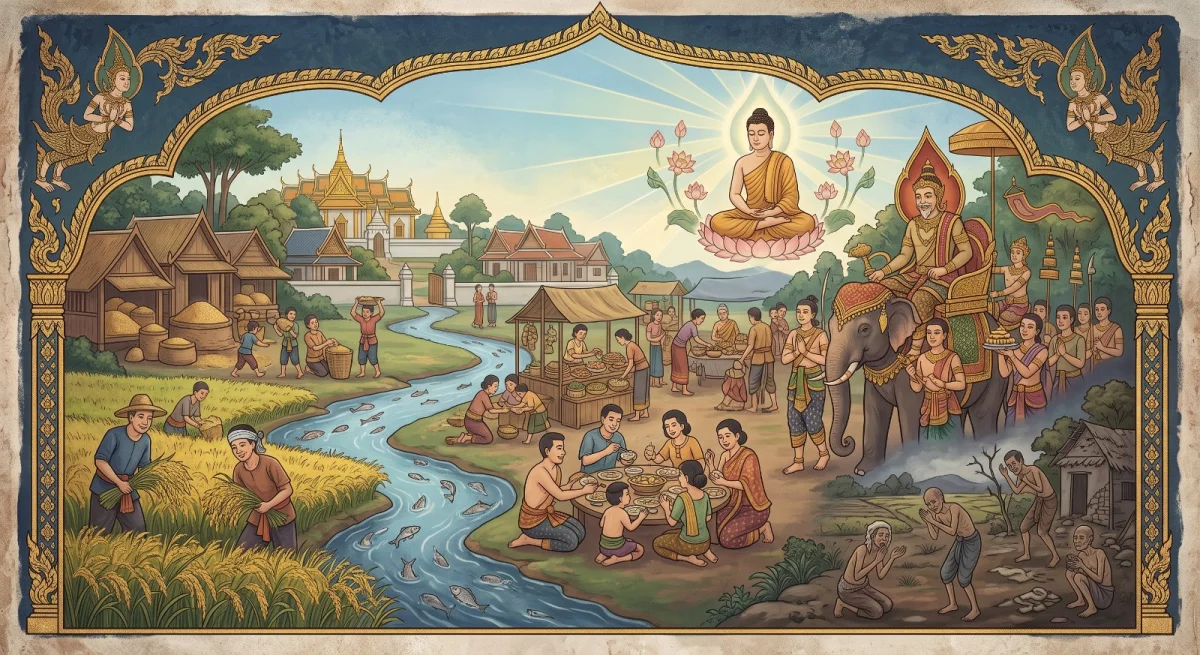
Kūṭadantasuttaṃ
Instead of suppressing bandits by punishment, the chaplain advised the king to give seed to farmers, capital to traders and wages to officials — and the finest sacrifice required no killing at all.
In the Kūṭadanta Sutta of the Dīgha Nikāya, the brahmin Kūṭadanta was preparing a great sacrifice, with hundreds each of bulls, goats and rams tied up for slaughter, and came to ask the Buddha how to perform a sacrifice properly.
The Buddha told of King Mahāvijita in the past, who wished to perform a great sacrifice. His chaplain said the country was still troubled by bandits, and suppressing them by execution, imprisonment or banishment would not end the problem, since those remaining would keep harassing the realm. The right way was for the king to give seed and food to those who farm and keep cattle, capital to those in trade, and food and wages to those in government service. When he did so, the people applied themselves to their work, the country prospered, banditry ended, and people lived with their doors open.
The sacrifice the king then performed involved no killing of animals and no felling of trees — only ghee, oil, butter, curd, honey and molasses. Having heard this, Kūṭadanta released all the animals and declared himself a lay follower.
The chaplain said that executing, imprisoning, fining, censuring or banishing bandits does not properly uproot the thorn in the realm, since those remaining will continue to harass it.
In an organisation or family, if the same problem recurs despite punishment, look for the root cause driving people to act that way.
Give seed and food to farmers and herders, capital to traders, and food and wages to officials. When people have a livelihood and apply themselves to work, the country prospers, banditry ends, and people live with their doors open.
Leaders who ensure those in their care have sufficient, fair income are preventing problems before they arise, not chasing after them.
In King Mahāvijita's sacrifice no cattle, goats, sheep, fowl or pigs were killed, no trees were felled for sacrificial posts, and no workers were driven by threat of punishment — only ghee, oil, butter, curd, honey and molasses were used.
When organising a merit-making event or celebration, ask whether anyone or anything will suffer for it — animals, workers or the environment.
More fruitful than that are regular gifts to the virtuous, building a dwelling for the Saṅgha, going for refuge, and keeping the five precepts with a confident heart.
Consistency matters more than grandeur. Small monthly giving means more than one big event. Read alongside "The Velāma Discourse: The Ranking of Merit".
Most fruitful of all is going forth, keeping virtue, training concentration to jhāna, and realising knowledge up to the destruction of the taints.
This is here for understanding the overall picture: the most valuable offering anyone can make is training their own mind, not things brought as gifts.
This discourse is a principle of governance at every level — nation, organisation, family. Many behavioural problems can't be solved by punishment alone; the root cause must be addressed by making honest livelihood genuinely possible.
It also teaches about merit: good merit involves no harm. If a big merit-making event causes anyone or anything to suffer, reconsider whether it is still merit. Read alongside "The Ten Royal Virtues".
Tap to read the actual passage on the page cited.
A street chief in Haṃsavatī gathered his whole neighbourhood — cooks, dyers, smiths, water-carriers, cake-sell…

The swan king Dhataraṭṭha is caught in a hunter's snare. The whole flock flies off, except his general, the sw…

Four levels of a collected mind — the right concentration of the eighth path factor, described stage by stage …

The powerful nāga prince Bhūridatta keeps the uposatha on an anthill and is betrayed by a brahmin he had hoste…