
The Sīhacamma Jātaka: The Donkey in the Lion's Skin
SīhacammajātakaṃA donkey covered in a lion's skin grazed on green crops for a long time, but when it brayed it revealed itself…


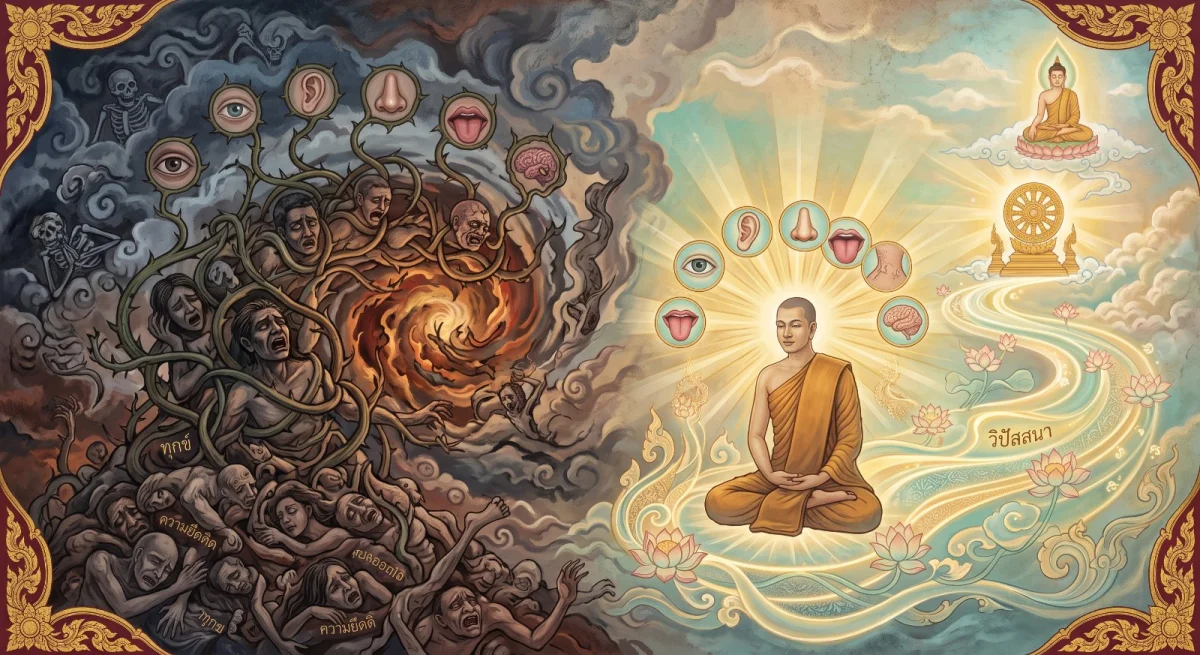
Saḷāyatanavibhaṅgasuttaṃ
One who does not know and see the eye, forms, sense consciousness, contact and feeling as they really are becomes infatuated; the five aggregates pile up, and craving and fever of body and mind increase. One who knows and sees them as they are experiences the opposite, the noble eightfold path is fulfilled, and serenity and insight proceed together.
In the Saḷāyatanavibhaṅga Sutta of the Saḷāyatana chapter in the Majjhima Nikāya (Uparipaṇṇāsa), which some Pali editions call the Mahāsaḷāyatanika Sutta (a different discourse from the Saḷāyatanavibhaṅga Sutta in the Vibhaṅga chapter, on the thirty-six positions), the Buddha is staying at Jeta's Grove and says he will teach in detail about the six sense bases.
He sets out two contrasting sides. On one side, one who does not know and see as they really are the eye, forms, eye-consciousness, eye-contact and the feeling born of eye-contact is inflamed by lust for them and sees only their gratification. The five aggregates subject to grasping pile up, craving grows, and stress, torment and fever grow in both body and mind. On the other side is one who knows and sees as they really are, for whom every result is the opposite.
He then shows that for such a person the noble eightfold path is fulfilled, all the qualities that lead to awakening are fully developed, serenity and insight proceed together, and the four tasks are done by direct knowledge. He teaches the same for ear, nose, tongue, body and mind.
What must be known and seen as it really is is not only the eye and forms, but also eye-consciousness, eye-contact and the pleasant, painful or neutral feeling that arises from that contact. Not knowing it as it is, one is inflamed by lust at every point in the chain.
Next time something on your screen catches you, trace it through: the eye sees, you know you're seeing, the mind is struck, then how do you feel? Tracing slowly like this keeps you from being dragged along at once.
One who is inflamed, fettered, infatuated, and dwells contemplating only gratification — seeing only the appealing side — finds the five aggregates subject to grasping piling up for the future, and craving that leads to renewed existence growing.
Before buying something or starting a new habit, write down at least one unappealing side of it, so you don't decide from the tasty side alone.
The discourse spells out the consequences: stress, torment and fever grow both bodily and mentally, and one experiences bodily and mental suffering. Unnoticed craving shows up in the body too.
Notice your body when you want something badly — a racing heart, fidgety hands, sleeplessness. These are signals to stop and look at the mind.
One who knows and sees the sense bases as they are is not inflamed, not fettered, not infatuated, and dwells contemplating danger. The five aggregates subject to grasping do not pile up; craving is abandoned, bodily and mental stress, torment and fever are abandoned, and one experiences happiness of body and mind.
The happiness of not being pulled back and forth is real. Notice a day when you chased nothing and see how much lighter your mind was.
For such a person, view becomes right view, intention right intention, effort right effort, mindfulness right mindfulness, concentration right concentration — and bodily action, speech and livelihood were already well purified beforehand. Thus the noble eightfold path comes to fulfilment.
Meditation goes further when outer life is clean. If some breach of the precepts is still unresolved, putting it right is itself a form of practice.
Developing the path in this way, the four foundations of mindfulness, four right efforts, four bases of power, five faculties, five powers and seven awakening factors are also fulfilled, and two things — serenity and insight — proceed yoked together. There is no need to pick one and drop the other.
In a short sitting, include both: first rest the mind on the breath until calm, then observe how feelings arise and pass.
What should be fully understood is the five aggregates subject to grasping; what should be abandoned is ignorance and craving for existence; what should be developed is serenity and insight; what should be realised is true knowledge and liberation. All are done by direct knowledge.
When facing an inner problem, use four questions to sort it out: what do I need to understand, what do I need to let go, what do I need to practise more, and what is the result I want to see?
This discourse describes a mechanism we know well in the age of screens: we see something appealing, the mind clings, wants more, and grows restless in body and mind. The discourse doesn't tell us to stop looking, but to know and see the whole chain as it is — eye, image, cognition, contact, and the feeling that arises.
What stands out is the result of seeing clearly: the discourse says such a person experiences happiness of both body and mind. Watching the senses isn't about making life dry; it's about no longer feeding the fire of restlessness.
Tap to read the actual passage on the page cited.
A donkey covered in a lion's skin grazed on green crops for a long time, but when it brayed it revealed itself…

A look at the Paṭṭhāna's own examples: giving and then recalling it, which can bring joy or lust; relying on f…

For one without sensual desire or craving, who has crossed over doubt, there is no further liberation to seek.…
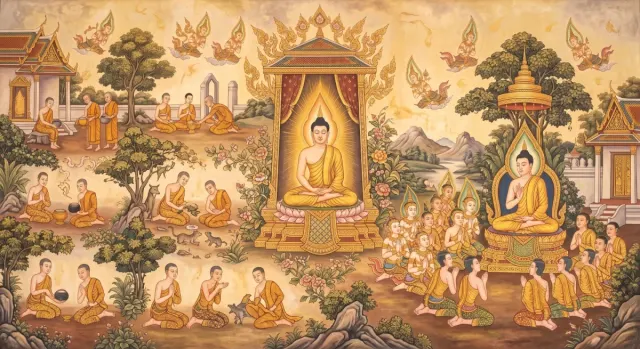
The Bodhisatta lies in a charnel ground; some come to harm him, others bring gifts, and his mind stays even li…