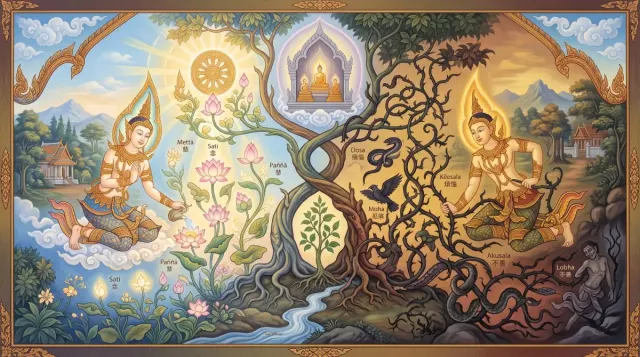
The Pairs on Phenomena: Developing the Wholesome Is Abandoning the Unwholesome
Yo kusalaṃ dhammaṃ bhāveti so akusalaṃ dhammaṃ pajahatītiThe Pairs on Phenomena ask whether wholesome, unwholesome and indeterminate states arise together and in which…


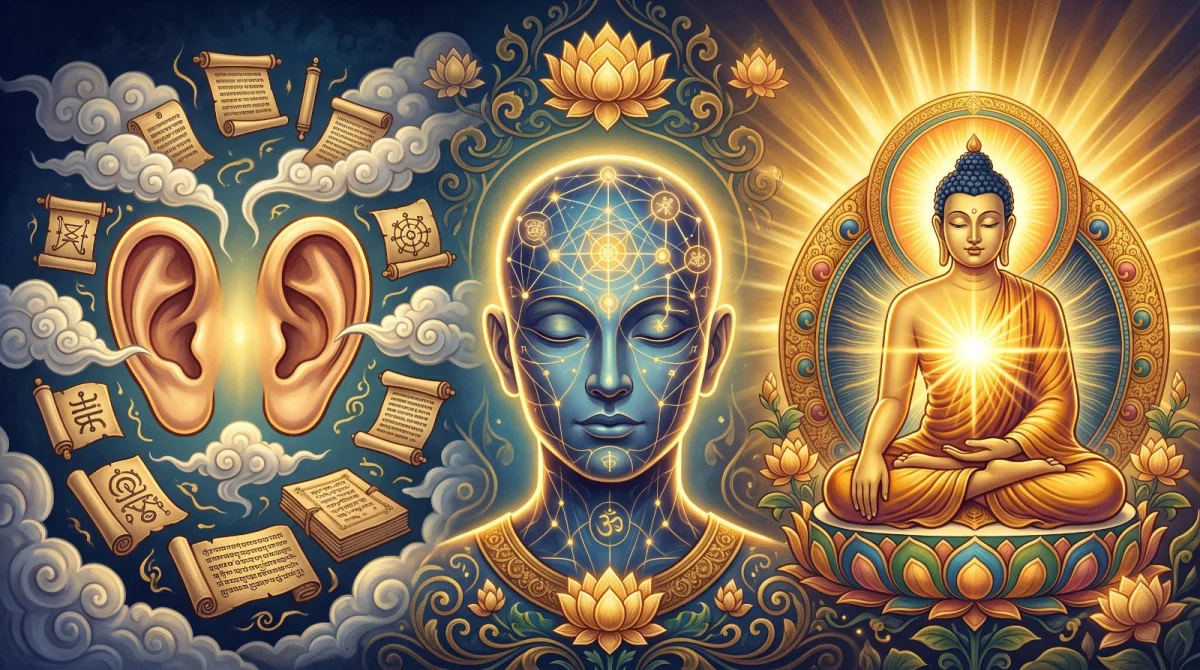
Sagāravasuttaṃ
The young brahmin Saṅgārava asks the Buddha what kind of ascetic he is. The Buddha divides those who proclaim the fundamentals of the holy life into three groups — those who rely on oral tradition, reasoners who rely on mere faith, and those who know the Dhamma for themselves — and then recounts how he tested things until he knew for himself.
In the Saṅgārava Sutta, in the Brāhmaṇa chapter of the Majjhima Nikāya (Majjhimapaṇṇāsa), the brahmin woman Dhanañjānī, who had deep faith in the Triple Gem, stumbles and exclaims homage to the Buddha three times. The young brahmin Saṅgārava, master of the three Vedas, hears it and rebukes her. She replies that he doesn't know the Blessed One's virtue and wisdom; if he did, he wouldn't abuse him. He asks her to tell him when the Buddha comes.
Meeting the Buddha, Saṅgārava asks: among the ascetics and brahmins who proclaim the fundamentals of the holy life, which kind is he? The Buddha distinguishes three groups and says he belongs to those who, regarding things not heard before, directly know the Dhamma for themselves.
The rest of the discourse recounts the Bodhisatta's quest — studying under Āḷāra and Uddaka, the similes of wet and dry wood, the austerities, up to the jhānas and the three true knowledges — much as in the Mahāsaccaka and Ariyapariyesanā Suttas. This page therefore focuses on the question of where knowledge comes from.
Saṅgārava rebukes Dhanañjānī for praising an ascetic instead of brahmins. She replies that he doesn't know the Blessed One's virtue and wisdom; if he did, he wouldn't think him worth abusing. So he asks her to tell him when the Buddha arrives, and goes to see him in person.
Before voicing strong opinions about a person or group you've never really known, ask whether you've heard them directly. If not, go and listen first.
Some ascetics and brahmins proclaim the fundamentals of the holy life on the basis of oral tradition, like the brahmins of the three Vedas. Their knowledge rests on what has been handed down from one to another.
Messages forwarded in group chats are a kind of oral tradition. Before forwarding, try tracing it back to its source at least once.
Another group proclaims the fundamentals of the holy life on the basis of mere faith, like reasoners and inquirers — people who think things through until convinced, but have not proven them by actually knowing and seeing.
An idea that sounds reasonable in your head isn't always true. When you feel very sure, look for a small way to test it against real life.
The last group directly knows the Dhamma for themselves regarding things not heard before. The Buddha says he is one of these, and recounts his own path as evidence.
In practice, use the teaching as a map but set out to see for yourself — for example, check whether anger really fades when you stop feeding it with thoughts.
Studying under Āḷāra Kālāma, the Bodhisatta quickly learned to recite and speak the teaching, but wasn't content with that. He reflected that Āḷāra surely did not proclaim this Dhamma by mere faith, and that it was not only Āḷāra who had faith, energy, mindfulness, concentration and wisdom — he had them too. So he strove until he realised that Dhamma himself, and then saw it was not yet the end.
When you admire a teacher or expert, turn admiration into action. You have the same basic tools: confidence, effort and attention.
The discourse gives three similes that occurred to the Bodhisatta. Wet, sappy wood — whether lying in water or on dry land — won't produce fire however one rubs a fire-stick on it, just as ascetics whose body and mind are not withdrawn from sensual pleasures cannot awaken, even if they torment themselves. But dry wood far from water will catch fire. The same set of similes also appears in the Mahāsaccaka Sutta.
If you're trying hard but not progressing, check whether the "wood" is still wet — is your mind still soaked in desires you haven't set down — before pushing even harder.
At the end, Saṅgārava asks whether there are gods. The Buddha says this is known on good grounds. Saṅgārava objects that this sounds evasive. The Buddha explains that one who answers this way is effectively saying they know, so a sensible person can conclude that gods exist; and he didn't answer directly at first because this is something widely agreed upon in the world (the Thai Royal edition renders it "agreed in the world with a lofty word"). This point is for overall understanding.
When asked about a delicate matter, choose an answer that matches what you truly know, and be ready to explain further if the other person is still unsure.
Today we get information in the same three ways as in this discourse: "people say so", thinking it through until fully convinced, and testing it ourselves until we see the result. The first two aren't always wrong, but if you are going to hang your life on something, know which one you're standing on.
The small story at the start has a lesson too. Saṅgārava criticised someone he had never met, but when told he didn't really know him, he was willing to go and see for himself. That readiness to check personally is what brought him to his answer.
Tap to read the actual passage on the page cited.
The Pairs on Phenomena ask whether wholesome, unwholesome and indeterminate states arise together and in which…
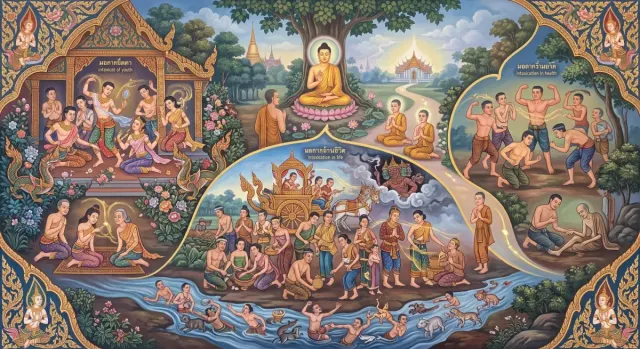
The Buddha recalls that he once lived in the greatest comfort, yet reflected that it was unfitting to be repel…

Mahāmoggallāna's past lives according to the Apadāna: a nāga king who invited the Buddha Anomadassī and the Sa…

Sāriputta teaches that a forest-dwelling monk who comes to stay in the Saṅgha should be respectful, know his s…