
The Rohitassa Discourse: The End of the World Within This Fathom-Long Body
RohitassasuttaṃA deity who once travelled at supernatural speed to find the end of the world died without reaching it. The Bu…


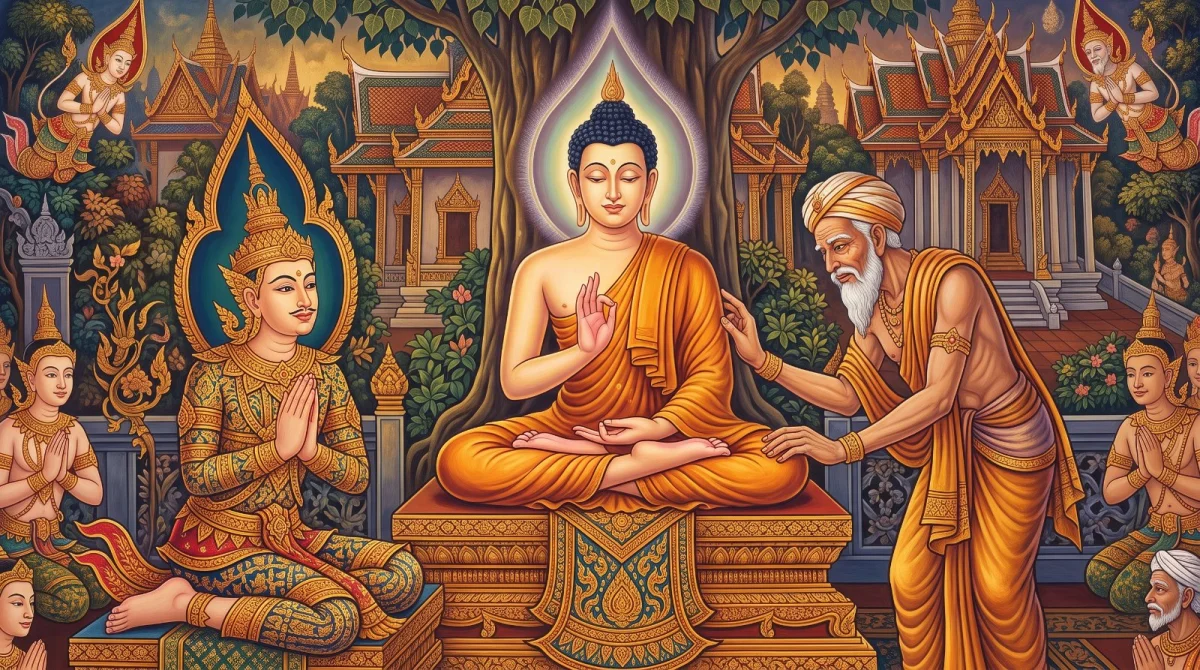
Dhammarājā anuttaro
Sela, a brahmin teacher of three hundred students, hears the word "Buddha" and goes to see for himself. The Buddha says he is a king by Dhamma: he has known what should be known, developed what should be developed and abandoned what should be abandoned. Sela goes forth and tells his students that whoever wishes may follow.
In the Sela Sutta of the Majjhima Nikāya, the Buddha, wandering in Aṅguttarāpa with about 1,250 monks, reaches the town of Āpaṇa. Keṇiya the matted-hair ascetic hears the Dhamma and invites them for the next day's meal. Twice the Buddha points out that the Saṅgha is large and that Keṇiya is devoted to brahmins, yet Keṇiya invites him a third time. His friends and relatives come to help prepare.
Sela, a brahmin master of the three Vedas who teaches the hymns to three hundred students, passes by. On hearing the word "Buddha" he goes with his students to see the Buddha. He examines him for the marks of a great man according to brahmin lore, then praises him in verse and urges him to become a wheel-turning monarch. The Buddha replies that he is already a king: a king by Dhamma. Sela and his three hundred students ask to go forth.
The next day the Buddha thanks Keṇiya in verse, saying that for those who seek merit the Saṅgha is foremost. Sela and his company later go into seclusion, practise diligently and soon attain arahantship. They return to tell the Buddha that they have been trained in his teaching for seven nights.
Twice the Buddha told Keṇiya that the Saṅgha was large, about 1,250 monks, and that Keṇiya was devoted to brahmins, as if leaving him free not to feel bound. Keṇiya insisted a third time. His friends and relatives dug ovens, split firewood, washed dishes, set out water jars and prepared seats, while Keṇiya set up the pavilion himself.
When you receive someone's kindness, leave them room to back out without losing face. When you are the host, work with your own hands too, don't just give orders.
Sela asked Keṇiya twice, "Did you say 'Buddha'?" He then reflected that even the sound of the word "Buddha" is hard to come across in the world, and at once asked where the ascetic Gotama was staying.
When you hear of a good person or valuable knowledge that is rare, don't let it pass out of habit. Ask more, and find a chance to meet it yourself.
Before the meeting, Sela told his students to come quietly, step by step, and not to break in while he was speaking with the ascetic Gotama, but to wait until the conversation was over.
In meetings, or when bringing people to see someone senior, agree beforehand who will speak, and don't interrupt. Hearing someone out honours both the speaker and the subject.
Sela examined the Buddha for the thirty-two marks of a great man according to brahmin texts. He saw almost all of them but still doubted two, so he was not yet convinced. The Buddha knew this and let him see them. Even then Sela reflected that the marks were complete, but he still did not know whether this was a Buddha, so he praised him in verse to hear the Buddha's own response.
For important decisions, have clear criteria and check against them, but know that outward criteria alone are not enough. You also need to hear the real substance of the thing.
Sela said that one with such fine marks ought to be a wheel-turning monarch. The Buddha replied that he is already a king: an unsurpassed king of Dhamma who turns the wheel by Dhamma, and that Sāriputta, born in the Tathāgata's image, keeps that wheel turning after him.
When those around you measure success by position or wealth, ask yourself what kind of greatness you want. A life governed by Dhamma is a power no one can take away.
The Buddha said: what should be directly known I have directly known, what should be developed I have developed, what should be abandoned I have abandoned; therefore I am a Buddha. He invited Sela to put away his doubt.
Make a short three-column list for your life: things to understand clearly, habits to build and habits to drop. Review it every month.
Sela told his students: let whoever wishes follow me, and whoever does not, stay. I will go forth under this one of excellent wisdom. All three hundred students chose for themselves to go forth too. The Buddha said this holy life is well proclaimed, visible here and now and immediate, and going forth in it is not in vain for one who trains diligently.
When you decide to change the direction of your life, you can explain your reasons to those close to you, but don't pressure anyone to follow. People who choose for themselves go further.
Sela is a model of a learned person who stays open. When he hears something new, he neither rushes to believe nor rushes to dismiss it. He goes to see for himself, checks against the criteria he knows, and is willing to change when things become clear. In an age of endless information, that stance is invaluable.
The Buddha's answer about being a king by Dhamma also offers another view of success. Power won by defeating others is not the only kind. Fully knowing, developing and abandoning what should be in your own mind is greatness of another kind.
And when we change our beliefs or choose a new path, we can do as Sela did: invite those who want to come along and respect those who don't.
Tap to read the actual passage on the page cited.
A deity who once travelled at supernatural speed to find the end of the world died without reaching it. The Bu…

A troop of monkeys offers to water the trees for the gardener, but pulls each sapling up to look at its roots …
Before King Mahāvijita performs his great sacrifice, his chaplain has him consult everyone involved, warns him…

Mindfulness directed to the body — seven methods from the Kāyagatāsati Sutta. The body is always in the presen…