
The Santhava Jātaka: The Intimacy That Burns the House and the Intimacy That Keeps You Safe
SanthavajātakaṃA fire fed with ghee and milk-rice still burns down a leaf hut that was hard to build, while the doe Sāmā can …


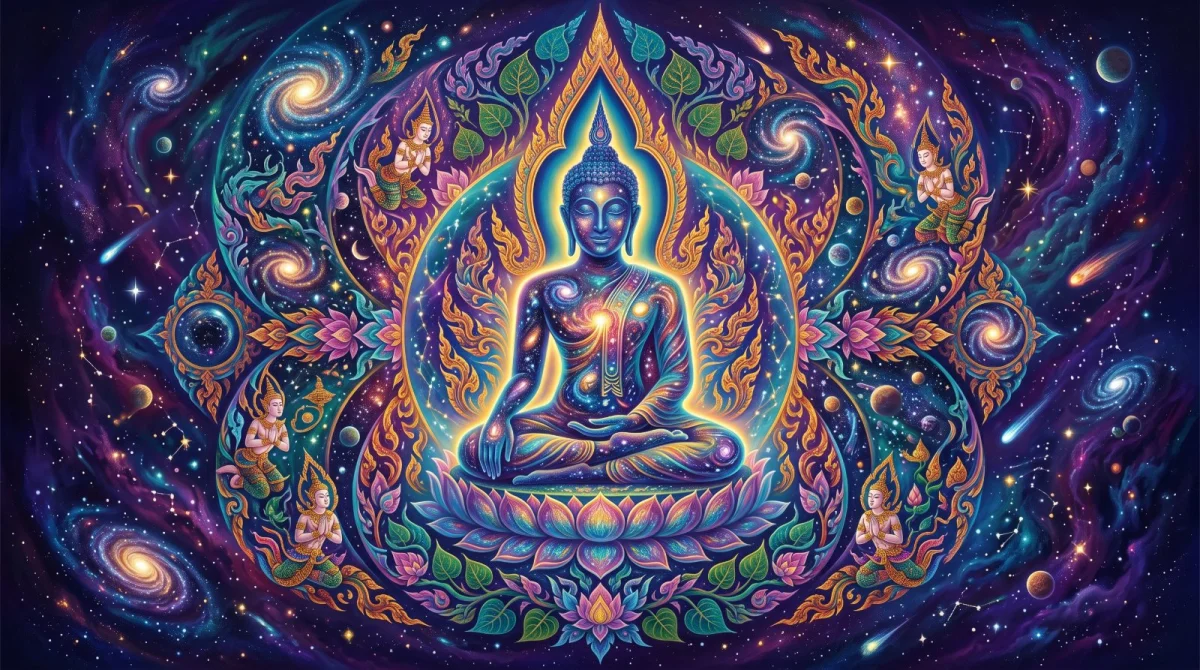
Rohitassasuttaṃ
A deity who once travelled at supernatural speed to find the end of the world died without reaching it. The Buddha says the world, its origin, its cessation and the way to its cessation are found in this fathom-long body with its perception and mind.
In the Rohitassa Sutta, the deity Rohitassa asks the Buddha whether it is possible, by travelling, to know, see or reach the end of the world.
He relates that in a past life he was a seer with psychic power, as swift as an arrow shot by a skilled archer, with a stride reaching from the eastern ocean to the western. Resolving to find the end of the world, he travelled for a hundred years, stopping only to eat, drink, relieve himself and sleep off fatigue, and died without reaching it.
The Buddha says the end of the world cannot be reached by travelling, yet without reaching the end of the world there is no making an end of suffering. And: "It is in this fathom-long body, with its perception and mind, that I declare the world, the origin of the world, the cessation of the world, and the way leading to the cessation of the world."
The world here is the world we experience through a body with perception and mind — not the geographical world whose edge one might travel to.
When you feel "the world is terrible", notice you're speaking of the world your mind is perceiving right now.
The world of suffering arises in this body and mind, caused by craving — corresponding to the origin of suffering in the noble truths.
If the world of suffering comes from craving within, fleeing elsewhere with the same craving just rebuilds the same world.
The cessation of the world of suffering is also found in this body and mind; there's no need to seek it elsewhere.
Moments when the mind lets go of craving even briefly show that the end of suffering isn't far away.
The way to the world's cessation is the noble eightfold path, practised with this very body and mind, requiring no journey anywhere.
Wherever your body and mind are is a place to practise. No need to wait for a special place to begin.
Many people look outside for happiness or life's answers — changing jobs, moving cities, travelling, chasing endless new experiences. This discourse says outer journeys aren't wrong, but they won't reach the end of suffering, because the "world" that suffers lies in our own perceiving.
If you're thinking "things would be better somewhere else", also ask whether the mind you'd bring along would change. Read alongside "The Four Noble Truths", which has the same structure.
Tap to read the actual passage on the page cited.
A fire fed with ghee and milk-rice still burns down a leaf hut that was hard to build, while the doe Sāmā can …
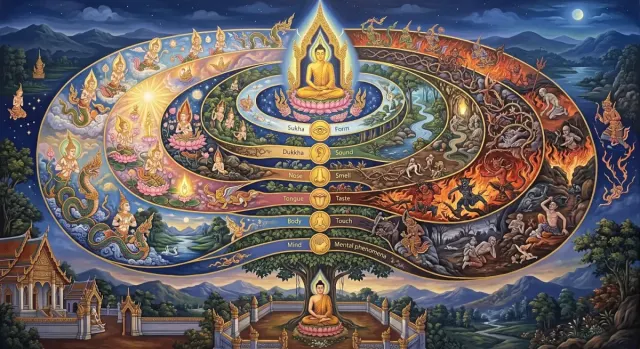
Joy, grief and equanimity are each analysed six times over, once for each sense, and then divided into the kin…

The group of six monks kept three sets of robes, one for going into the village, one for the monastery and one…
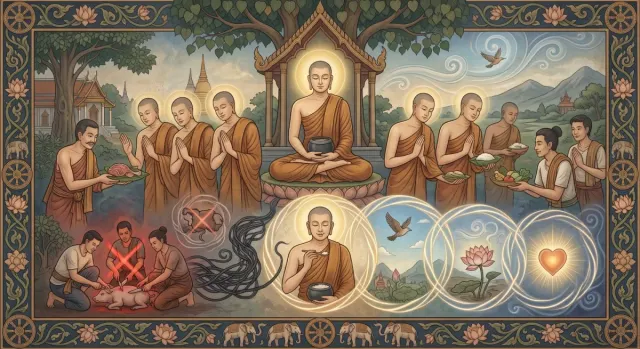
Jīvaka asks about the report that the Buddha knowingly eats meat from animals killed for him. The Buddha says …