
The Verses of Bhaddiya: Oh, What Happiness!
Aho sukhaṃ aho sukhaṃVenerable Bhaddiya, son of Kāḷigodhā and formerly a ruler, compares palace life, guarded by men with swords ye…


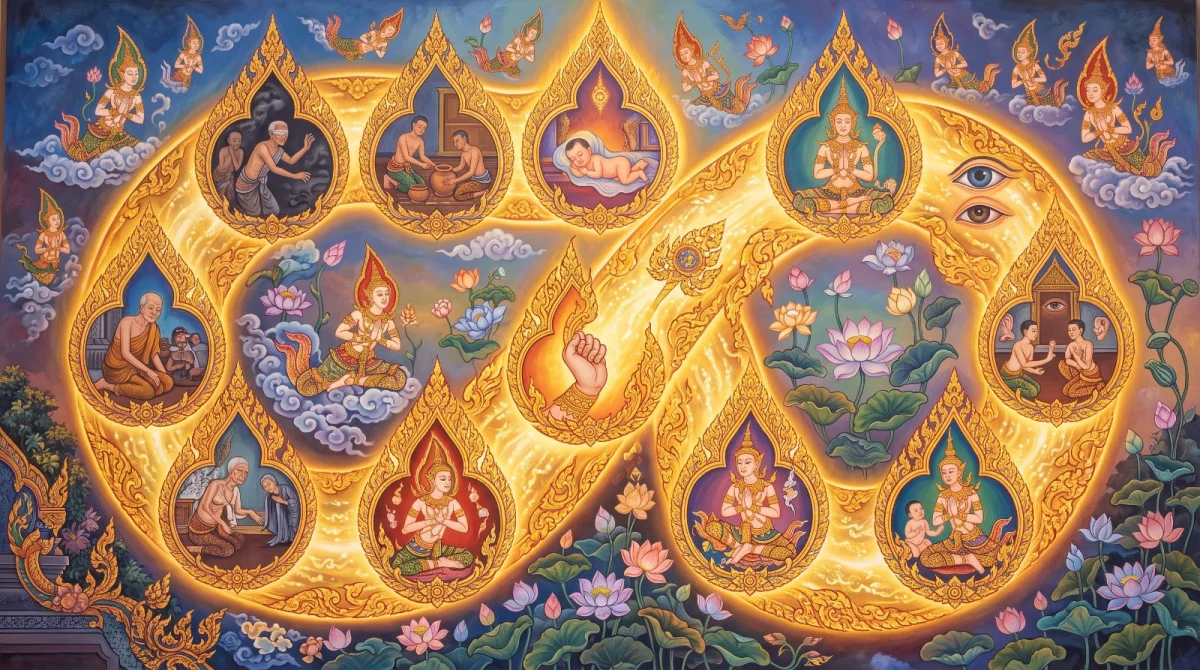
Gambhīro cāyaṃ ānanda paṭiccasamuppādo
Ānanda says dependent origination seems quite clear to him. The Buddha tells him not to say so: because beings don't understand this teaching, they are tangled like a ball of thread. He then compares craving to a great tree fed by its roots, and seeing danger to uprooting the tree entirely.
In the Nidāna Sutta of the Nidāna Saṃyutta, Saṃyutta Nikāya, while the Buddha is staying at Kammāsadamma, a market town of the Kurus, Ānanda says: it is amazing, sir, how deep dependent origination is and how deep it appears, yet to me it seems as clear as clear can be. The Buddha replies: don't say that, Ānanda, don't say that. Dependent origination is deep and appears deep. Because they don't know, understand or penetrate this teaching, beings have become like a tangled skein, a knotted ball of thread, like matted reeds and rushes, and they don't escape the lower realms, the bad destinations, the underworld and saṃsāra.
He then shows that when one keeps seeing gratification in things that are prone to grasping, craving grows, leading on to grasping, existence, birth and the whole mass of suffering. It is like a great tree whose roots draw nourishment upward so that it lasts a long time. When one keeps seeing danger, craving ceases, like a man who cuts down the tree, digs out the roots, splits it into pieces, dries them, burns them to ash, and scatters the ash in the wind or a river.
In the same chapter is the Parivīmaṃsana Sutta, which shows how to investigate suffering step by step back to ignorance, and compares the feelings of one free of defilements to a hot pot taken from a kiln that gradually cools. This page covers both discourses, focusing on depth and the method of investigation; the twelve links themselves are not explained in detail here.
Ānanda, who had heard more teachings than anyone, says dependent origination seems clear to him. The Buddha stops him twice: don't say that; this teaching is deep.
When you feel you understand something, ask further: has this understanding changed how I act? If not, you haven't reached its core.
Because they don't know, understand or penetrate this teaching, beings are like a tangled skein, a knotted ball of thread, like matted grass, and so they don't escape the lower realms, bad destinations and saṃsāra.
When life's problems are so tangled you don't know where to start, pull one thread at a time: find the causes of one issue first, instead of yanking the whole knot.
When one keeps seeing gratification in things that are prone to grasping, craving grows. Craving is a condition for grasping, and so on to birth, ageing, death and the whole mass of suffering.
Notice whether you keep dwelling only on the good side of what you're hooked on, such as remembering the taste but not the effect on your health.
A great tree has roots going down and spreading sideways, all drawing nourishment upward, so it lasts a long time. Craving nourished by gratification is just like that.
Find what "feeds" the habit you want to break, such as stress, loneliness or triggers on your phone, and reduce those sources one at a time.
When one keeps seeing danger in things that are prone to grasping, craving ceases. With the cessation of craving, grasping ceases, and so on until the whole mass of suffering ceases.
Write down the real harm that habit has caused you and put it somewhere you'll see often, so the mind sees the other side each time the urge arises.
A man cuts the tree at its base, digs out even roots as fine as grass stems, splits it into pieces, dries them in wind and sun, burns them to ash, and scatters the ash in a strong wind or a swift river. The tree does not grow again. Abandoning craving completely is like that. This point is for overall understanding.
Don't lose heart when an old habit returns. Uprooting takes many stages, and each time you see the danger clearly you dig a little deeper.
In the Parivīmaṃsana Sutta, a monk investigates: what is the cause of the suffering of ageing and death? When what exists does it exist, and when what is absent is it absent? He understands that birth is the cause, then investigates each link in turn back to formations, which have ignorance as their cause, and knows their cessation and the practice leading to it.
Apply two questions to any problem: "Because of what does this exist?" and "If that were absent, would this still exist?"
The Parivīmaṃsana Sutta compares it to a man who takes a hot pot out of a potter's kiln and sets it on level ground; its heat dissipates and only the shards remain. One who has abandoned ignorance knows any feeling as impermanent, not delighted in with craving, and knows that all feelings will become cool at the end of life. This point is for overall understanding.
When emotions run hot, think of the pot taken off the kiln. If you don't add fuel by going over it again and again, the heat will subside on its own.
The Buddha's words to Ānanda warn everyone who studies the Dhamma that memorising the headings or drawing the diagram is not deep understanding. If we truly understood, our lives would no longer be as tangled as before.
The tree simile applies right away. A habit we want to break, such as irritability or compulsive screen use, has roots feeding it: the gratification we see in it. Cutting off the branches by forbidding ourselves soon regrows. Repeatedly seeing the danger is digging out the roots.
Tap to read the actual passage on the page cited.
Venerable Bhaddiya, son of Kāḷigodhā and formerly a ruler, compares palace life, guarded by men with swords ye…

This saṃsāra has no known beginning. Counting mothers' mothers with bundles of all the grass in India would ne…

The Paṭisambhidāmagga explains the four foundations of mindfulness as contemplating body, feeling, mind and ph…

Mahānāma the Sakyan asks how a wise lay follower should comfort another wise lay follower who is gravely ill. …