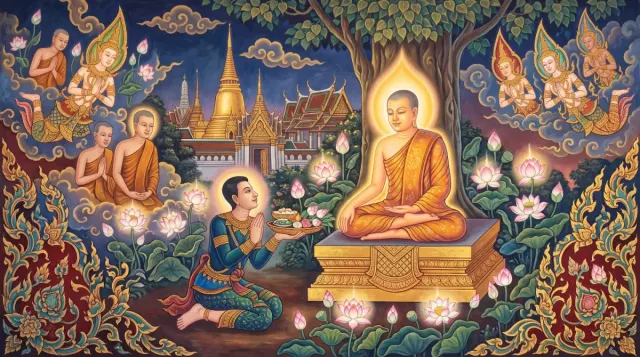
The Discourse with Esukārī: Serve What Makes You Better
EsukārīsuttaṃThe brahmin Esukārī reports that brahmins decree who must serve whom and what wealth each caste has. The Buddh…



Jarāsuttaniddeso
The Mahāniddesa's explanation of the Jarā Sutta: life is short both because it lasts only a single moment and because it hangs on the breath; people die at every age; clinging to 'mine' is of two kinds; and one who truly holds the Buddha dear does not incline towards it.
The Niddesa is a canonical text in the Khuddaka Nikāya of the Sutta Piṭaka that explains discourses of the Sutta Nipāta word by word. In the Jarā Sutta Niddesa of the Mahāniddesa, the Jarā Sutta of the Aṭṭhaka Vagga is explained. It begins: short indeed is this life; one dies within a hundred years, and even one who lives longer dies of old age.
The Niddesa does not explain 'life is short' only in terms of years. It gives two senses: life is short because its duration is brief, and life is short because its own function or strength is slight. It then compares human lifespans with those of the various deities and quotes the Buddha's words urging us to hurry to do good.
The last part explains clinging to things as 'mine', the five kinds of stinginess, and the qualities that make one a sage in body, speech and mind.
The Niddesa explains that the life lived in a past mind-moment is not living now, and the life of a future mind-moment is not yet living; life truly exists only in the present moment. The aggregates arise and cease like lightning, and stand like a mustard seed on the point of an awl.
When the mind is sunk in yesterday or anxious about tomorrow, come back to feeling this one breath, the only part of life that actually exists.
Life depends on the in-breath and out-breath, the four elements, bodily heat, food and consciousness. The Niddesa says these are weak; they depend on one another but cannot hold one another up for good, so life is short in another sense.
Next time you are mildly ill or short of breath, take it as a chance to recall how fragile life is, and to appreciate a body that is still working.
Compared with the lifespans of the deities up to the Brahmās, human life is very short. The Niddesa quotes the Buddha: human life is short, one should do what is wholesome and live the holy life; one who lives long lives about a hundred years. It also quotes the verse that one should act swiftly, like someone whose head is on fire, for days and nights pass and life runs out like the water of a small stream.
If there is something good you have been putting off, such as apologising to someone, calling your parents or starting meditation, pick one and do it this week.
The Niddesa lists how people die while still in the womb, at birth, at half a month, one year, ten years, and on up to ninety. One who lives past a hundred still reaches the day of broken teeth, grey hair, wrinkled skin, a bent back and a walking stick, and dies of old age all the same.
Don't assume important matters can wait until old age. Writing down your wishes for your family, for example, can be done today.
Clinging to things as 'mine' comes from craving and from views. People grieve when they fear something will be taken and after it is taken, while it is changing and after it has changed. And the clinging itself is impermanent and ends in separation.
Notice what you guard because you like it (craving), and what ideas you guard because you believe things must be only this way (views). Both cause suffering alike.
The Niddesa explains 'one who holds as mine' (māmaka) as one who regards the Buddha, Dhamma and Saṅgha as their own. It quotes the Buddha's words that monks who are deceitful, obstinate, chattering, conceited and unconcentrated do not truly hold him dear, while monks who are not deceitful, not chattering, wise, not obstinate and well concentrated do hold him dear and grow in the Dhamma and discipline.
Measure your own Buddhism by your honesty and gentleness rather than by how often you go to the temple.
The Niddesa explains 'possessiveness' in the verse as five kinds of stinginess: about dwellings, about families, about gains, about praise or appearance, and about the Dhamma, together with the mind's shrinking when it is time to give.
Stinginess isn't only about money. Notice whether you are possessive of knowledge, of clients, or of praise you ought to give a colleague.
The Niddesa explains that knowledge is called 'mona', and one endowed with it is called a sage (muni). The qualities of a sage are threefold: abandoning the three kinds of bodily misconduct, the four kinds of verbal misconduct and the three kinds of mental misconduct, together with good conduct and understanding of one's own body, speech and mind.
A sage's calm isn't just keeping quiet. Start with one thing a day: today, no harsh words; tomorrow, no ill will towards anyone.
Knowing that life is short needn't be depressing. The Niddesa uses this fact to encourage spending the time we have on what is truly good, and to loosen the possessiveness that makes us suffer.
What applies every day is noticing that we grieve or worry over what is ours at two moments: when we fear losing it, and after it is lost. If you catch the first moment, the suffering of the second grows lighter.
If reflecting on death makes you very frightened or disheartened, set it aside for now and return to it when your mind is steadier.
Tap to read the actual passage on the page cited.
The brahmin Esukārī reports that brahmins decree who must serve whom and what wealth each caste has. The Buddh…
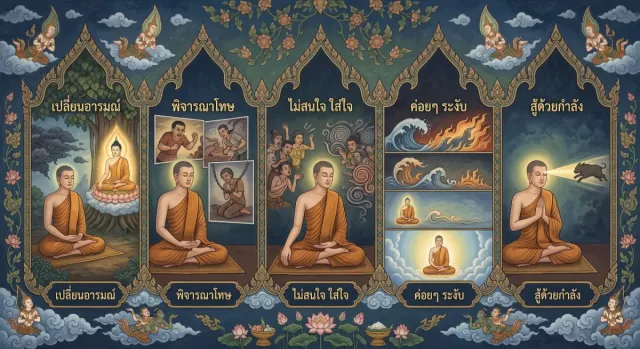
Five methods for dealing with unwholesome thoughts from the Vitakkasaṇṭhāna Sutta, ordered from gentlest to st…
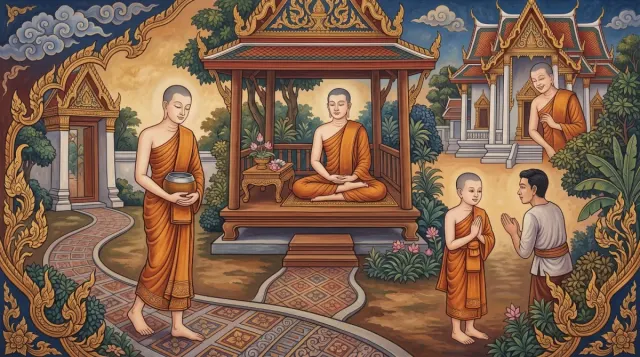
The twenty-six training rules on proper behaviour in the Sekhiya section teach monks to dress neatly, restrain…

Four things rarely obtained — human birth, staying alive, hearing the true Dhamma, and the arising of a Buddha…