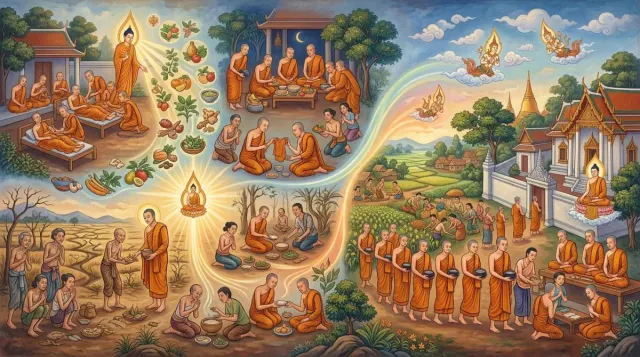
The Medicine Chapter: Rules Relaxed for the Sick and in Famine, Then Restored After the Crisis
BhesajjakkhandhakaṃSeeing monks thin and pale from an autumn illness, the Buddha allows the five medicines, then relaxes the rule…


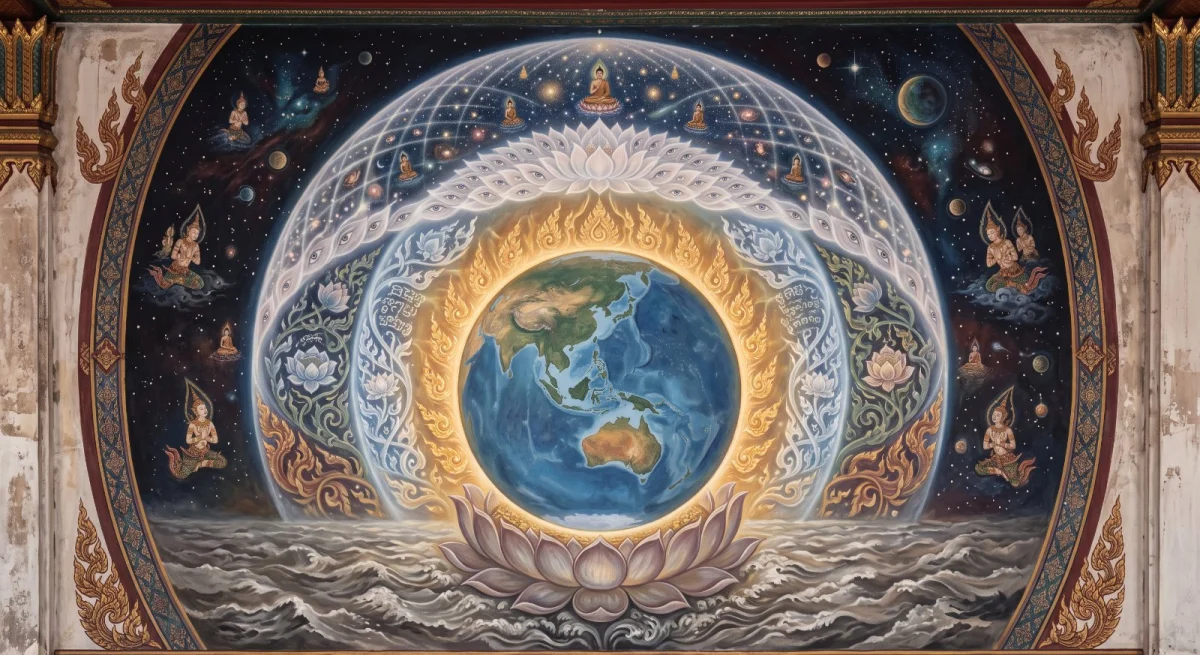
Ajitamāṇavapucchā
The first question of the Pārāyana Vagga: ignorance shrouds the world, craving smears it, the streams flow towards every object, mindfulness holds them back, and wisdom shuts them off.
In the Pārāyana Vagga of the Sutta Nipāta, Khuddaka Nikāya, the young brahmin Ajita is the first of the brahmin Bāvarī's sixteen pupils to go and question the Buddha. The Introductory Verses at the start of the chapter tell that a brahmin came asking Bāvarī for five hundred coins and, when refused, cursed him, saying that on the seventh day his head would split into seven pieces. A deity told Bāvarī to go and ask the Buddha, so he sent his pupils. This is a story as the text records it.
According to those verses, Ajita asks on his teacher's behalf what the "head" is and what makes the head fall. The Buddha says ignorance is the head, and knowledge joined with faith, mindfulness, concentration, desire and energy is what makes the head fall. The curse about a splitting head is turned into a teaching on cutting off ignorance.
Ajita then asks his own questions: what shrouds the world, what smears it, what holds back the streams that flow everywhere, and where wisdom, mindfulness and name-and-form cease.
The Buddha says the world of beings is shrouded by ignorance, and it does not shine because of avarice and heedlessness. Not knowing is the first thing that keeps us from seeing things as they are.
When you keep getting stuck on the same problem, ask: what is there about this that I still don't know, or refuse to look at?
He says craving is what smears the world, making things look worth clinging to, and suffering is the great fear of that world.
When you want something badly, notice whether its appeal comes from the thing itself or from the craving coating it.
Ajita asks: the streams flow towards every object — what holds them back? The Buddha answers that mindfulness is what holds back the streams in the world.
Before automatically picking up your phone or opening a new tab, let mindfulness catch that moment for one breath.
Mindfulness holds the streams back, and the wise shut them off with wisdom — seeing clearly enough that there's no need to follow them again.
When mindfulness catches you about to follow a craving, reflect on what you actually got the previous times you followed it. Seeing this repeatedly weakens the pull.
Ajita asks where wisdom, mindfulness and name-and-form cease. The Buddha says: where name and form cease without remainder, there mindfulness and wisdom cease too, through the cessation of consciousness. This point is for overall understanding.
This shows that even mindfulness and wisdom are tools for crossing, not things to cling to as a self. Use them fully, but don't let pride in them become a new ego.
Asked about those who have fully understood the Dhamma and those still in training, he says a monk should not be greedy for sensual pleasures, should have an unclouded mind, be skilled in all things, and go forth mindful.
Use these four as an end-of-day checklist: was I greedy today, was my mind clouded, did I understand what I was doing, and how often was I mindful?
Ajita's answers describe the ordinary mind very precisely. We don't see clearly because we don't know; craving coats everything so that it looks worth having; and thoughts flow towards everything that touches us — screens, news and worries.
The way out isn't stopping the world from touching us, but having mindfulness as a gate that holds back the stream, then using wisdom to see that the stream needn't be followed. Mindfulness catches it in time; wisdom actually closes it.
The last point, on how a trainee conducts himself, is a guide for every day: not greedy for sensual pleasures, mind unclouded, skilled in the Dhamma, and mindful.
Tap to read the actual passage on the page cited.
Seeing monks thin and pale from an autumn illness, the Buddha allows the five medicines, then relaxes the rule…

A trapper plants fodder to lure four herds of deer. One gorges, one flees to extremes, one is careful but stil…
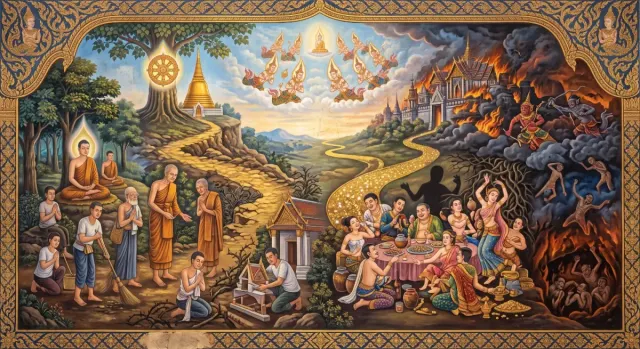
Things to be done come in four kinds: unpleasant and harmful, unpleasant but beneficial, pleasant but harmful,…

Five qualities by which a resident monk shows sympathy to householders: encouraging them in virtue, establishi…