
The Discourse to Mahāli: Seeing Divine Forms but Not Hearing Divine Sounds, and the Real Aim of Practice
MahālisuttaṃMahāli asks why Sunakkhatta saw divine forms but never heard divine sounds. The Buddha explains that he develo…


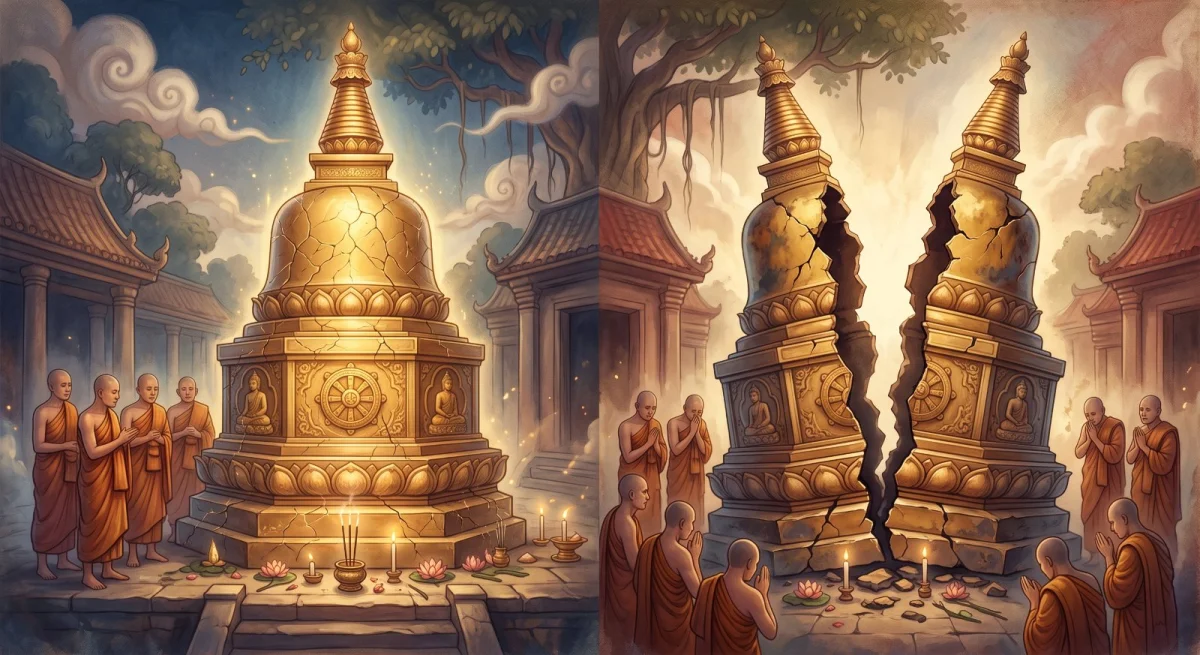
Saṅgharāji ceva hoti saṅghabhedo ca
Upāli asks how a rift in the Saṅgha differs from a schism. The Buddha says that neglecting prescribed duties or taking seniors' seats is only a rift, but holding separate Uposatha and Saṅgha acts is both a rift and a schism — along with five considerations before taking up a matter.
The Parivāra is the last book of the Vinaya Piṭaka, summarising Vinaya material in question-and-answer form. In the Upālipañcaka, Upāli asks the Buddha several questions about conflict in the Saṅgha.
In the Adhikaraṇavūpasama chapter, the Buddha says the Saṅgha is split in five ways: by a formal act, by recitation, by declaration, by proclamation and by taking voting tickets. Upāli then asks when there is only saṅgharāji (a rift) without saṅghabheda (a schism), and when there is both.
In the Saṅghabheda chapter that follows, the Buddha speaks of those who split the Saṅgha by presenting what is not Dhamma as Dhamma, what is Dhamma as not Dhamma, and so on, distinguishing those who do so while misrepresenting their own view from those who do not. The Attādāna chapter gives five considerations before a monk takes up a matter, the last being whether it will lead to quarrels or division in the Saṅgha.
Schism is specific to the monastic community and is one of the heinous deeds with immediate result, so the statements about grave consequences concern monks. But the distinction between a crack and a break is very useful for understanding conflict in any group.
The Buddha says he has laid down duties for visiting monks and duties for resident monks. When visiting monks don't observe the visitors' duties, or residents don't observe the residents' duties, this is a rift in the Saṅgha, but not yet a schism.
Newcomers should learn the customs of the place they join, and long-standing members should welcome and look after newcomers. When either side neglects this, the crack begins.
He laid down that seats, water and food in the refectory, and lodgings, be allotted by seniority. When new monks keep senior monks from their seats in the refectory or from their lodgings, this too is a rift in the Saṅgha, but not yet a schism.
Don't dismiss small things like grabbing seats, jumping queues or ignoring agreed order. They accumulate into resentment.
He laid down that monks within one boundary hold one Uposatha, one Pavāraṇā and one set of Saṅgha acts. When monks form a faction and hold a separate Uposatha, separate Pavāraṇā and separate Saṅgha acts within that same boundary, this is both a rift and a schism in the Saṅgha.
A sign that conflict in an organisation or family has become serious is when people start doing core shared things separately — separate meetings, separate celebrations, separate decisions.
The Buddha says the Saṅgha is split in five ways: by a formal act, by recitation, by declaration, by proclamation and by taking voting tickets. All of these turn the Saṅgha's own procedures into tools for division. This point is for overall understanding.
Beware of using proper-looking procedures — votes, called meetings, announcements — to gather a faction and divide people, rather than to reach a resolution.
In the Saṅghabheda chapter, the Buddha says that one who splits the Saṅgha by presenting what is not Dhamma as Dhamma, Dhamma as not Dhamma, what is not Vinaya as Vinaya and Vinaya as not Vinaya, while misrepresenting his own view, approval, preference or perception, is bound for a state of deprivation, for hell, remaining there for an aeon, incurable.
The most destructive thing for a group is saying what you yourself don't believe in order to make people take sides. If you disagree, state your real view openly.
In the second Saṅghabheda chapter, the Buddha speaks of one who splits the Saṅgha in the same way but without misrepresenting his view, and says he is not bound for a state of deprivation or hell for an aeon, and is not incurable. This does not say splitting the Saṅgha is good; it shows that intention and honesty make a great difference to the weight of the deed.
When someone disagrees with the group, distinguish whether they genuinely believe it or are deliberately twisting things for their own benefit, and treat the two cases differently.
In the Attādāna chapter, a monk about to take up a matter should consider in turn: is it the right time? Is it true? Is it beneficial? Will I have familiar monks on my side in accordance with the Dhamma and Vinaya? Will it lead to strife, quarrels, disputes, a rift or a schism in the Saṅgha? A matter taken up after passing all five will not cause regret later.
Before raising a contentious issue in a group chat or meeting, ask these five questions. If any one doesn't pass, wait or change approach — for example, talk one-to-one first.
Relationships in families, teams and communities rarely break in a single day. The Parivāra shows that rifts start with small things — not doing one's part and not showing respect. Left alone, the crack widens until people start doing the group's core activities separately, and then the group has effectively split.
What we can do is repair things while they are still cracks: do our own part fully, show respect in small matters, and when we disagree with the group, state our real view openly rather than distorting information to win people over.
Before raising a contentious issue in a group, try the five considerations from the Attādāna chapter: is it the right time, is it true, is it beneficial, will there be people to consider it fairly with me, and will it divide the group?
Tap to read the actual passage on the page cited.
Mahāli asks why Sunakkhatta saw divine forms but never heard divine sounds. The Buddha explains that he develo…
The arising of the eye, ear and nose is the arising of suffering and the continuance of disease. In the next c…

A young brahmin asks whether brahmins can claim "only this is true". The Buddha distinguishes three stages: pr…

Ten things to recollect when the mind needs something to hold — pick the one that matches the state you are in…