
The Discourse on Disciplinary Issues: Wanting Respect Without Letting Go
Aho vata maṃ sabrahmacārī sakkareyyuṃAn ordinary horse wants the place and food of a thoroughbred, but people see its crookedness. A mendicant who …


Piyajātikasuttaṃ
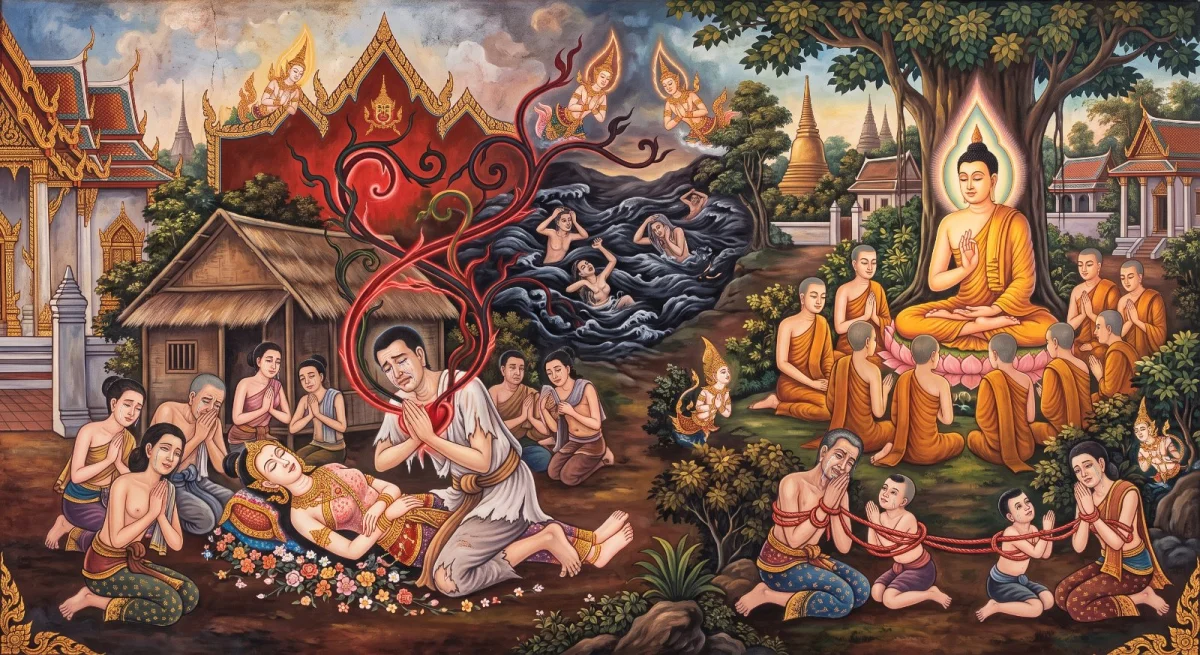
A man who lost his only son refused to believe love brings suffering, until Queen Mallikā questioned King Pasenadi one step at a time — an understanding that doesn't forbid love, but helps us love knowing the truth.
In the Piyajātika Sutta of the Majjhima Nikāya, a man lost his only son, stopped working and went daily to the charnel ground to weep. The Buddha told him, "Sorrow, lamentation, pain, grief and despair are born from those who are dear." The man disagreed — joy and happiness are born from those who are dear — and walked away. The story spread to King Pasenadi of Kosala, who agreed with the man.
Queen Mallikā said that if the Blessed One said so, it must be so. She then asked the king one by one: if Princess Vajirī were to change, if Queen Vāsabhā were to change, if Prince Viḍūḍabha were to change, if I myself were to change, or if the kingdom of Kāsi-Kosala were to change — would sorrow arise in you? The king said yes to each, and acknowledged he understood.
In the Piya Vagga of the Dhammapada: "From what is dear, grief is born; from what is dear, fear is born. For one freed from what is dear there is no grief — whence fear?"
Sorrow, lamentation, pain, grief and despair arise from what is dear, since losing what we don't love doesn't make us suffer.
When grieving a loss, that grief shows you truly loved. Be kind to yourself through it; don't force it to end.
The grieving father and King Pasenadi both saw what is dear as bringing only joy — which is only half the truth.
The happiness loved ones bring is real, but it is the same coin as the pain of parting. Seeing both sides makes love steadier.
She didn't argue from principle, but asked the king about each person and thing he loved, until he saw it for himself.
When explaining Dhamma to someone who disagrees, asking so they see it in their own life works better than quoting teachings at them.
One who doesn't cling to what is dear has no grief, nor the fear that comes from dreading loss.
The level most people can train at is loving without ownership: caring fully while accepting that others have their own lives and kamma.
This page doesn't say to stop loving anyone, or that someone grieving a loss should hurry to get over it. Grief after loss is natural and human, and takes time.
What you can use is loving with knowledge of the truth while you're still together — knowing every love ends in parting, so care for each other as well as you can now, and don't tie all your happiness to one person or thing. Read alongside "The Five Daily Recollections", recollection four.
Tap to read the actual passage on the page cited.
An ordinary horse wants the place and food of a thoroughbred, but people see its crookedness. A mendicant who …

King Pasenadi of Kosala and Queen Mallikā frankly admit that no one is dearer to them than themselves. The Bud…

The second Vibhaṅga analyses the twelve sense bases three times over: a single short paragraph saying all of t…
Three destructive fires that burn the mind, and three "fires" to tend with care — parents, family and dependan…