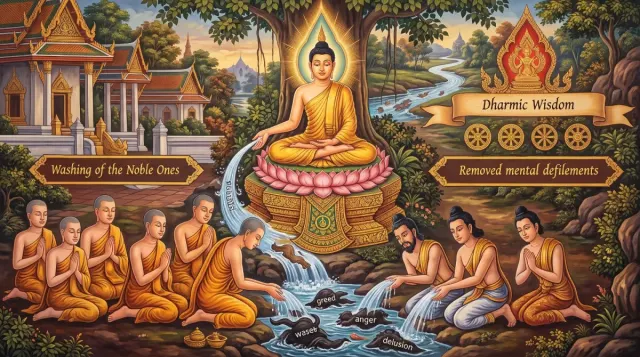
The Washing Discourse: The Noble Washing
Ariyaṃ dhovanaṃPeople in the southern regions held a rite of washing the bones of dead relatives. The Buddha says the rite do…


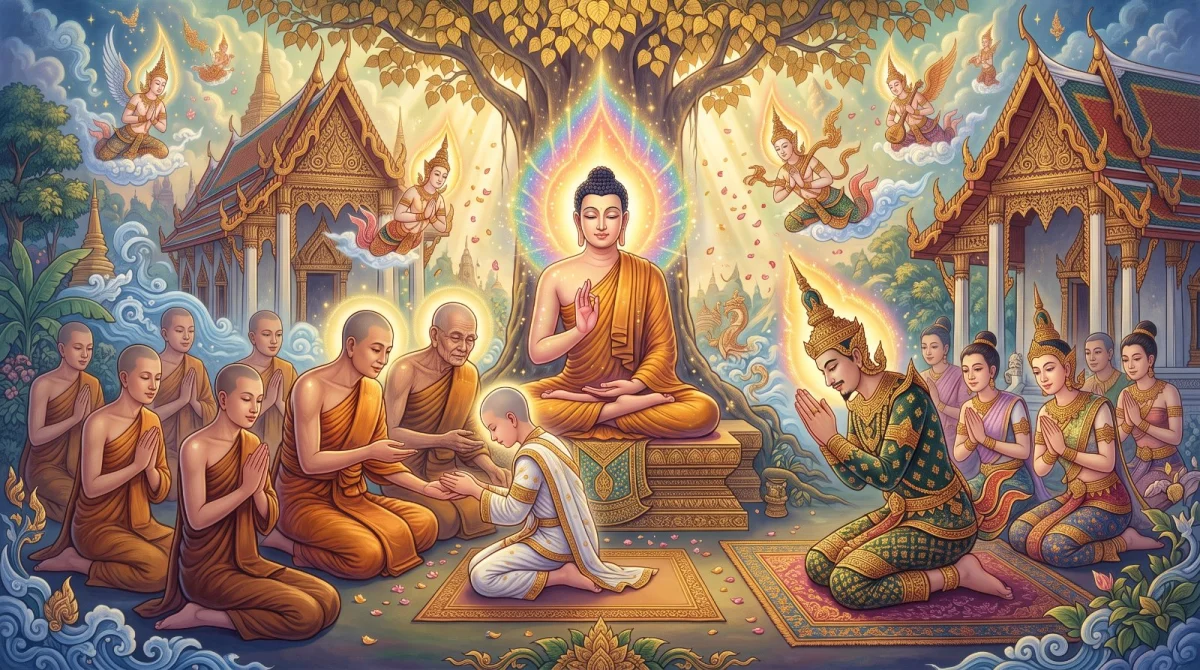
Na bhikkhave ananuññāto mātāpitūhi putto pabbājetabbo
Prince Rāhula asks the Buddha for his inheritance but is given the going forth, which leads to the allowance for novice ordination. King Suddhodana describes a father's love that cuts to the marrow and asks that no child be ordained without the parents' permission. The Buddha agrees and makes it a rule.
In the Great Section of the Mahāvagga in the Vinaya Piṭaka, the Buddha travels to Kapilavatthu and goes to sit in the residence of King Suddhodana. Rāhula's mother (known as Yasodharā, though this passage calls her only "Rāhula's mother") tells the boy that the ascetic is his father and he should go and ask for his inheritance. Rāhula stands before the Buddha, says "Your shade is pleasant, ascetic", and follows him asking for his inheritance.
The Buddha tells Sāriputta to give Rāhula the going forth and allows novice ordination by the three refuges. The explanation that he gave a spiritual inheritance instead of a worldly one, and Rāhula's age at the time, come from the commentary, not from this Vinaya passage.
Later King Suddhodana comes and says he suffered greatly when the Buddha went forth, likewise when Nanda did, and most of all now with Rāhula. Love for a son cuts the outer skin, the inner skin, the flesh, the sinews and the bone, and stays reaching the marrow. He asks that the venerable ones not ordain a child without the parents' permission. The Buddha gladdens him with a Dhamma talk and then lays down that monks should not give the going forth to a child without the parents' permission.
Rāhula's mother tells him the ascetic is his father and to ask for his inheritance. Rāhula follows the Buddha, repeating, "Give me my inheritance, ascetic."
When parents are separated or estranged, children are often used as go-betweens over property or feelings. Adults should be careful not to put that burden on a child.
When Rāhula stands before him, his first words are "Your shade is pleasant, ascetic": the simple words of a child near his father.
Parents being close by, giving time and attention, means a great deal to children, sometimes more than any gift.
The Buddha tells Sāriputta to give Rāhula the going forth and sets out the method for novices: shaving hair and beard, putting on dyed robes and reciting the three refuges three times. The explanation that he gave a spiritual rather than worldly inheritance is from the commentary.
The best inheritance you can pass on to children is character and inner anchors, such as honesty and self-reliance, not only money.
King Suddhodana says he suffered when the Buddha went forth, when Nanda went forth, and most of all when Rāhula did. Love for a son cuts the outer skin, inner skin, flesh, sinews and bone, and stays reaching the marrow.
When making a big life decision, consider how your parents feel. Their worry doesn't mean they don't trust you; it comes from deep love.
When the king asks for a boon, the Buddha says Tathāgatas have gone beyond granting boons. The king says he asks for something proper and blameless, and the Buddha tells him to speak.
When asking something of a person with principles, ask for what is fair and harms no one, and state your reasons clearly. You are more likely to be heard.
The Buddha gladdens the king with a Dhamma talk, then addresses the monks and lays down that a child without the parents' permission should not be given the going forth; a monk who does so commits an offence of wrongdoing.
Teachers, coaches and organisers of children's activities should have a clear process for parental consent, rather than accepting a child just because the child wants to come.
The king's request came from personal grief, but once the Buddha accepted it, it became a rule protecting every family whose child later wished to go forth.
When something has hurt you, consider what you could propose so others don't go through the same, such as a new guideline at work or in your community.
This shows that even a noble decision like going forth still has to take the family's feelings into account. The Buddha doesn't tell his father that love is just a defilement to be ignored; he listens and turns it into a rule that protects other families too.
Today the principle applies to major decisions involving children, such as retreats, changing schools or joining a group. Adults who take children in should first have the consent of parents or guardians, however good their intentions.
Note that this is a monastic rule about ordination. Today an adult has the legal right to decide about their own life, but talking things through with the family first is still worth doing.
Tap to read the actual passage on the page cited.
People in the southern regions held a rite of washing the bones of dead relatives. The Buddha says the rite do…

Three monastic training rules: not to be apart from the three robes for even one night; permission to keep a r…

The Buddha names disciples who were foremost in different qualities, across monks, nuns, laymen and laywomen. …
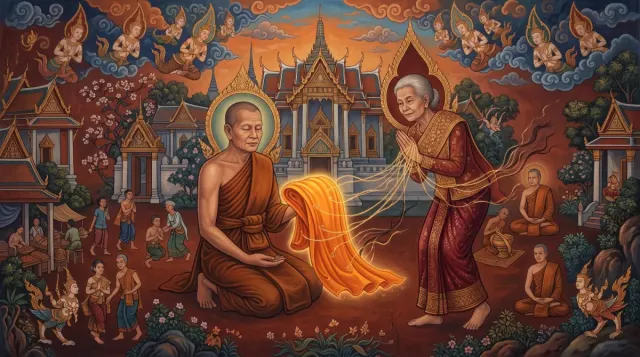
Upananda gave a robe to a monk to persuade him to travel together, but when the monk chose to accompany the Bu…