
Praise with an Agenda: Talking Up One's Own Faction for Offerings, and Paying Performers for Praise
Bhikkhunīparipācitaṃ piṇḍapātaṃTwo rules arising from the nun Thullanandā. First she calls the great disciples a householder had invited mere…


Surāmerayapāne pācittiyaṃ
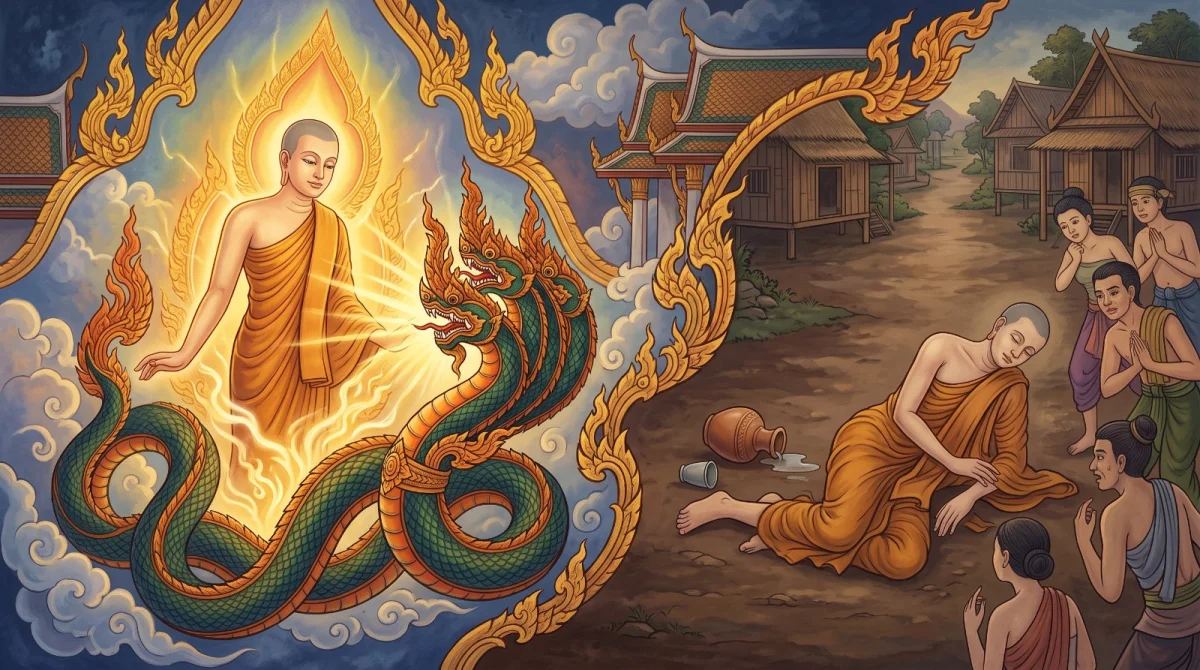
Sāgata had the power to overcome a fierce nāga, yet when lay people offered him liquor he drank until he collapsed at the city gate. The Buddha asked whether he could now fight even a water snake, and laid down the rule forbidding monks to drink alcohol.
Venerable Sāgata appears in two places in the Vinaya Piṭaka. In the Cammakkhandhaka, Mahāvagga part 2 (volume 5), he is the Buddha's attendant; he displays psychic powers before the people of eighty thousand villages, then bows at the Buddha's feet declaring that the Blessed One is the teacher and he is the disciple. The liquor episode is in the Surāpāna Vagga, training rule 1, Mahāvibhaṅga part 2 (volume 2), and is the origin of that rule.
In the latter story, Sāgata sat in the fire hall at Ambatittha, where a fierce nāga lived. The nāga produced smoke and flames; Sāgata entered a meditative attainment, countered them and prevailed. Hearing of this, the lay people of Kosambī wanted to offer what monks like. The group of six monks told them it was clear red liquor the colour of a pigeon's foot, so they prepared it in every house. Sāgata drank at each house and collapsed at the city gate.
The Buddha had monks carry him back to the monastery. He rolled over so that his feet pointed at the Buddha. The Buddha asked the monks: wasn't Sāgata respectful to the Tathāgata before? Is he now? He fought the nāga; could he now fight even a water snake? He then laid down that drinking liquor and fermented drinks is an offence entailing expiation (pācittiya).
In the Cammakkhandhaka, the people of eighty thousand villages paid attention only to Sāgata, not the Buddha. When the Buddha asked him to display his powers, he did so in the air, then bowed his head at the Buddha's feet and said the Blessed One is his teacher and he is the disciple. The people then turned their attention to the Buddha.
When people admire you more than is due, direct their attention back to the principle or the person who taught you, rather than keeping it for yourself.
Sāgata sat in meditation in the ascetics' fire hall at Ambatittha. The nāga produced smoke, and he did too; the nāga blazed up, and he entered the fire-element attainment and countered it until he overcame the nāga's fire. This news made the people of Kosambī deeply devoted.
Past successes are worth rejoicing in, but be aware that fame often brings invitations and temptations with it.
The people of Kosambī asked what is rare and agreeable to the monks. The group of six monks said clear red liquor the colour of a pigeon's foot. So the people prepared it in every household and invited Sāgata to drink.
Before giving a gift or throwing a party to please someone, ask whether it is truly good for them, not just whether they'll like it.
Sāgata drank at every house and, as he left the city, fell down at the city gate. The Buddha, leaving with many monks, saw him and told the monks to carry him back to the monastery.
One drink at each person's invitation doesn't seem much, but together they bring you to a point where you lose control. Set a limit before you go, or choose not to drink at all.
The monks laid Sāgata down with his head towards the Buddha, but he turned over so his feet pointed at him. The Buddha asked whether Sāgata had not formerly been respectful and deferential towards the Tathāgata, and whether he was now. The monks said he was not.
Notice how, when drunk, people often say or do disrespectful things to those they love and honour. That is reason enough not to let yourself get there.
The Buddha asked: didn't Sāgata fight the nāga at Ambatittha? Could he now fight even a water snake? Then he asked whether one should drink what, once drunk, makes one lose consciousness. The monks said one should not.
The abilities you have when sober don't come with you when drunk. Don't drive, make important decisions or argue with anyone while drinking.
The Buddha rebuked the act as unfitting and not conducive to confidence in those without it, then laid down that drinking liquor and fermented drinks is a pācittiya offence. The analysis explains that even drinking a drop on the tip of a blade of kusa grass is an offence, but there is no offence for a drink with the colour, smell and taste of liquor that is not intoxicating, or for alcohol mixed into cooked curry, meat or oil.
For lay people the fifth precept follows the same principle. If you are trying to quit, not touching it at all is easier than trying to drink just a little.
The clearest lesson is that abilities and good qualities built up over time do not protect us from what destroys mindfulness. The most capable person in the room can become the one who has to be carried home in a single night.
On the other side, the lay people meant well but took advice from the wrong people. Good intentions without wisdom can harm those we love, for example pressing a friend to drink to please them.
This training rule is for monks; for lay people it corresponds to the fifth precept. If you or someone close to you can't stop drinking, in Thailand you can get advice from the quit-drinking hotline 1413; outside Thailand, contact a local helpline. Asking for help is nothing to be ashamed of.
Tap to read the actual passage on the page cited.
Two rules arising from the nun Thullanandā. First she calls the great disciples a householder had invited mere…

Five qualities that make speech good — timely, true, gentle, beneficial and spoken with kindness. Useful both …
Venerable Puṇṇiya asks why the Buddha sometimes feels inspired to teach and sometimes not. The Buddha says it …

A poor labourer used his wages to feed the Saṅgha, but the monks had already eaten on alms round and took only…