Upāli's Apadāna: From Arrogance to Foremost in Discipline
UpālittherāpadānaṃUpāli's past lives according to the Apadāna: a proud brahmin, a prince intoxicated with his birth who drove an…


Āgatānāgatassa cātuddisassa saṅghassa
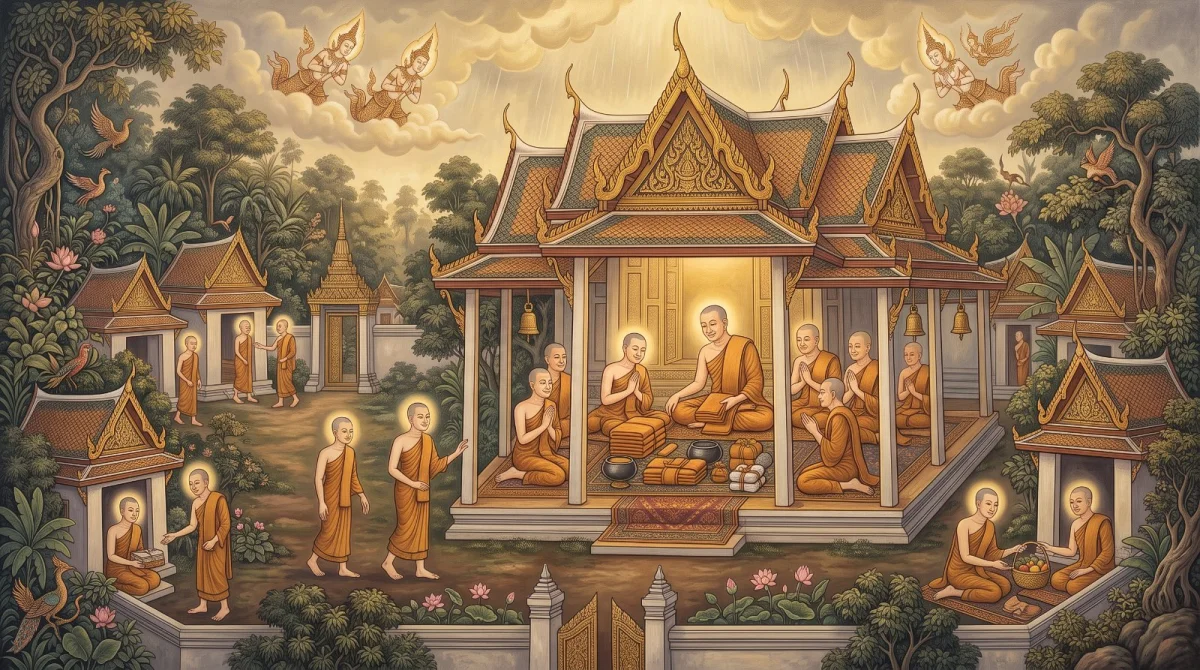
Some monks rushed ahead to reserve lodgings, made monks who were eating or ill get up, dragged fellow monks out of a dwelling they had repaired, and held lodgings in two places. The Buddha set rules: appoint an impartial lodging officer, allocate by number of monks and beds, hold lodgings only for a set period, and never give away or divide the Saṅgha's core property as anyone's own.
In the Senāsana Khandhaka of the Cullavagga, Vinaya Piṭaka, are regulations on the Saṅgha's dwellings and furnishings. Most arose from real problems when some monks grabbed or hoarded common property. The same khandhaka relates that Anāthapiṇḍika asked what to do with Jeta's Grove, and the Buddha told him to establish it for the Saṅgha of the four directions, present and to come. The Saṅgha's lodgings belong to every monk, not to any individual.
The story of Sāriputta finding no place to stay because everything had been reserved, which led the Buddha to tell the fable of the partridge, the monkey and the elephant and to set the principle of respect by seniority, is covered on a separate page. This page focuses on the rules that follow, on allocating and caring for common property.
These are monastic rules, and some details, such as the dates for allocating lodgings by rains retreat, apply only in monasteries. But the principles behind them apply to dormitories, workplaces, public spaces and shared property of every kind.
People set up pavilions, mats and open spaces for the Saṅgha. Pupils of the group of six claimed that the Buddha's rule of seniority applied only to the Saṅgha's own property, not to things specially offered, and rushed ahead to reserve places: this for our preceptor, this for our teacher, this for us. Sāriputta, arriving later, found no place and sat under a tree. The Buddha rebuked them and ruled that even what is specially offered must not be withheld from the order of seniority.
Don't leave items on several seats in a meeting room or restaurant to hold them for your friends. Common space should go to those who actually come to use it.
At a meal given by a certain high official, Upananda the Sakyan arrived late and made the monk next in line get up while still eating. The dining hall was thrown into commotion, and the official complained that one could eat one's fill sitting anywhere. The Buddha ruled that a monk in the middle of eating must not be made to get up; if a seat must be given to a senior monk, the younger should first finish swallowing properly. But he added that this does not mean one may withhold a seat from a senior monk.
If you arrive and there's no seat, wait or find another place. And if you're seated and an elderly person arrives, give up your seat without waiting to be asked.
The group of six made sick monks get up, lifting them and then letting go so they fell unconscious. The Buddha forbade making sick monks get up. Then the same group claimed to be ill so no one could move them and occupied the best beds, so he allowed suitable beds to be given to the sick. When they used slight illness as a pretext to hoard lodgings, he forbade that too.
Accessible parking spaces and priority seats are for people who truly need them. Use them when needed, and don't use small excuses to claim that right.
The group of seventeen repaired a large dwelling on the outskirts to spend the rains in. The group of six waited until the repairs were finished, then told them to leave because the dwelling had fallen to them. The seventeen said they should have been told earlier so they could repair another, and that the dwelling was big enough for both groups. But they were seized by the neck and dragged out, weeping. The Buddha forbade angrily dragging monks out of the Saṅgha's dwellings and allowed lodgings to be allocated systematically.
If you have a claim to a space or project others are putting work into, say so from the start. And if there's enough to share, there's no need to push anyone out.
The Buddha allowed the Saṅgha to appoint as lodging officer a monk with five qualities: not biased by desire, not biased by aversion, not biased by delusion, not biased by fear, and knowing which lodgings have and have not been allocated. The Saṅgha first asks the monk's consent, then appoints him by a motion and one announcement.
When choosing someone to handle allocation in a team or community, look for impartiality and careful record-keeping rather than rank or seniority.
The lodging officer was to count the monks first, then count the beds, then allocate by bed. When many beds were left over, allocate by dwelling; if still more were left, by precinct; if still more, extra shares could be given. If another monk arrives later, one who holds an extra share need not give it up unwillingly. Lodgings must not be allocated to a monk standing outside the boundary.
Before dividing a budget, rooms or donations, know how many people need a share and what is actually available, give everyone a basic share, and only then hand out the rest.
Some monks took lodgings and held them all the time. The Buddha forbade this and allowed holding them for the three months of the rains, not for the other seasons. Later Upananda took lodgings in Sāvatthī and then took lodgings again at a village residence; the monks there worried because he was a troublemaker. The Buddha rebuked him: taken there, released here; taken here, released there; in this way you are an outsider in both places. He ruled that one monk must not hold lodgings in two places.
If you've booked rooms, seats or access in several places at once, release the ones you won't use right away. Holding options stops others using them, and you end up fully present nowhere.
Resident monks near Sāvatthī, tired of arranging lodgings for visitors, handed all the Saṅgha's lodgings over to one monk, so newcomers had nowhere to stay. In another case, the followers of Assaji and Punabbasuka divided up all the Saṅgha's lodgings so they would not have to provide lodgings for Sāriputta and Moggallāna. The Buddha laid down five groups of things that must not be given away or divided: a monastery and its site; a dwelling and its site; beds, chairs, mattresses and pillows; metal vessels and tools; and materials such as creepers, bamboo, grass, clay, woodware and earthenware. Even if the Saṅgha, a group or an individual gives or divides them, they are not validly given or divided, and whoever does so commits a grave offence.
The common property of a village, condominium or organisation should not be parcelled out to a small circle, even if a subgroup agrees among itself, because it belongs to those here now and those who will come in future.
Shared resources usually run into trouble because of whoever arrives first or speaks loudest, not because there isn't enough. Parking spaces, meeting rooms, the office fridge and public seating all face the same problems as monasteries in the Buddha's time.
The rules in this khandhaka offer ideas you can use right away: have an impartial person do the allocating, count people and items clearly before distributing, give priority to the sick and those in need, set a time limit on holding things, and be clear about what is common property that no one can take as their own.
For ourselves, the easiest practice is not to reserve more than we will actually use, and not to cling to what we hold when someone who needs it more arrives.
Tap to read the actual passage on the page cited.
Upāli's past lives according to the Apadāna: a proud brahmin, a prince intoxicated with his birth who drove an…

On a winter night with hard ground, a thin mat of leaves and a cold wind, the Buddha says he slept well. He th…

Anāthapiṇḍika hears the word "Buddha" and cannot sleep. He walks out into the dark despite his fear, a voice u…

People who hear the same Dhamma get three different results: wisdom like an upside-down pot, which holds no wa…