The Discourses on Future Dangers: Seeing What Lies Ahead, Striving Today
AnāgatabhayāniFuture dangers to see in advance — dangers in the forest, old age, illness, famine and a divided Saṅgha, which…


Satthā pariyesitabbo
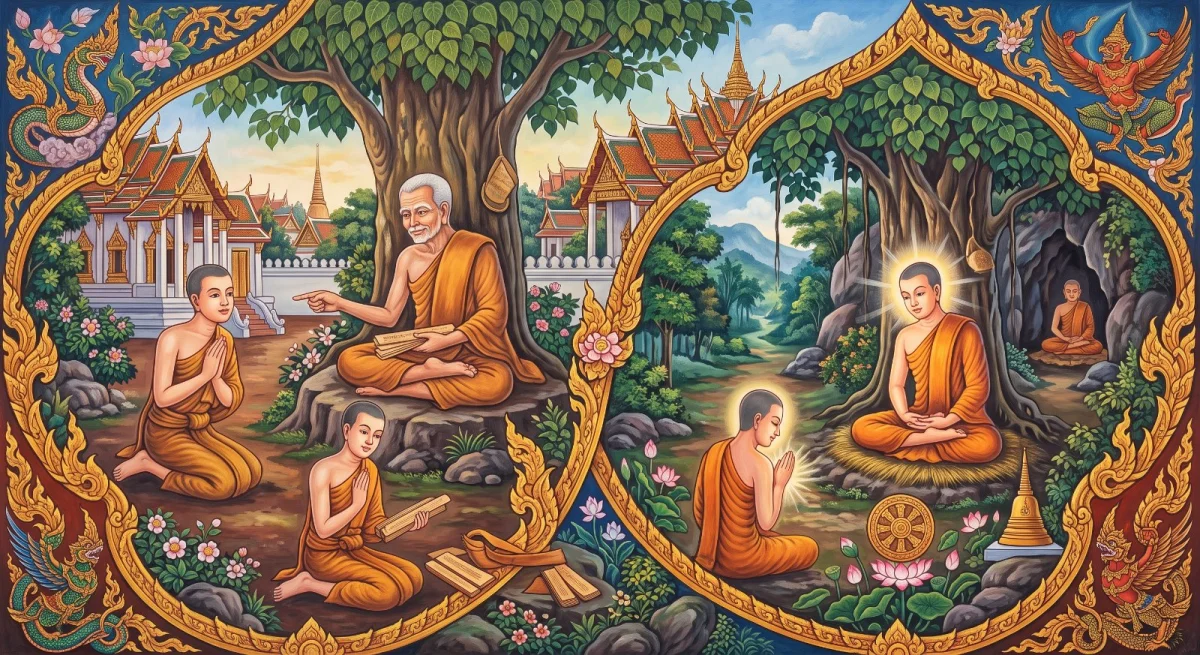
When one does not know and see as it really is, one should seek a teacher, and then practise training, exertion, desire, zeal, persistence, ardour, energy, perseverance, mindfulness, clear comprehension and heedfulness: twelve in all. The chapter also shows why seeing the Dhamma is worth it.
Towards the end of the Nidāna Saṃyutta, Saṃyutta Nikāya, come three short chapters in a row. In the Samaṇabrāhmaṇa Vagga, the Buddha says that ascetics or brahmins who do not understand ageing and death, its origin, its cessation and the way leading to its cessation are not regarded as ascetics among ascetics. He says the same of birth, existence, clinging and so on, down to volitional formations.
In the Antarapeyyāla, a series of abbreviated discourses, he says that one who does not know and see ageing and death as it really is should seek a teacher for knowledge of it, and applies the same pattern to every link of dependent origination and to all four noble truths. He then replaces "seek a teacher" with eleven other things to be done: training, exertion, desire to act, zeal, persistence, ardour, energy, perseverance, mindfulness, clear comprehension and heedfulness, making twelve headings in all.
The Abhisamaya Vagga follows. In the Nakhasikha Sutta, the Buddha picks up a little dust with his fingernail and compares it with the great earth: the suffering remaining for a noble disciple who has seen the Dhamma is as small as that dust. Several similar similes follow.
Ascetics or brahmins who understand ageing and death, its origin, its cessation and the way leading to its cessation are regarded as ascetics among ascetics, and realise the goal of the ascetic life by their own direct knowledge in this very life.
When choosing a teacher or advisor, see whether they can explain the whole picture: what the problem is, what causes it, how it can end, and what needs to be done.
One who does not know and see ageing and death as it really is should seek a teacher for knowledge of it as it really is, along with its origin, cessation and the way to its cessation. The same is said of each link, down to volitional formations.
Admit honestly that there are things you don't yet understand, then actively look for someone who knows, both in Dhamma and in life, instead of going on guessing.
The second heading changes "seeking a teacher" to "training". Knowledge of things as they are does not transfer from teacher to student by itself; the learner must do the training on each point.
After a Dhamma talk or course, go back and reread, take notes, and try applying at least one point in real life that week.
After training come exertion (yoga), desire to act (chanda) and zeal, as things to be done for knowledge as it really is. Knowledge needs both motivation and the effort to act.
If you lack energy for something, first find the reason you truly want to do it. Clear desire makes effort less of a struggle.
Persistence, not turning back, is also on the list. This shows that learning the truth of life has hard stretches when we want to retreat, which is normal and worth preparing for.
When you want to quit halfway, set a small condition: keep going for just one more day, then decide again tomorrow.
Ardour that burns up defilements (ātappa), energy (viriya) and continuous effort (sātacca) are listed one after the other. Effective effort isn't only strength; it has to be continuous.
Doing a little every day beats doing a lot and then stopping for long. Ten minutes of meditation daily is better than an hour once a month.
The last three are mindfulness, clear comprehension and heedfulness. They keep all the preceding effort on track: knowing what you are doing and not letting time slip by uselessly.
Before starting something important, ask yourself briefly, "What am I doing now, and why?" and ask again when you finish.
In the Nakhasikha Sutta, the Buddha picks up a little dust on his fingernail and says that the suffering already destroyed for a noble disciple who has seen the Dhamma is as great as the earth, while what remains, at most seven more lives, is as small as that dust. So great is the benefit of breaking through to the Dhamma and gaining the vision of the Dhamma.
When you wonder whether studying the Dhamma is worth the time, recall this image. Even a beginning of right understanding can change the burden of a whole life.
The sequence in these chapters is a map for learning that fits any subject. It begins by admitting we don't yet know, then finding someone who truly knows. After that the work is ours, from study, intention and effort through to heedfulness. The teacher points the way; the other eleven are the learner's job.
The Samaṇabrāhmaṇa Vagga also helps in choosing a teacher. Someone worth listening to understands the problem, its cause, the way out and how to get there, not just someone with a title or a loud voice.
The Nakhasikha Sutta encourages us that the effort is worthwhile. The fruit of seeing the Dhamma is not small: it shrinks remaining suffering to almost nothing compared with what came before.
Tap to read the actual passage on the page cited.
Future dangers to see in advance — dangers in the forest, old age, illness, famine and a divided Saṅgha, which…

Sāgata had the power to overcome a fierce nāga, yet when lay people offered him liquor he drank until he colla…
The four debates opening chapter eighteen answer the view that the Buddha did not really stand in the human wo…

Four things people wish for but rarely gain, the four qualities that lead to them, the fitting uses of wealth,…