
The Discourse to Ghoṭamukha: Changing a View Through Dialogue
GhoṭamukhasuttaṃThe brahmin Ghoṭamukha holds that there is no righteous going forth. Venerable Udena doesn't argue back direct…


Jambukhādakasaṃyuttaṃ
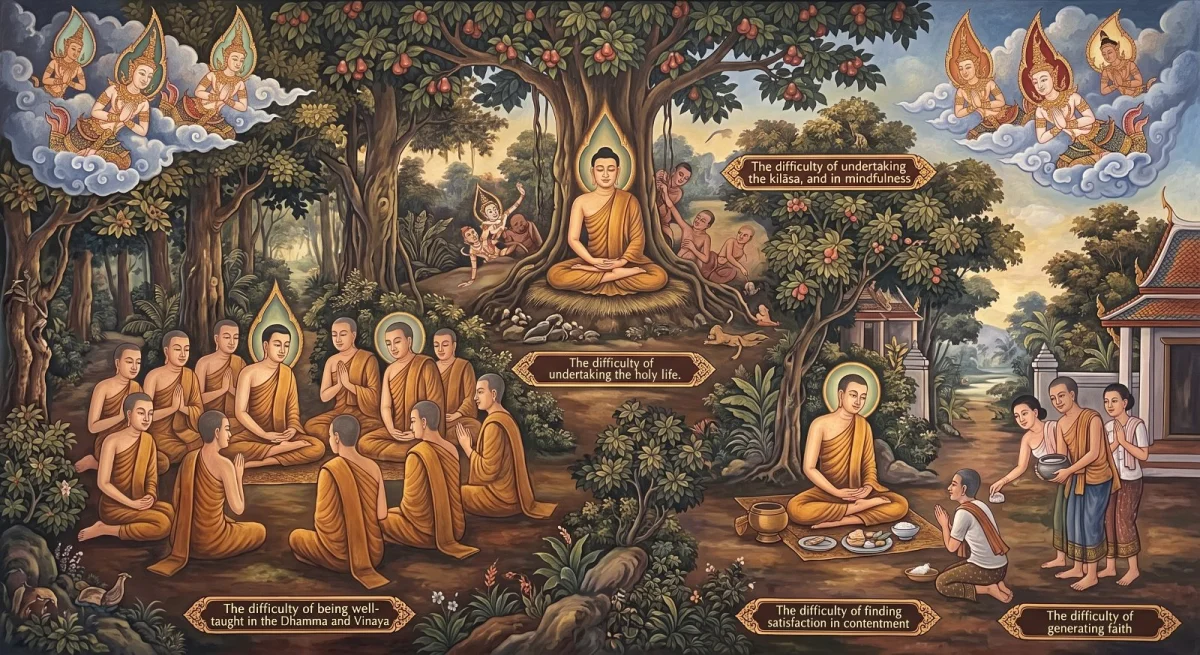
The wanderer Jambukhādaka asks Sāriputta about sixteen topics, from Nibbāna and arahantship to ignorance, craving and identity. Each time Sāriputta says the way is the noble eightfold path. Last, he says going forth is hard; for one gone forth, delight is hard; for one who delights, practice in line with the Dhamma is hard — but one who practises so will not take long.
In the Jambukhādaka Saṃyutta of the Saṃyutta Nikāya, Sāriputta is staying at the village of Nālaka in Magadha. A wanderer (a renunciant outside the Buddha's teaching) named Jambukhādaka comes and asks him questions one by one, making sixteen suttas: what is Nibbāna, what is arahantship, who speaks the Dhamma in the world, for what purpose is the holy life lived, who has attained consolation, and what are feeling, the taints, ignorance, craving, the floods, clinging, existence, suffering and identity.
Each sutta follows the same pattern. Sāriputta gives a short definition. The wanderer asks whether there is a path, a practice, to realise, fully understand or abandon it. Sāriputta says there is: the noble eightfold path. The wanderer says it is a fine path, and enough for diligence.
The last sutta asks what is hard to do in this Dhamma and discipline. In the Sāmaṇḍaka Saṃyutta that follows, a wanderer named Sāmaṇḍaka asks Sāriputta the same set of questions on the bank of the Ganges near Ukkacelā in the Vajji country.
Asked what Nibbāna is, Sāriputta answers that the destruction of greed, the destruction of hatred and the destruction of delusion is called Nibbāna. Asked what arahantship is, he answers in the same terms.
Use this as a yardstick for your practice: are greed, anger and delusion lighter today than before? Measure by that rather than by special experiences.
Whether asked about realising Nibbāna, abandoning the taints, ignorance or craving, or fully understanding feeling, existence or suffering, Sāriputta answers that the way is the noble eightfold path: right view, right intention, right speech, right action, right livelihood, right effort, right mindfulness and right concentration.
When confused by many techniques, come back to a simple check of the eight factors: today, which has slipped — view, thought, speech, action, livelihood, effort, mindfulness or concentration?
Those who teach the Dhamma for abandoning greed, hatred and delusion are speakers of Dhamma in the world. Those practising to abandon them are practising well. Those who have abandoned them, cut off at the root like a palm stump so they cannot arise again, are the well-gone in the world.
When choosing a teacher to listen to, see whether their teaching leads to less greed, anger and delusion, or to more.
Asked for what purpose the holy life is lived under the ascetic Gotama, Sāriputta answers: for the full understanding of suffering. He describes suffering as threefold: the suffering of pain, the suffering of formations, and the suffering of change.
Ask yourself why you go to the temple, meditate or read the Dhamma. If the answer is to understand your own suffering clearly, it matches Sāriputta's answer.
A monk who understands as they really are the origin, ending, gratification, danger and escape regarding the six bases of contact has attained consolation. If, having understood so, he is freed through not clinging, he has attained supreme consolation.
When you feel hooked on something through your eyes, ears or a screen, run through five points: how it arises, how it ends, what pleasure it gives, what harm it brings, and how to get free of it.
Asked what is hard to do in this Dhamma and discipline, Sāriputta answers: going forth is hard. For one gone forth, delight is hard. For one who delights, practice in line with the Dhamma is hard.
Use this as a frame for any new resolution, such as exercising. Starting is hard; having started, still loving it is hard; loving it, doing it correctly and consistently is harder. Prepare yourself for one stage at a time.
Asked how long it takes a monk practising in line with the Dhamma to become an arahant, Sāriputta simply answers: not long.
When discouraged, don't measure by the distance left; measure by whether you are on the right path today. Sāriputta gives no number, but affirms that the right path is not as long as we fear.
Sāriputta's answers are surprisingly short and direct. He doesn't use lofty language for Nibbāna; he says it is the ending of greed, hatred and delusion. And every question comes back to the same path, the eightfold path, which can begin in real life with our views, speech, actions and livelihood.
The last answer is a map of difficulty that fits any good intention. Starting is hard; having started, keeping your delight in it is hard; having delight, doing it rightly and consistently is harder still. But Sāriputta ends by saying that once you are practising rightly, the result is not far away.
Tap to read the actual passage on the page cited.
The brahmin Ghoṭamukha holds that there is no righteous going forth. Venerable Udena doesn't argue back direct…

The fourteenth Vibhaṅga asks what the five training rules "are" in the moment of mind that abstains, and answe…

One standard, the ten kinds of rightness, decides whom to associate with, attend, venerate, praise and respect…
Jhāna is only pleasant abiding here and now, not yet effacement of defilements. True effacement is resolving, …