
The Pāṭaliya Discourse: When Four Teachers Contradict Each Other
Pāṭaliyo gāmaṇīThe headman Pāṭaliya tells how four teachers with utterly opposed views stayed in his rest house, leaving him …


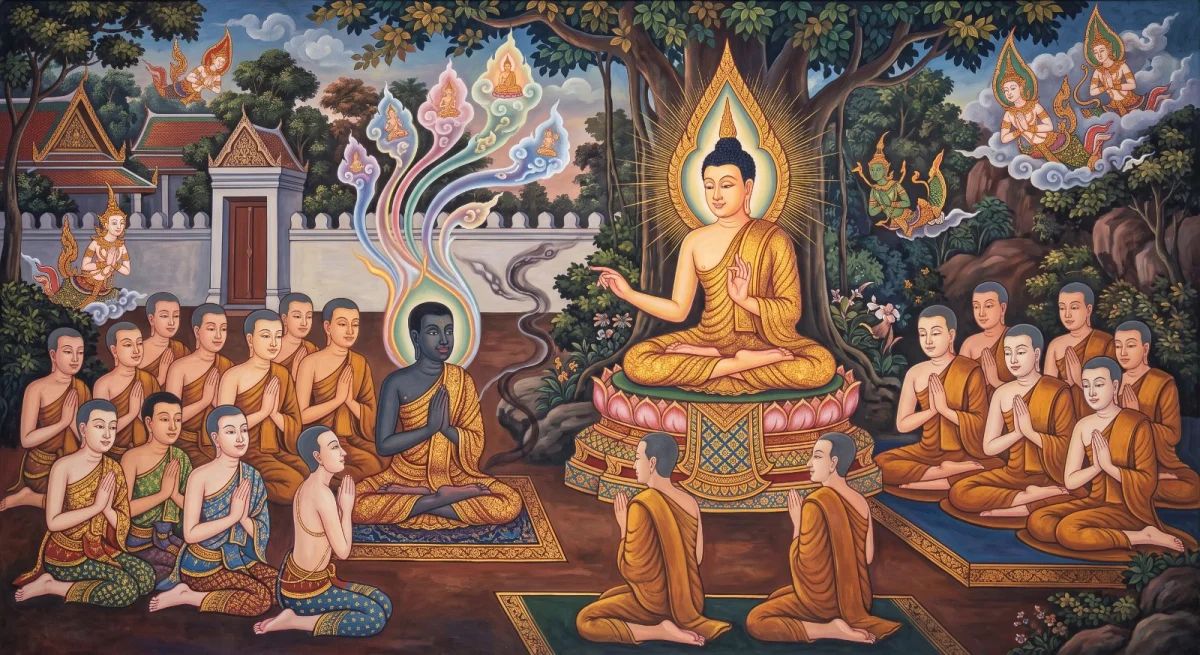
Moggallānasaṃyuttaṃ
Mahāmoggallāna recounts how, at each stage of jhāna, what he had just left behind kept intruding, and the Buddha came to urge him to steady his mind, so he passed through stage by stage. The collection ends with his talks with Sakka on the value of going for refuge and of virtue.
In the Moggallāna Saṃyutta of the Saṃyutta Nikāya, Mahāmoggallāna tells the monks that while he was alone in seclusion the thought arose: "'The first jhāna' is spoken of. What is the first jhāna?" He then entered the first jhāna, but while he dwelt there, perception and attention accompanied by sensuality kept arising. The Blessed One came to him by psychic power and said, "Moggallāna, Moggallāna, do not be negligent about the first jhāna. Steady your mind in the first jhāna, unify your mind, concentrate your mind in the first jhāna." Later he entered the first jhāna.
The same pattern repeats at every stage: the second, third and fourth jhānas, the four formless attainments, and finally the signless concentration of mind. Each stage has a different intrusion, and each time he concludes that, rightly speaking, one would say of him that he is a disciple who, helped by the Teacher, attained great direct knowledge.
In the closing discourses, Mahāmoggallāna appears in the Tāvatiṃsa heaven and tells Sakka and a great many deities that going for refuge to the Buddha, Dhamma and Saṅgha, unwavering confidence in the Triple Gem, and the virtue dear to the noble ones are good, because through them some beings go to a good destination. Sakka affirms this in the same words. The last discourse says the same took place with the deva Candana and other devas.
While Mahāmoggallāna dwelt in the first jhāna, perception and attention accompanied by sensuality kept arising. In the second jhāna it was perception accompanied by thought; in the third, by rapture; in the fourth, by pleasure — what he had just passed beyond at the previous stage came back in.
When a habit you've dropped comes back to visit, don't panic. Recognise it as the pull of what you've just let go, and return to what you intended.
The Buddha came by psychic power, called his name twice, and told him not to be negligent about the first jhāna. The warning wasn't to abandon what he was doing or rush to the next stage, but to give full care to the stage right in front of him.
When work or training starts to feel easy, watch out for complacency. A stage you think you've mastered still needs care.
The admonition has three parts: steady the mind in that jhāna, unify the mind, and concentrate the mind. It brings the mind back to the jhāna being trained rather than fighting what intrudes. After this he was able to enter that stage.
When your mind wanders while meditating or reading, use three short steps: set it back where it was, gather it in one place, and hold it there.
After the fourth jhāna the same pattern repeats in the dimensions of infinite space, infinite consciousness, nothingness, and neither perception nor non-perception. Last is the signless concentration of mind, entered by not attending to any signs; yet while dwelling in it, his consciousness still followed signs, and the Buddha came to admonish him as before.
A hard task doesn't have to be broken through in one go. Divide it into stages, and accept that each new stage brings something new to adjust.
Each time he passed a stage, he said that, rightly speaking, one would say of him that he is a disciple who, helped by the Teacher, attained great direct knowledge. He did not credit the success to himself alone.
When you succeed at something, recall the people who warned you or showed you the way at key moments, and thank them clearly.
Mahāmoggallāna tells Sakka that going for refuge to the Buddha, the Dhamma and the Saṅgha is good, because some beings in this world, on dying, go to a good destination, a heavenly world. Sakka and the deities with him affirm this in the same words.
Having a clear refuge for the mind means that when life is shaken, you know which principles to return to.
In the following discourses he speaks of unwavering confidence in the Buddha, Dhamma and Saṅgha, and of the virtue dear to the noble ones — unbroken, untorn, unblemished, unspotted, leading to concentration — as likewise leading to a good destination. Some discourses add that those reborn this way surpass other deities in ten respects, such as lifespan, beauty, happiness and glory.
Unblemished virtue doesn't mean perfection from day one. Start with the precept you most often slip on, and keep it more and more consistently.
This is very encouraging for anyone practising meditation. Even the chief disciple foremost in psychic power had times when his mind was pulled back by old things and needed someone to urge him to refocus. A restless mind is not failure; it is part of the training.
Another point is humility. Mahāmoggallāna doesn't present himself as skilled, but as someone the Teacher helped. In real life, almost every achievement has a teacher, mentor or friend who reminded us at a crucial moment.
The details of jhāna and the formless attainments are advanced practice. Most people needn't measure themselves by the names of jhānas. The main principle is enough: notice what is pulling the mind, and return to your intention without blaming yourself.
Tap to read the actual passage on the page cited.
The headman Pāṭaliya tells how four teachers with utterly opposed views stayed in his rest house, leaving him …

King Ajātasattu put the same question to six rival teachers: what visible fruit does the ascetic life bear her…

Plants and animals differ in marks according to species, but humans have no such marks. A person is a farmer, …

The last pairing checks the twenty-two faculties one by one. Eye and ear as words are wider than the eye facul…