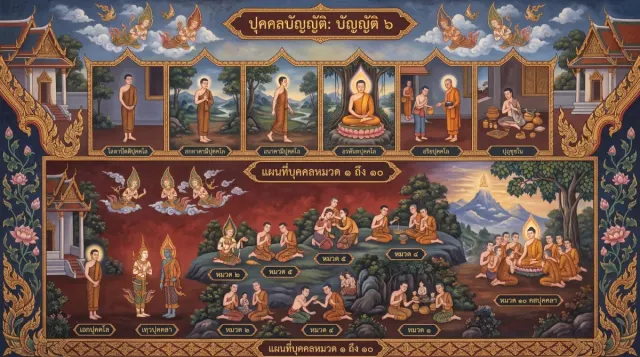
Puggalapaññatti: Six Designations and a Map of Persons from Ones to Tens
PuggalapaññattiThe Puggalapaññatti opens with six designations — aggregates, sense bases, elements, truths, faculties and per…



Tapena brahmacariyena saññamena damena ca
Verses of elders once looked down on: Sunīta the former flower-scavenger, Cūḷapanthaka the slow learner sent home by his brother, Sopāka ordained at seven, and Mogharāja of poor complexion but good mind. One becomes excellent through self-training, not through birth.
In the Theragāthā of the Khuddaka Nikāya, several elders speak frankly about their lives before ordination. Some were born into low, poor families; some learned so slowly that they were despised. This page gathers the verses of Sunīta (Book of Twelves), Cūḷapanthaka (Book of Tens), Sopāka (Book of Sevens) and Mogharāja (Book of Twos).
These verses do not tell of people who went from rags to riches. They tell how, once given a chance and putting in real practice, people society did not value reached the highest goal and were honoured by the Buddha and by deities. At the end of Sunīta's verses, the Buddha says one becomes a brahmin through austerity, the spiritual life, restraint and self-taming.
The details on this page come mainly from the verses themselves; anything from the commentary is marked as such.
Sunīta says he was born into a low family, poor, with little to eat. His work was lowly: he threw out flowers. People found him disgusting, despised and reviled him, and he had to humble his mind and bow to many people.
Notice how you treat garbage collectors, housekeepers or cleaning staff, and start by greeting and thanking them with respect.
One day he saw the Buddha with the Saṅgha entering the city of the Magadhans. He put down his carrying load and went to pay respects. The Buddha stood still out of compassion for him. He asked for ordination, and the Buddha said, "Come, monk" — that was his full ordination.
When someone nobody pays attention to comes up to you, pause what you are doing for a moment and really listen. A few minutes of waiting may mean a great deal to them.
After ordination he lived alone in the forest, tireless, doing as the Teacher instructed. In the first watch of the night he recollected past lives, in the middle watch he gained the divine eye, and in the last watch he shattered the mass of darkness, ignorance. At dawn Indra and Brahmā came and paid homage to him with joined palms.
If you receive an unexpected opportunity, such as a scholarship or a new job, repay it with steady effort rather than waiting for others to carry you further.
Seeing him surrounded by deities, the Buddha smiled and said: one becomes a brahmin through austerity, the spiritual life, restraint and self-taming; this is the highest brahmin.
When assessing others or yourself, ask "How have they trained themselves?" rather than "Where are they from, where did they study?"
Cūḷapanthaka says his understanding was slow, so he was despised, and his brother told him to go home. He stood miserable at the monastery gateway, still longing for the teaching. The Buddha came, stroked his head, took him by the arm and led him in, then gave him a foot-wiping cloth and told him to focus on that clean cloth. He did so and attained the three knowledges. At the end of the verses he says he is now worthy of offerings, a field of merit for people. (The detail about repeating the words "removing dust" is found in the Thai translation and the commentary.)
If a child, a junior or a colleague learns slowly, don't conclude they can't. Look for a simpler, more concrete method. Some people are not dull; the teaching method just doesn't suit them yet.
Sopāka says he followed the Buddha as he walked up and down. The Buddha asked him questions, and he answered without trembling or fear. The Buddha told the monks it was a gain for the people of Aṅga and Magadha to provide requisites to Sopāka, and declared that answering those questions was his full ordination. He was seven years old. The word sopāka in Pāli is a term for an outcaste; the story of his hard childhood comes from the commentary.
Don't judge anyone's ability by age or family reputation. Give children and newcomers a chance to answer and to think, and praise them when they do well.
In Mogharāja's verses, someone (the commentary says the Buddha) asks him: you of poor complexion but good mind, what will you do on cold winter nights? He replies that Magadha is rich in crops; he will lie comfortably covered with straw, like others who live happily.
When you don't have things as good as others have, look for what you already have that is good enough. This contentment is not giving up; it is refusing to let lack wound the mind a second time.
These verses work in two directions. For anyone who has been looked down on because of their job, status or slowness, they say such things do not decide how far the mind can go. For those in a higher position, they say the person we barely notice may be the most valuable one in the room.
What the Buddha does in these stories is an example we can follow: stopping to wait for someone others shun, stroking the head of someone in tears, and giving a practice simple enough for a slow learner.
Still, the verses do not say poverty is good or that social injustice needs no remedy. Their point is a person's worth, which no one can take away.
Tap to read the actual passage on the page cited.
The Puggalapaññatti opens with six designations — aggregates, sense bases, elements, truths, faculties and per…
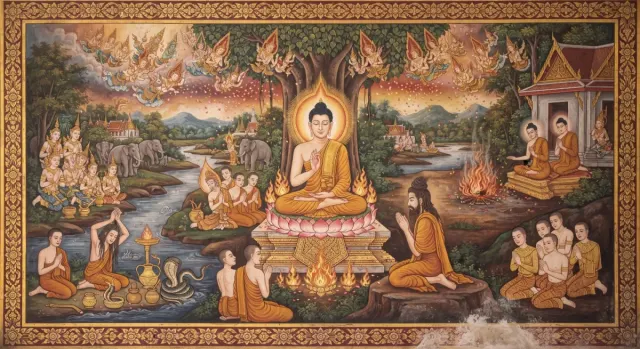
A brahmin who once asked for a boon — that he might always have a large following — who once held a wrong view…

Some mice dig a hole but don't live in it; some live in a hole they didn't dig. Learning the Dhamma is like di…

Form, feeling, perception, formations and consciousness are not yours; abandoned, they lead to welfare and hap…