
The Root Sutta: All Things Are Rooted in Desire
Chandamūlakā sabbe dhammāIf wanderers of other sects ask what all things are rooted in, the Buddha says to answer: they are rooted in d…


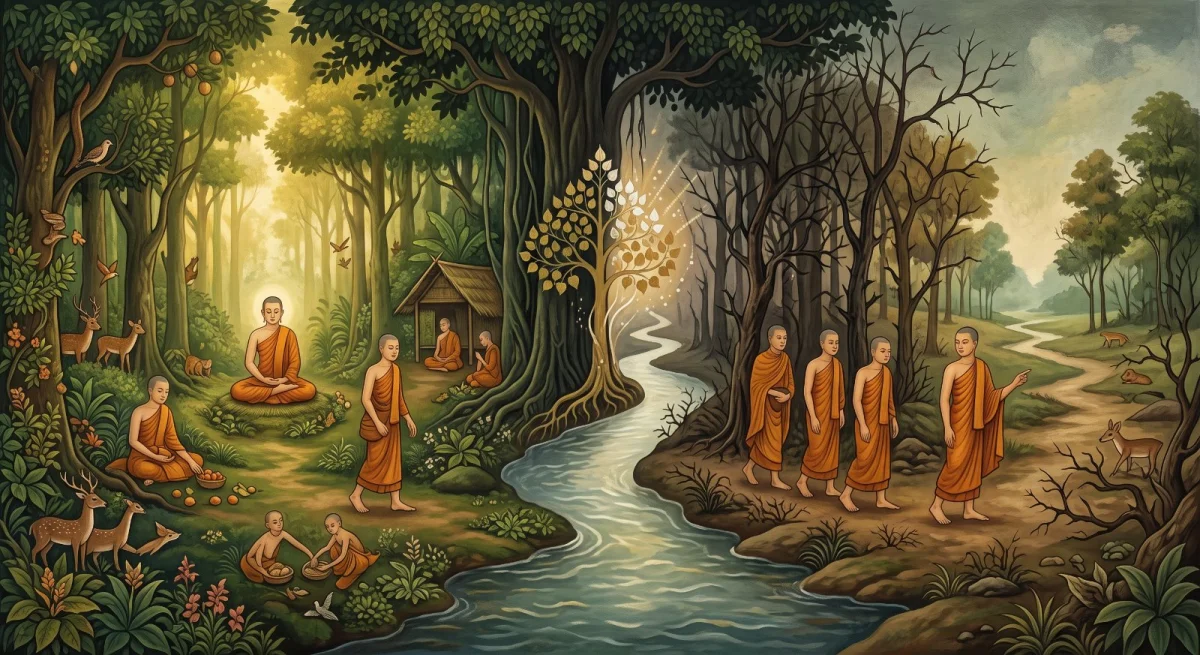
Vanapatthasuttaṃ
A way of deciding whether to stay in or leave a forest, village, town or person, by looking at two things: whether the mind is growing, and whether the requisites for living are easy or hard to get — with growth of mind always weighing more than material convenience.
In the Vanapattha Sutta of the Majjhima Nikāya, the Buddha teaches a discourse on jungle thickets: a way of reflecting on dwelling in a forest by asking two questions. First, while living here, does unestablished mindfulness become established, does the unconcentrated mind become concentrated, do undestroyed taints come to destruction, and does one attain the unattained supreme security from bondage? Second, are robes, almsfood, lodging and medicine hard or easy to come by?
These two questions give four cases. If the mind doesn't grow and requisites are hard to get, one should leave at once, even at night. If the mind doesn't grow but requisites are easy, one should still leave, since one did not go forth for the sake of requisites. If the mind grows but requisites are hard, one should stay. And if the mind grows and requisites are easy, one should stay for life.
The Buddha applies the same principle to living in dependence on a village, market town, city, country and a person.
When living somewhere, consider whether mindfulness becomes established, the mind becomes concentrated, the taints are destroyed and the unattained is attained; and consider whether the requisites a monk needs — robes, almsfood, lodging and medicine — are hard or easy to obtain.
At the end of each year, ask two questions about your current job or home: is my mind better, and is my living adequate? Write down the answers.
If, living there, mindfulness is not established, the mind is not concentrated, the taints are not destroyed, and requisites are hard to get, the monk should leave that forest, whether by night or by day. He should not stay.
When an environment both makes your mind worse and makes life hard, you don't need to wait for things to deteriorate further before deciding.
If the mind doesn't grow but requisites are easy to get, the monk should reflect: I did not go forth for the sake of robes, almsfood, lodging or medicine. Since the mind doesn't grow, having considered this, he should leave.
Ask yourself whether you stay in this job or relationship because it leads you towards your true goal, or because it is too comfortable to change.
If mindfulness becomes established, the mind concentrated and the taints destroyed, but requisites are hard to get, the monk should reflect that he did not go forth for requisites. Since the mind grows, having considered this, he should stay and not leave, even knowing it is hard.
During a tough period of study or a new job that is difficult but truly helps you grow, don't retreat just because of inconvenience.
If the mind grows and requisites are easy to get, the monk should stay in that forest for as long as life lasts, and not leave.
When you find a place that is good for the mind and sufficient for living, appreciate it rather than endlessly looking for somewhere that seems better.
The Buddha applies the same four cases to living in dependence on a village, market town, city or country, not only a forest. A good place doesn't depend on whether it is forest or city, but on its effect on the mind.
Before moving city or job to follow a trend, consider whether the new environment gives you more or less mindfulness, concentration and time to care for your mind.
The same criteria apply to living in dependence on a person. If the mind doesn't grow with that person, one should leave and not follow them. If the mind grows and requisites are easy, one should follow that person for life and not leave, even if sent away.
Teachers and good friends who truly help us grow are rare. Even if they are strict or so direct that you want to back away, patiently stay close to them.
Although this discourse was taught to monks about their dwelling place, the reasoning applies to choosing a workplace, a home, a circle of friends, or any environment in life. The key question isn't "Is this place comfortable?" but "Does this place make me a better person?"
The most challenging case is the second: a comfortable place where you don't grow. The discourse says you should still leave. The third is just as challenging: a hard place where the mind grows, where you should patiently stay.
A caution: don't use this principle as an excuse to abandon responsibilities you carry, such as caring for family. Conversely, if an environment or relationship endangers your physical or mental safety, safety comes first.
Tap to read the actual passage on the page cited.
If wanderers of other sects ask what all things are rooted in, the Buddha says to answer: they are rooted in d…
An ascetic admits that anger really did arise in his mind, but he checked it at once, as heavy rain settles du…

A headman who is a professional warrior asks about his teachers' claim that a warrior killed in battle is rebo…

Ānanda's past life according to the Apadāna: he climbed down from an elephant to hold a parasol over the Buddh…