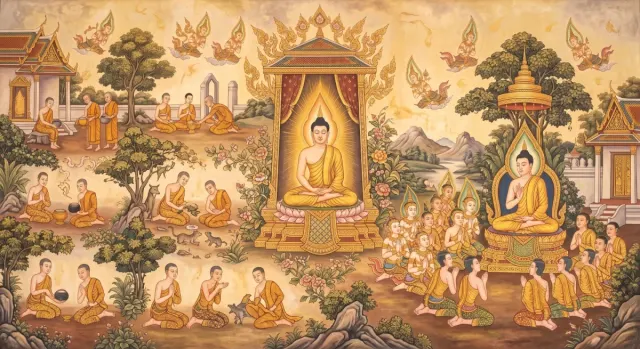
Mahālomahaṃsa and the Summary: Equanimity and the Conclusion on the Perfections
Sukhadukkhe tulābhūtoThe Bodhisatta lies in a charnel ground; some come to harm him, others bring gifts, and his mind stays even li…


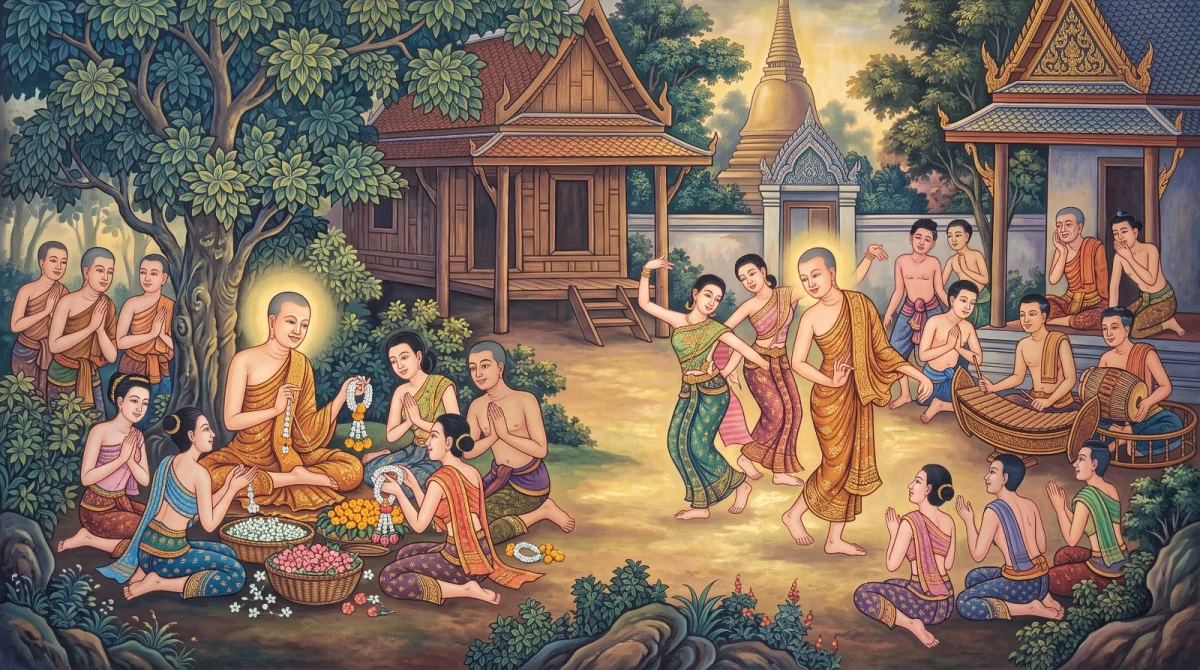
Kuladūsako pāpasamācāro
Resident monks at Kīṭāgiri grow flowers, make garlands for women of local families and behave improperly in many ways, so villagers prefer smooth-talking monks to restrained ones. The Buddha has the Saṅgha banish them and lays down the rule on corrupters of families.
The thirteenth saṅghādisesa rule in the Great Analysis, Vinaya Piṭaka volume 1, concerns the monks led by Assaji and Punabbasuka, residents of the Kīṭāgiri district, whose conduct led to the rule on a monk who corrupts families (kuladūsaka). The rule is monastic discipline, but the lesson about using gifts to buy favour applies to everyone.
These monks planted flowering plants, watered them, picked the flowers, made many kinds of garlands and took them to women of various families. They also behaved improperly in many other ways, such as eating at the wrong time, drinking alcohol, dancing, singing and playing games. Yet the villagers preferred them, with their gentle speech, smiles and ready greetings, to a restrained monk.
A monk passing through received no almsfood at all. A lay follower invited him home for a meal and asked him to tell the Buddha that the monastery at Kīṭāgiri had gone bad. The Buddha sent Sāriputta and Moggallāna to carry out a legal procedure of banishment. When those monks refused to accept it, abusing and accusing the Saṅgha, he laid down the rule.
These monks planted flowering plants and had others plant them, watered them, picked the flowers and made them into garlands, bouquets, wreaths and chest ornaments, then took them to the women, daughters, daughters-in-law and servant women of various families. They used these things to build ties with villagers instead of being a refuge through the Dhamma.
People in positions that depend on trust, such as teachers, doctors, officials or salespeople, should be wary of using gifts or special favours to win people over to their side.
The analysis explains that a corrupter of families is one who curries favour with families by means of flowers, fruit, powder, clay, tooth-cleaners, bamboo, medical treatment or running errands. Families are corrupted when people who had faith lose it, and those who had confidence lose it, because of that monk.
Even small things can buy favour. Ask yourself whether you give out of kindness, or so that people will feel indebted and take your side.
Seeing the visiting monk, restrained, eyes lowered and composed in his movements, the villagers said he looked feeble, weak and sullen, and asked who would give him alms. Their own monks, they said, were gentle, pleasant-spoken, smiling first, greeting people with "Come, welcome!"; those were the ones to give to. The restrained monk got nothing.
Friendliness is good, but don't make charm or easy familiarity the only test of whom to trust. Look at how people behave as well.
The lay follower's message said that people who once had faith had lost it, regular offerings to the Saṅgha had been cut off, well-behaved monks were leaving and bad monks were staying. He asked the Buddha to send monks to Kīṭāgiri so the monastery could be re-established.
In organisations that run on connections and flattery rather than results, good workers gradually leave. If you see this sign, fix the system quickly rather than waiting until only the flatterers remain.
The Buddha told Sāriputta and Moggallāna to carry out the banishment, saying those monks were their pupils. The two said the monks were fierce and rough. The Buddha told them to go with many monks, and set out the procedure: first accuse them, have them recall the offence, charge them with it, and then announce it to the Saṅgha.
When dealing with aggressive people, don't confront them alone. Go as a team with a clear process: state the charge, let them hear and respond, and only then decide.
After being banished, those monks did not conduct themselves properly or ask forgiveness. They abused the Saṅgha and accused it of acting out of desire, ill will, confusion and fear; some left and some disrobed. So the rule has a monk who speaks like this admonished: the monks are not biased; you are the corrupter of families. If he does not give it up after the Saṅgha's third formal pressing, it is a saṅghādisesa.
When you are criticised or penalised, before accusing the decision-makers of bias, first review whether your actions really harmed others.
This story does not say smiling or giving gifts is wrong. The problem is using gifts and familiarity to bind people to one's side, until real values are forgotten and those who want to do good can no longer stay.
Today the same pattern appears in vote-buying, in pleasing key clients at the expense of standards, or in building a fan base with giveaways rather than substance. In the long run, trust in the whole system erodes.
The story also shows a fair way to respond: someone reports the matter, it is looked into, suitable people go together to deal with it, the charge is stated before judgment, and there is a chance to give up the wrongdoing.
Tap to read the actual passage on the page cited.
The Bodhisatta lies in a charnel ground; some come to harm him, others bring gifts, and his mind stays even li…
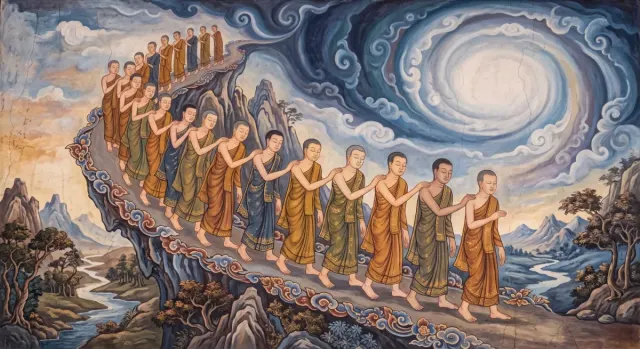
Two young brahmins argue over whose teacher's path to Brahmā is more direct. The Buddha shows that no one in t…
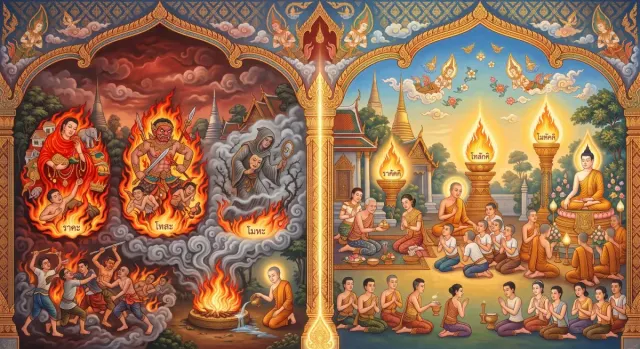
Three destructive fires that burn the mind, and three "fires" to tend with care — parents, family and dependan…

The nun Soṇā had ten sons, but her husband took all of them with him into the monastic life against her wishes…