
The Aggañña Discourse: No One Is Noble by Birth; Dhamma Alone Is Best
AggaññasuttaṃTwo novices from brahmin families are abused by brahmins for abandoning the highest caste. The Buddha says goo…


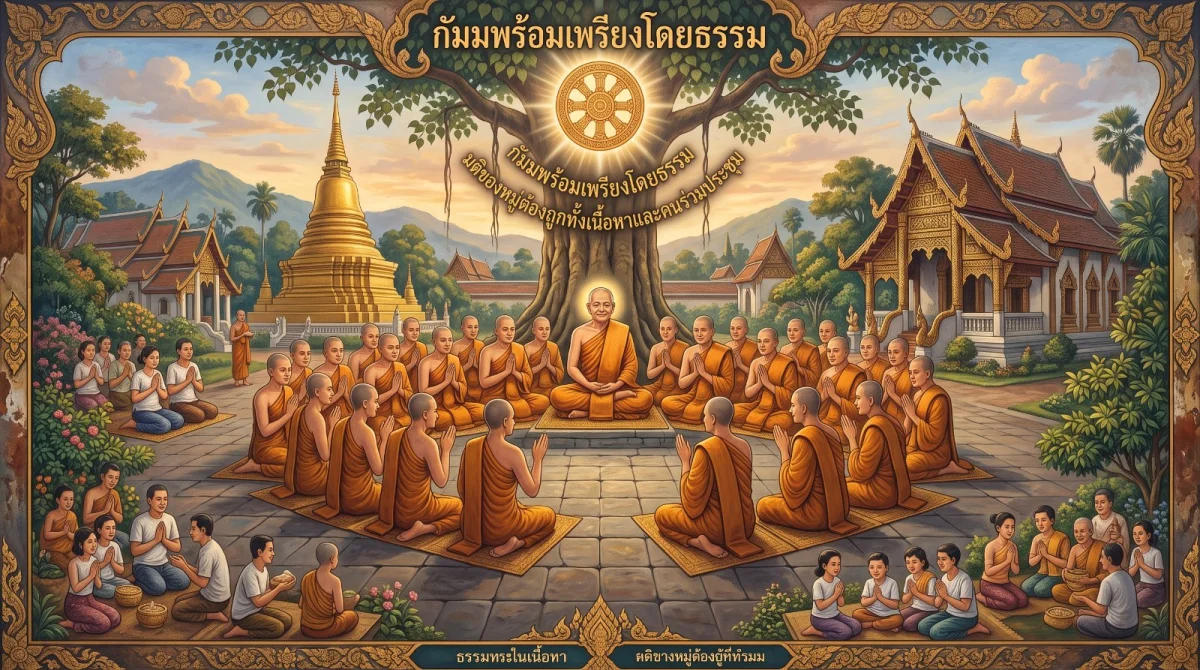
Dhammena samaggakammaṃ
The monks of Campā suspended one another at will — one monk suspending many, a Saṅgha suspending a Saṅgha. The Buddha laid down that an act of the Saṅgha is valid only when it is both legitimate and unanimous, with rules on quorum, on who may object, on right and wrong expulsion, on matching the penalty to the person, and on lifting a penalty by the proper procedure as well.
In the Campā Chapter (Campeyyakkhandhaka) of the Mahāvagga in the Vinaya Piṭaka, the monks of Campā carried out acts in confusion: illegitimate acts, acts by a faction, one monk suspending one monk, two suspending several, several suspending the Saṅgha, even one Saṅgha suspending another. Monks of few wishes criticised this and reported it. The Buddha said such acts were invalid and should not be done, and distinguished four kinds of act: illegitimate and by a faction, illegitimate but unanimous, legitimate but by a faction, and legitimate and unanimous. Only the last is valid.
He then explained that "legitimate" means following the correct procedure: first the motion, then the announcement the required number of times. "Unanimous" means that all monks entitled to take part are present, the consent of those unable to come has been brought, and those present do not object. He set the size of Saṅgha needed for each kind of act, said who may object and whose objection does not stand, and distinguished right and wrong expulsion and readmission.
Later Upāli asks about matching the penalty to the offence, and the end of the chapter works through the five disciplinary acts imposed on monks, from the act of censure to the act of suspension, both when imposed and when lifted. Every case repeats the same principle: it must be done legitimately and unanimously. This material is Saṅgha procedure; this point is for overall understanding of how the Saṅgha decides matters.
Of the four kinds of act, one that is illegitimate or done by a faction is called reversible and unfit to stand; the Buddha does not allow it. Only an act that is both legitimate and unanimous is irreversible and fit to stand. He told the monks to resolve: we will do acts that are legitimate and unanimous.
Before closing a decision in a meeting, check two things: have we followed the agreed procedure, and have all those entitled to take part been informed?
In an act requiring a motion and announcement, making the motion without the announcement, or the announcement without the motion, is illegitimate. Making the announcement first and the motion afterwards, even with everyone present and no one objecting, is unanimous only in a semblance of legitimacy: it looks right but is invalid. A correct act makes the motion first, then the announcement once or three times depending on the kind of act.
In paperwork and approvals, the order of steps matters. Signing the approval first and submitting the proposal afterwards may look complete, but it skips real consideration.
A unanimous act is one where all monks entitled to take part have assembled, the consent of those entitled to send it has been brought, and those present do not object. If any one of these is missing, even with the other two complete, it is an act by a faction.
If some members can't attend, give them a way to register their view or consent beforehand, rather than treating those absent as having no voice.
There are five sizes of Saṅgha: four, five, ten, twenty and more than twenty monks. A Saṅgha of four can do every act except ordination, the invitation ceremony and rehabilitation (abbhāna); a Saṅgha of five, every act except ordination in the middle country and rehabilitation; a Saṅgha of ten, every act except rehabilitation; a Saṅgha of twenty or more, every act. If a nun, a novice, someone no longer a monk, or the very person the act concerns is counted towards the quorum, the act is invalid.
Matters that affect many people or are hard to undo should involve more people, and the person whose case it is shouldn't be counting the votes on it.
A nun, a novice, one who has renounced the training, one who is insane, one suspended from the community, one in a different boundary, or the person the act concerns cannot make an objection that stands in the midst of the Saṅgha. But for a regular monk in full communion within the same boundary, even if he only lets the monk in the next seat know, the objection stands.
If you chair a meeting, actively seek out disagreement, including from people who murmur to their neighbour rather than speaking up.
There are two kinds of expulsion. A pure monk with no offence, if the Saṅgha expels him, is wrongly expelled. A monk who is foolish, incompetent, full of offences, ill-mannered and mixing improperly with householders, even if he has not yet reached the point of expulsion, is rightly expelled if the Saṅgha expels him. Readmission is likewise divided into right and wrong.
Asking someone to leave a group must rest on behaviour that has really and repeatedly happened, not on dislike. Someone who has done nothing wrong should not be pushed out just because the majority finds them disagreeable.
If a monk accused of an offence says he sees it, yet the Saṅgha suspends him for not seeing it, the act is illegitimate. When Upāli asked, the Buddha said that if the Saṅgha imposes one penalty on someone who deserves another, such as an act of further dependence on someone deserving an act of censure, it is illegitimate, not in accordance with the Vinaya, and the Saṅgha is at fault. Imposing the penalty each person deserves is legitimate, and the Saṅgha is not at fault.
When dealing with a child's or a team member's mistake, ask whether they have already admitted it and whether the measure fits what happened. An excessive penalty makes the one who imposes it the one in the wrong.
A monk under a disciplinary act who behaves properly, is subdued and mends his ways may ask for it to be lifted. But if the Saṅgha lifts it illegitimately or as a faction, the monks in the meeting who say "the act is not done, badly done, it must be done again" are called speakers of the Dhamma. This principle applies both to imposing and to lifting all five disciplinary acts.
When you forgive someone or restore their rights, do it openly by the same standard used to penalise them, and thank those who point out a flawed procedure instead of seeing them as blocking reconciliation.
These two tests can check almost any group decision, from a parents' meeting or village committee to a work team. A decision that is right in substance but bypasses people entitled to take part is invalid; a decision everyone votes for but that breaks the agreed procedure is invalid too.
One striking detail: a monk in the same boundary who merely tells the monk in the next seat that he disagrees has made an objection that stands. A small dissenting voice is not drowned out by the majority, and those who say "that wasn't done properly, it must be redone" are called speakers of the Dhamma, not troublemakers.
Another point: fairness is not only for imposing penalties. Lifting a penalty must also be done properly. A hasty pardon worked out among a few can leave others feeling it was unfair, just as a wrong penalty can.
Tap to read the actual passage on the page cited.
Two novices from brahmin families are abused by brahmins for abandoning the highest caste. The Buddha says goo…

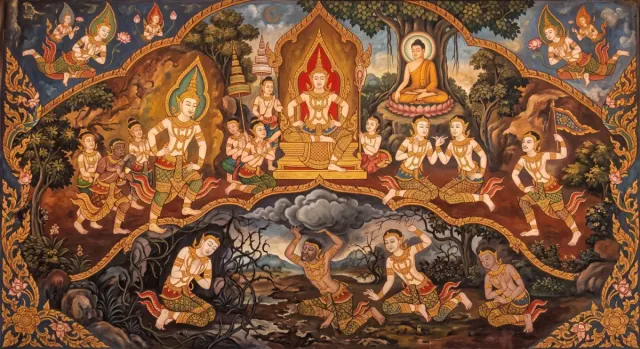
King Cetiya knows the truth but deliberately answers otherwise. A sage warns him again and again that if he sp…
Six things to give up before realising arahantship: conceit, the sense of being inferior, arrogance, overestim…

Life is short and no one knows when it will end. Everyone dies, like ripe fruit waiting to fall, like clay pot…