
Four Benefits Here and Now, Four Benefits Hereafter
Diṭṭhadhammikatthasaṃvattanikā · samparāyikatthasaṃvattanikāThe Buddha's answer for working people with families — work hard, protect what you earn, keep good friends, li…


Cammakkhandhakaṃ
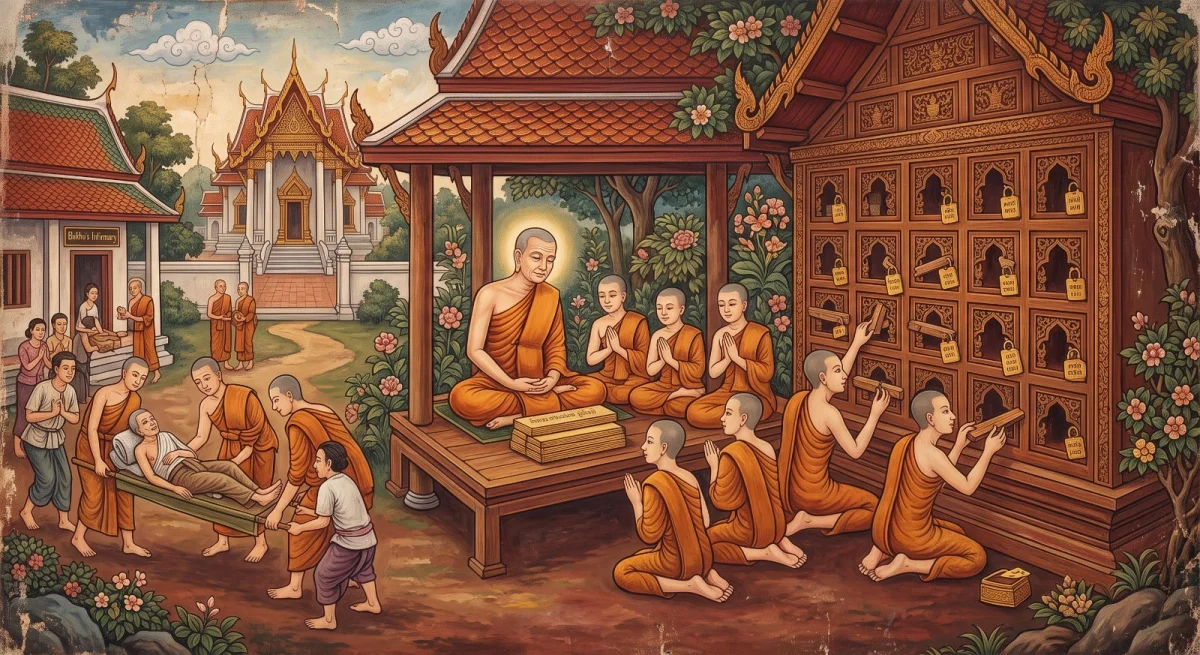
The rules on monks' sandals and leather goods. Every time the Buddha prohibited something, the group of six monks found a way around it — from brightly coloured sandals to wooden clogs, palm-leaf clogs and finally cowhide, until one monk got a lay follower to kill a calf for its skin. At the same time, whenever a monk was sick or in real hardship, the Buddha relaxed the rule.
In the Leather Chapter (Cammakkhandhaka) of the Mahāvagga in the Vinaya Piṭaka, after Soṇa Koḷivisa attained arahantship, the Buddha said he would allow him single-soled sandals, since Soṇa was delicately raised. Soṇa replied that he had given up some eighty cartloads of money and a troop of seven elephants to go forth; if he were now attached to single-soled sandals, people would talk. If the Buddha allowed them to the whole Saṅgha, he would use them. So the Buddha allowed single-soled sandals to all monks.
The rest of the chapter reads as two strands side by side. In one, the group of six monks looks for a way around every prohibition: when bright sandals are banned they use coloured straps; when wooden clogs are banned they have young palm trees cut for palm-leaf clogs; when large animal hides are banned they turn to cowhide, until one monk gets a lay follower to kill a calf for its skin. In the other, monks with cracked feet, monks who are ill, or monks who step on thorns in the dark receive an allowance each time a real need appears.
The reasons given for each rule are clear: some because people criticised the monks as being like householders who enjoy sensual pleasures, some because they harmed trees that people regarded as living, some because they led monks to neglect their studies, and the most serious because a monk encouraged killing. All of these are rules for monks; lay readers can read them for the thinking behind the rules.
The Buddha was going to allow single-soled sandals to Soṇa alone, but Soṇa asked that if they were allowed, they be allowed to the whole Saṅgha; otherwise he would not use them. The Buddha then allowed single-soled sandals to all monks and prohibited sandals of two, three or more layers.
When someone offers an exception just for you, ask what would happen if everyone in the same situation had it too. If it shouldn't be given to everyone, perhaps you shouldn't accept it alone.
The group of six wore sandals that were all blue, all yellow or all red, sandals with coloured straps, sandals with upturned points like ram's horns or scorpion tails, sandals sewn with peacock feathers, and sandals trimmed with lion, tiger or otter skin. Each time people criticised them as being like householders who enjoy sensual pleasures, and the Buddha prohibited each kind in turn.
Before buying a new personal item, ask whether you are buying it for use or to be looked at. Things that work well don't need to announce who you are.
A monk attending the Buddha on almsround was limping because his feet were cracked. A lay follower took off his own multi-layered sandals to offer them, but the monk refused because such sandals were prohibited. The Buddha told him he could accept them, and then allowed multi-layered sandals that had already been used; new multi-layered sandals remained prohibited.
Good second-hand things are both economical and add nothing new to the world. And when you see someone in difficulty right in front of you, offering what you already have is kindness enough.
The Buddha was walking up and down in the open without sandals, so the senior monks walked without sandals too, but the group of six walked in sandals. The Buddha said that even white-clothed householders respect the teachers from whom they learn a craft for their livelihood; monks who have gone forth in this Dhamma and Vinaya should respect their teachers and preceptors. He prohibited walking in sandals when one's teachers walk barefoot, and wearing sandals inside the monastery.
Respect shows in small things, such as not lounging while an elder is standing, or not using your phone while your teacher is speaking.
The group of six wore wooden clogs and walked in the open before dawn, clattering loudly, chattering about worldly matters, treading insects to death and disturbing other monks' concentration. When wooden clogs were banned, they had young palm trees cut to make palm-leaf clogs, and the cut palms withered. People criticised them for harming living things. The Buddha said that people regard trees as having life, and prohibited them. When palm leaf was banned they cut young bamboo instead, and another prohibition was needed.
If you find yourself looking for a slightly different word so you can keep doing the same thing, that is a sign you are evading the purpose of a rule, not following it.
The monks of Bhaddiya were busy making many kinds of clogs, making them themselves and having others make them, from grasses, reeds, leaves and wool, until they neglected recitation, questioning and training in higher virtue, higher mind and higher wisdom. The Buddha prohibited all clogs for walking, including those decorated with gold, silver and gems, allowing only three fixed kinds: for the privy, the urinal and the washing place.
A hobby that starts from a small need can gradually eat up time until it crowds out what matters. Count the hours this week and see whether more went into arranging your things than into learning.
When large hides were prohibited, the group of six turned to cowhide. One wicked monk visited a lay family he was close to and stared at their fine young calf. When the man asked why, he said he wanted its skin. The man killed the calf and gave him the skin, and the mother cow followed the monk out of love for her calf. The Buddha rebuked him, saying he had criticised killing in many ways, and prohibited monks from encouraging others to kill, from using cowhide, and from using any hide at all. Later he allowed monks to sit on householders' hide-covered beds and chairs, but not to lie on them.
Saying "I'd love one of those" to someone eager to please you can turn into an order without your noticing. Beware of wants that others pay for with a life or with hardship.
A monk fell ill on the road while going to see the Buddha. People invited him to ride in their vehicle, but he refused because monks were prohibited from travelling by vehicle. The Buddha then allowed vehicles for sick monks, and later, when a monk was badly shaken by a vehicle, a litter and a hammock. He also allowed monks with bruised or cracked feet or foot ailments to wear sandals; allowed sandals, torches, lamps and walking sticks within the monastery at night after monks trod on stumps and thorns in the dark; and allowed sick monks to wear sandals into the village.
When you are responsible for rules, keep asking whether anyone is suffering unnecessarily because of them. Relaxing a rule for the sick is not breaking it; it makes the rule serve people.
This chapter is a good case study in how sound rules grow. They are not written complete in a day; they are added one at a time when someone finds a loophole, and relaxed one at a time when someone is genuinely suffering. Anyone who sets rules at home, at school or at work will see that both directions matter equally.
The lesson for ourselves: when you catch yourself asking "but that isn't actually forbidden", ask next what the rule is for. Someone who keeps to the purpose of a rule doesn't need a prohibition for every gap.
For those who look after rules, this chapter warns against applying them so rigidly that the sick and the struggling are forgotten. The monk limping on cracked feet who refused sandals, and the sick monk who refused a ride, were not praised for strictness; the Buddha relaxed the rule for them.
Tap to read the actual passage on the page cited.
The Buddha's answer for working people with families — work hard, protect what you earn, keep good friends, li…
The Buddha asks Ānanda whether every observance, way of life and holy life that is properly kept up is fruitfu…

Plants and animals differ in marks according to species, but humans have no such marks. A person is a farmer, …
Eight verses of Mahākaccāna: not taking on more work than needed, the subtle dart of honour, no one is a thief…