
The Act of Censure: When Someone Keeps Stirring Up Quarrels
TajjanīyakammaṃThe followers of Paṇḍuka and Lohitaka stirred up strife and went round urging other monks to argue until they …



Vihāradānaṃ saṅghassa aggaṃ buddhehi vaṇṇitaṃ
A merchant of Rājagaha saw monks living in forests and at the roots of trees, with graceful deportment, and offered to build dwellings. The monks wouldn't promise before asking the Buddha, who allowed five kinds of lodging. The merchant built sixty dwellings in a single day and gave them to the Saṅgha of the four quarters.
The Senāsana Khandhaka (Chapter on Lodgings) of the Cullavagga, Vinaya Piṭaka, tells that at first the Buddha had not yet allowed lodgings. Monks lived here and there: in forests, at the roots of trees, on hills, in ravines, caves, charnel grounds, jungle thickets, the open air and on heaps of straw. Early in the morning they came out with graceful movements in going forward and back, looking ahead and aside, bending and stretching their arms, eyes lowered.
The merchant of Rājagaha, going to his park early, saw them and was inspired. He asked whether they would live in dwellings if he built them. The monks replied that the Blessed One had not allowed dwellings, so he asked them to find out. The Buddha allowed five kinds of lodging: a dwelling, a lean-to, a multi-storey building, a flat-roofed house and a cave. The merchant built sixty dwellings in a single day and, on the Buddha's advice, gave them to the Saṅgha of the four quarters, present and to come. The Buddha expressed appreciation with verses on the benefits of dwellings.
The chapter then describes improvements to the dwellings problem by problem, from doors and windows to beds, pillows, a fire hall and fences. It continues with Anāthapiṇḍika, the merchant's brother-in-law, who first heard of the Buddha at the merchant's house.
The monks came out of forests, tree roots and caves early in the morning, graceful in going forward and back, looking ahead and aside, bending and stretching their arms, eyes lowered, perfect in deportment. The merchant saw them and his mind was at once inspired.
Your composure when you think no one is looking — early in the morning where you stay, or in a lift — is the self others remember.
When the merchant asked whether they would live in dwellings he built, the monks answered plainly that the Blessed One had not allowed dwellings. He asked them to enquire and let him know, and they did.
When someone proposes something you have no authority to decide, say honestly that you must ask the person responsible first, and remember to get back to them with the answer.
The merchant built sixty dwellings in a single day and asked the Buddha what to do with them. The Buddha told him to establish them for the Saṅgha of the four quarters, present and to come.
When donating or building something for the public, think of the people who will use it in future, not only those you know today.
The verses of appreciation say that a dwelling wards off cold and heat, wild beasts, snakes and mosquitoes, rain, wind and fierce sun.
When helping the homeless or disaster victims, safe shelter is the foundation that makes other help possible.
The verses continue that giving a dwelling to the Saṅgha, for seclusion, for ease, for meditation and insight, is praised by the Buddhas as the foremost gift. The wise should build pleasant dwellings for learned monks to live in, and with a confident mind give food, drink, cloth and lodgings to the upright, for they teach the Dhamma that dispels all suffering.
Set aside a quiet corner at home or at work for reading, reflection or meditation. Such a space is worth far more than its size.
When dwellings had no doors and snakes, scorpions and centipedes moved in, the Buddha allowed doors and bolts. When there were no windows, the air was stale and it was bad for the eyes, so he allowed three kinds of window. When bats could still get in, he allowed shutters and blinds.
When your home has a problem, fix it at the point where it actually occurs, one thing at a time, without waiting to rebuild everything.
The group of six slept on high beds and people criticised them, so the Buddha forbade it. Later a monk sleeping on a low bed was bitten by a snake, and he allowed bed-leg supports. When some used supports that were too high, he set a limit of eight finger-breadths.
When setting a standard of simplicity, don't forget safety, and define clearly how much is enough.
The group of six used pillows half the length of the body. People touring the monastery saw and criticised them, and the Buddha forbade it and allowed pillows the size of the head.
Choose household items by the size you actually need; your home will feel roomier and be easier to keep.
What inspired the merchant was not a sermon but the monks' demeanour early in the morning, when no one was telling them to be composed. Quiet conduct in daily life communicates more than we think.
The monks didn't promise what they had no authority to decide, but asked the one who could decide and came back to report — a good model for working in any organisation.
Giving to the Saṅgha of the four quarters, present and to come, is giving that isn't tied to people we know but open to all who will use it in future, like donating to a school or hospital that later generations will use.
Tap to read the actual passage on the page cited.
The followers of Paṇḍuka and Lohitaka stirred up strife and went round urging other monks to argue until they …

Eight things that come round to everyone — gain and loss, status and disgrace, praise and blame, pleasure and …
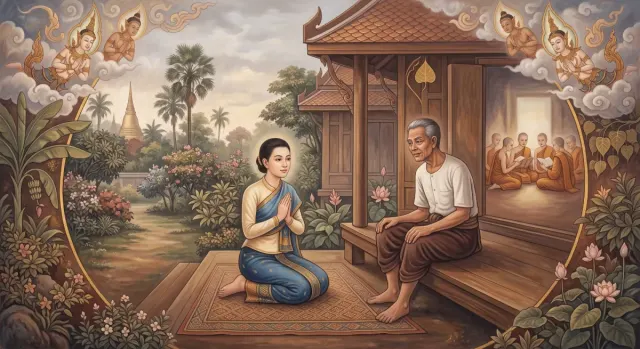
Her father asks Rohinī why she loves recluses who are lazy and live on others. Rohinī answers point by point: …
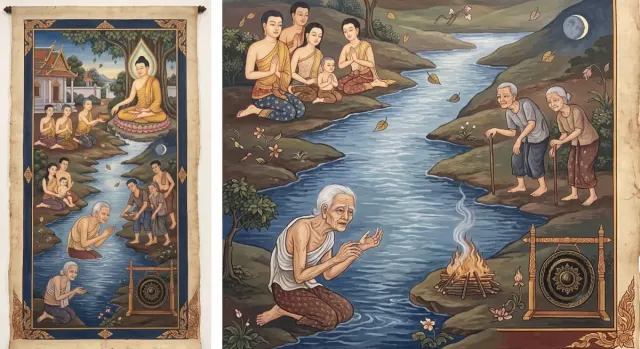
Life is short; most die before a hundred years. What we call "mine" is left behind at death, just as on waking…