
The Discourse to Vekhanassa: There Is Always a Brighter Light
VekhaṇasasuttaṃThe wanderer Vekhanassa exclaims "This is the supreme colour!" The Buddha compares lights from a firefly to th…


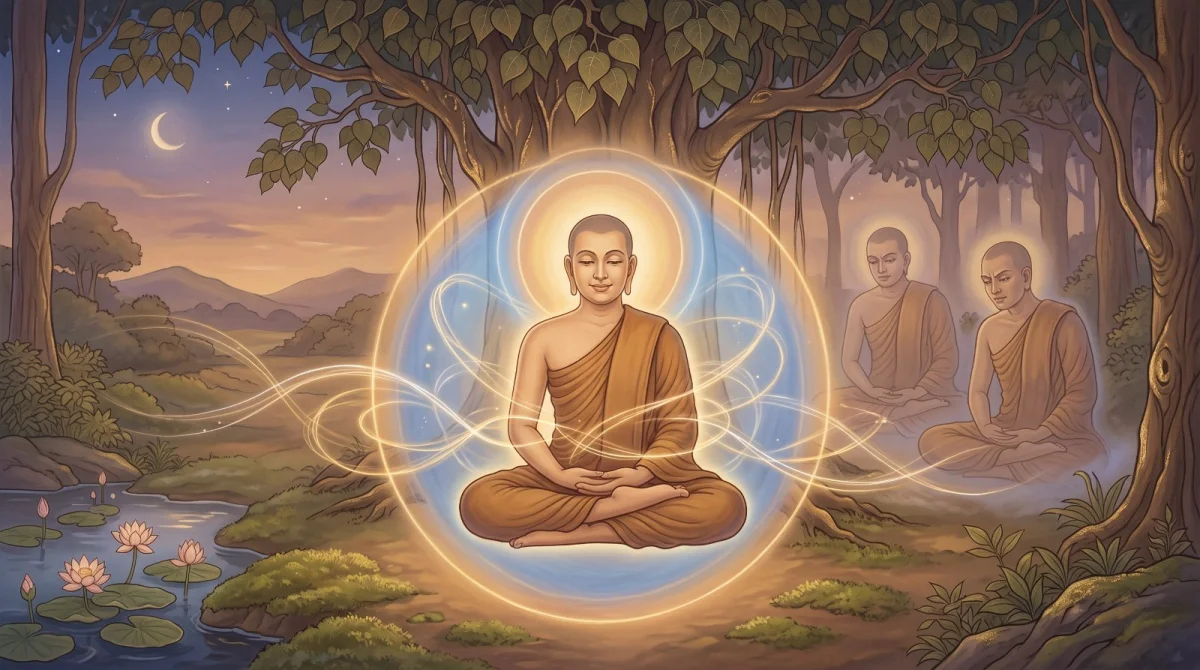
Samāpanno assādetikathā
A group of debates at the end of chapter 13 asks whether one in jhāna can relish that jhāna at the same moment, whether there is lust for the disagreeable, and whether craving for dhammas is neither unwholesome nor a cause of suffering. Each shows that clinging, even to something refined like jhāna or dhamma, is still craving.
In the Samāpanno Assādeti Kathā of the Kathāvatthu, Tipiṭaka volume 37, chapter 13, the opponent agrees that one in attainment relishes, and that the longing for jhāna (jhānanikanti) has that very jhāna as its object. The Theravādin asks: then is the jhāna the object of itself? Does one touch that contact with that same contact, and know that wisdom with that same wisdom? And can the longing, which is unwholesome, arise in the same mind as the jhāna, which is wholesome? The opponent quotes the discourse that a monk, having attained jhāna, relishes it, longs for it and finds satisfaction in it.
The next debate, on lust for the disagreeable, asks whether there is lust for what is unpleasant. The Theravādin points out that beings seek happiness, not suffering, and that the underlying tendency to lust lies in pleasant feeling while the underlying tendency to aversion lies in painful feeling. The opponent quotes the discourse that one caught in favouring and opposing delights in whatever feeling one feels, pleasant, painful or neutral.
At the end of the chapter come two debates on craving for dhammas. The opponent holds that craving for dhammas is indeterminate and not the origin of suffering. The Theravādin asks: craving for forms and sounds is unwholesome, so how could craving for dhammas differ, when the Blessed One said craving is unwholesome, is greed, and is the origin of suffering? The text does not explain in which sense the opponent means dhamma.
The Theravādin asks: if the longing for jhāna has that jhāna as its object at the same moment, is that jhāna the object of itself, like touching contact with that contact, feeling feeling with that feeling, drinking rapture with that rapture, knowing wisdom with that wisdom? The opponent cannot agree. This point is for overall understanding.
Notice that while the mind is truly absorbed in the breath, there is no room to think "this is lovely". That thought always comes afterwards, and when it comes, the mind has already left the breath.
The opponent agrees that the longing for jhāna is unwholesome while jhāna is wholesome. So the Theravādin asks: if both arise together, is it a meeting of two minds, with wholesome and unwholesome, dark and bright states coming together? That contradicts the discourse that the Dhamma of the good is as far from that of the bad as sky from earth.
Calm and clinging to calm are different things. When meditation feels good, know that good feeling as it is, but don't set a target of getting the same feeling every time.
The opponent quotes the discourse that a monk secluded from sensual pleasures attains the first jhāna, and so on up to the fourth, and relishes it, longs for it and finds satisfaction in it. The Theravādin accepts that the discourse exists. A reading consistent with the earlier questions is that the relishing really occurs, but at a different moment from the jhāna, taking the jhāna that has passed as its object.
After doing something good, like meditating or helping someone, the mind often looks back with pleasure. Notice whether, if you linger, it starts turning into wanting more or into pride.
The opponent holds that there is lust for what is disagreeable. The Theravādin asks: are there beings who long for, seek and cling to suffering? This cannot be accepted. Beings seek happiness; the underlying tendency to lust lies in pleasant feeling and the underlying tendency to aversion in painful feeling, not the other way round.
When you feel you "like" dwelling on something painful, ask what you are really holding on to: the pain itself, or something that comes with it, such as feeling in the right, or simple familiarity.
The opponent quotes the discourse that one caught in favouring and opposing, whatever feeling one feels, pleasant, painful or neither, delights in it, welcomes it and remains holding to it. The Theravādin accepts that the discourse exists. The text closes the debate with the opponent's argument.
Going over a painful story again and again is also a kind of holding on. If you notice you are telling the same story for the tenth time, pause and ask whether telling it helps solve anything, or just keeps you circling.
The opponent holds that craving for dhammas is indeterminate, neither wholesome nor unwholesome. The Theravādin asks: craving for forms, sounds, smells, tastes and touches is unwholesome, so how could craving for dhammas differ, when the Blessed One said craving is unwholesome and craving for dhammas is greed? The opponent replies that because it is craving for Dhamma, it must be indeterminate.
Wanting spiritual experiences, wanting to know more than others, or wanting to be seen as good is craving in fine clothes. Notice whether it makes you impatient or makes you compare yourself with others.
In the last debate of the chapter, the opponent holds that craving for dhammas is not the origin of suffering. The Theravādin asks with the same structure: craving for forms is the origin of suffering, the Blessed One said greed is the origin of suffering, and craving for dhammas is greed, so how could it not be the origin of suffering?
If Dhamma practice makes you tense, argumentative about views, or disappointed when you don't get the result you want, that is a sign craving has slipped into something that looks good. Return to tending the causes well and let go of the results.
This debate is a mirror for meditators who have begun to find calm. Calm is good, but wanting yesterday's calm again, or being irritated that today is not calm, is another state arising at a different moment. Once these are told apart, it becomes clear that what blocks meditation is not calm but clinging to calm.
The debate on craving for dhammas warns of the same thing at another level. Feeling that "I know more Dhamma", or clinging to teachings until we quarrel with others, is still a kind of wanting and grasping, however refined its object looks.
Seeing our own clinging need not be followed by self-blame. Simply knowing that it has arisen and knowing it as craving is already meditation.
Tap to read the actual passage on the page cited.
The wanderer Vekhanassa exclaims "This is the supreme colour!" The Buddha compares lights from a firefly to th…

The past life of Venerable Rāhula in the Apadāna: bedding that shone like a mirror, offered to the Buddha Padu…
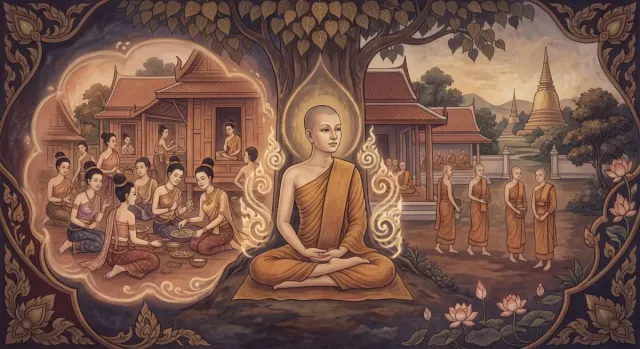
Rules from the Cittāgāra chapter: going to see picture halls and pleasure grounds, using oversized seats, spin…
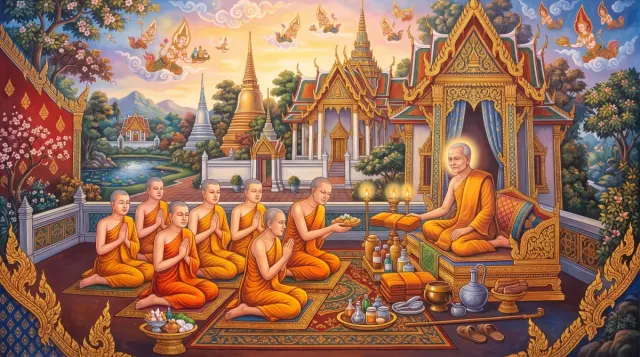
A gatekeeper in Haṃsavatī wanted to give what no one had given before. He did not choose the most expensive th…