
Sakka's Questions: Why Everyone Wants to Live Without Enmity, Yet Still Holds Grudges
SakkapañhasuttaṃSakka asks why gods and humans wish to live without enmity yet remain hostile. The Buddha answers: because of …



Ñāṇavibhaṅgo
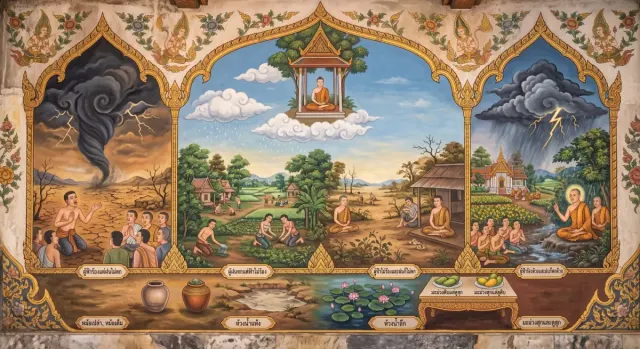
The closing section of the sixteenth Vibhaṅga runs through ten knowledges that belong to a Buddha — from knowing what is possible and impossible, to knowing why identical deeds do not ripen identically, to knowing the destruction of the taints.
In the Ñāṇavibhaṅga, the sixteenth chapter of the Vibhaṅga of the Abhidhamma Piṭaka, the bases of knowledge are gathered into groups, from groups of one up to groups of ten. The group of ten, the Dasakaniddesa, consists of the ten knowledges commonly called the ten powers.
These ten are explicitly said to be the Tathāgata's; they are not set out as a goal for ordinary practitioners to reach. Each one closes with the same formula: wisdom, the act of understanding clearly, non-delusion, investigation of states, right view, with regard to that matter.
Even so, the material used to explain them concerns things people meet every day: why those who resemble each other end up together, why some people are easy to instruct and others hard, and why certain deeds have not yet borne fruit.
Several examples are given. It is impossible that one accomplished in the view of the path should take any formation as permanent or as pleasant, while for an ordinary person it is possible. It is impossible that bodily misconduct should produce a wished-for, agreeable result. The summary is: whatever states are cause and condition for the arising of other states, that is possible; whatever are not, that is impossible.
Before pinning hopes on something, ask whether the causes you have set in place can actually lead to that result. If not, change the causes rather than adding more hope.
Some bad deeds do not ripen because they are obstructed by a favourable destination, a favourable constitution, a favourable time or favourable effort; some ripen because of an unfavourable destination, constitution, time or effort. Good deeds are described in the reverse way.
When someone acts badly and still seems fine, understand that surrounding conditions are holding the result off — not that cause and effect have failed. And do not take it as a model.
The Tathāgata knows: this is the way, this is the path leading to hell; leading to the animal realm; leading to the realm of ghosts; leading to the human world; leading to the deva world; and this is the way leading to nibbāna.
Every choice has a destination. Ask where you would end up after ten more years of the present course. The answer is usually clearer than we would like.
The explanation is brief: he knows the diversity of the aggregates, the diversity of the sense bases and the diversity of the elements, and is therefore said to know the world as of many elements and various elements. This point is for overall understanding.
Human difference is not a fault in the system. Accepting that people are assembled from different mixtures lowers the expectation that everyone be like you.
Beings of low disposition associate with and draw close to beings of low disposition; beings of refined disposition do the same with the refined. This is said of the past, the future and the present alike.
If you want to know which way you are heading, notice whose company feels most comfortable lately. Your circle is an honest mirror.
Beings are sorted into pairs: those with dull faculties and those with keen faculties, those of poor bearing and those of good bearing, those hard to instruct and those easy to instruct, those incapable and those capable — the incapable being described as obstructed by deeds, by defilements or by results, without faith, without desire, of poor understanding.
When teaching or explaining, pitch it to the listener rather than repeating the same script and blaming them for not following.
Meditators are sorted into several sets of four. Some enter concentration slowly and emerge quickly, some enter quickly and emerge slowly; some are skilled in concentration but not in attainment. Defilement is explained as states on the side of decline, and cleansing as states on the side of distinction.
Different aptitudes are not a fault. Some settle quickly but come out with difficulty, others the reverse. Know your own pattern and design your sitting time around it.
The last three are: recollection of past lives with their aspects and details; seeing with the divine eye beings passing away and reappearing and knowing that beings fare according to their deeds; and knowing the destruction of the taints as it truly is. This point is for overall understanding.
The second of these restates something you can check in this life: people go according to what they actually do, not according to what they wish or are wished.
Read as qualities of a Buddha, several of these still give frameworks you can use at once. The second knowledge says a deed may not yet ripen because it is blocked by destination, by the person's constitution, by time, or by effort. That saves you from concluding too quickly that good conduct went unrewarded.
The fifth and sixth carry warnings about company and about teaching. People of like disposition gather together; and people differ in how mature their faculties are, so the same approach will not work for everyone.
A caution: this is not a tool for deciding who is capable and who is hopeless. The text says knowing this as it truly is belongs to the Tathāgata. What we can do is look after our own faculties and keep giving others the chance.
Tap to read the actual passage on the page cited.
Sakka asks why gods and humans wish to live without enmity yet remain hostile. The Buddha answers: because of …
Some people talk but don't act; some look fine but are empty inside — a set of similes from the Book of Fours …

Four things rarely obtained — human birth, staying alive, hearing the true Dhamma, and the arising of a Buddha…

A newly ordained monk of no reputation lay gravely ill in a certain dwelling. A fellow monk asked the Buddha t…