
The Analysis of the Sense Bases: Twelve Doors the World Comes Through
ĀyatanavibhaṅgoThe second Vibhaṅga analyses the twelve sense bases three times over: a single short paragraph saying all of t…


Jhānavibhaṅgo
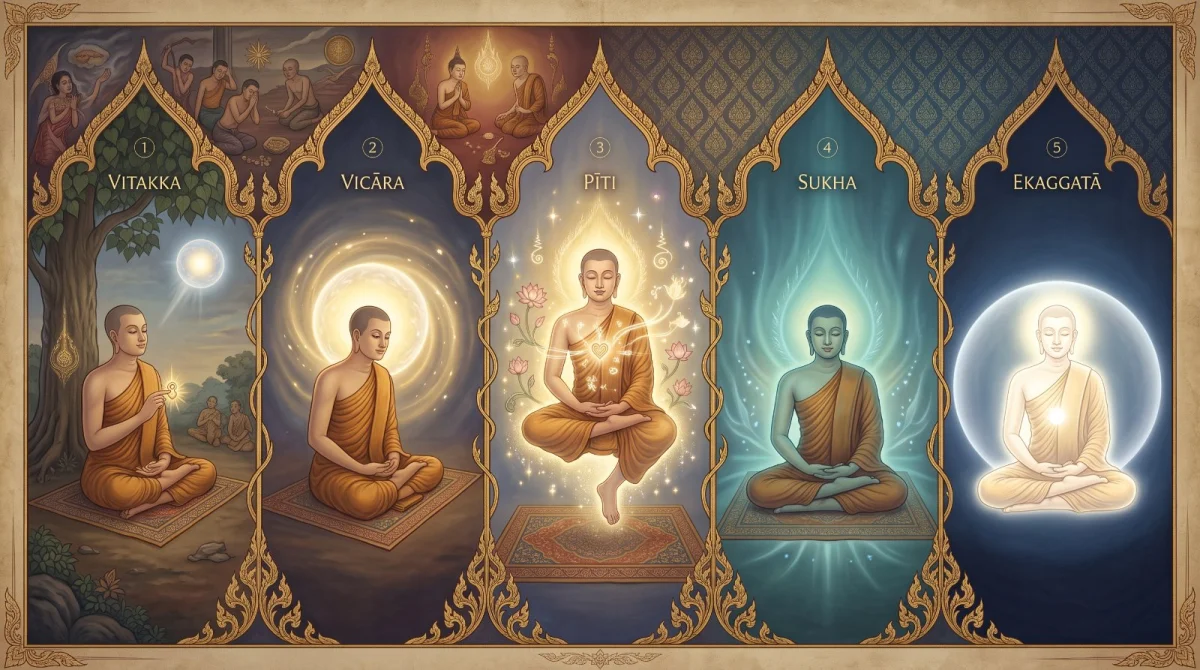
The Sutta section of the Analysis of Jhāna explains the familiar jhāna formula one word at a time: what sensuality must be secluded from, how applied and sustained thought, rapture and happiness differ, why inner clarity is faith, which components the word jhāna names, and which perceptions the formless stages go beyond.
In the Jhāna-vibhaṅga, the twelfth analysis of the Vibhaṅga in the Abhidhamma Piṭaka, the Sutta section (Suttanta-bhājanīya) takes the jhāna formula found throughout the suttas — secluded from sensual pleasures, secluded from unwholesome states, one enters the first jhāna, with applied and sustained thought, with rapture and happiness born of seclusion — and explains it word by word.
The method is to ask what a thing is and answer with a cluster of near-synonyms: rapture is gladness, joy, delight, elation. Then it says that the practitioner possesses it, or that it has subsided. Read this way, you can see what is added and what drops away at each stage.
The preceding part of the same analysis covers preparation for jhāna, from virtue to abandoning the hindrances. This page continues from there with the formula for the four jhānas and the formless stages.
Sensual pleasures here, the text explains, are desire, lust, desire-and-lust, intention, and lust bound up with intention. The unwholesome states to be secluded from are the five hindrances: sensual desire, ill will, sloth-and-torpor, restlessness-and-remorse and doubt. Sensuality means wanting in the mind, not objects themselves.
Before meditating or doing work that needs focus, you need not flee everything; first set down the wanting and irritation lingering in the mind.
Applied thought (vitakka) is thinking, intention, directing the mind onto the object, and the text includes right intention within it. Sustained thought (vicāra) is examining, continued attention, the mind staying connected with the object and repeatedly regarding it. In the second jhāna both subside.
When doing detailed work, notice the mind's two rhythms: picking the topic up, and staying with it. If you keep slipping off, train the staying rhythm longer.
Rapture is gladness, joy, delight, merriment, elation. Happiness is mental ease, the pleasant feeling born of mental contact. In the early jhānas this happiness is conjoined and associated with rapture; by the third jhāna rapture fades but happiness remains.
After good news, notice whether, once the excitement fades, a quiet ease remains. That kind of ease usually lasts longer.
In the second-jhāna phrase inner clarity, the text explains that clarity as faith, believing, deep confidence; and unification of mind as the stability of mind, that is, right concentration.
Confidence in what you are doing helps the mind settle. If you act while hesitating all the time, the mind will not gather; first get clear why you are doing it.
When it reaches the word jhāna, the text answers with a list: the first jhāna is applied thought, sustained thought, rapture, happiness and one-pointedness; the second is clarity, rapture, happiness and one-pointedness; the third is equanimity, mindfulness, clear comprehension, happiness and one-pointedness; the fourth is equanimity, mindfulness and one-pointedness. This point is for overall understanding.
Jhāna is not a mysterious place but a countable set of mental states. In practice, notice the states actually present instead of chasing special experiences.
In the third jhāna, equanimity is looking on, neutrality of mind; mindfulness is recollection; clear comprehension is wisdom, non-delusion. In experiencing happiness with the body, the text says the body here is the perception, formations and consciousness aggregates — the mental body, not the physical one. The noble ones who praise this jhāna are the Buddhas and their disciples.
Neutral happiness guided by mindfulness does not make the mind drift. Notice times of ease with clear awareness and remember that feeling as a reference point.
The text specifies that the pleasure and pain abandoned in the fourth jhāna are bodily, while the joy and grief that ceased earlier are mental. What remains is neither-painful-nor-pleasant feeling, and mindfulness that is open, pure and clear because of equanimity.
Separate bodily pain from the mental distress that follows. Sometimes we can ease the distress even while the pain remains.
The formless formulas are explained too. Perception of form is the perception of those in fine-material attainment; sensory-impact perception is perception of sights, sounds, smells, tastes and touches; perception of diversity is that of one not in attainment; and space is the gap untouched by the four great elements, into which the practitioner extends the mind as boundless. This point is for overall understanding.
In daily life the mind is pulled by countless perceptions. Resting briefly with openness, such as looking at a clear sky, lets it rest from that variety.
Even without training to jhāna, these explanations help you know your own states of mind more finely. For example, excited delight (pīti) and ease (sukha) are not the same, and deeper ease often comes when excitement settles.
Also, the text counts right intention as part of applied thought and calls inner clarity faith. So thinking in the right direction and confidence in what you are doing are part of concentration, not its enemies.
Anyone who wants to train in jhāna should have an experienced teacher. Reading definitions aids understanding but is not a yardstick for judging whether you have attained jhāna.
Tap to read the actual passage on the page cited.
The second Vibhaṅga analyses the twelve sense bases three times over: a single short paragraph saying all of t…

Four things people wish for but rarely gain, the four qualities that lead to them, the fitting uses of wealth,…

The association condition covers mental states so bound together that they cannot be separated. The dissociati…
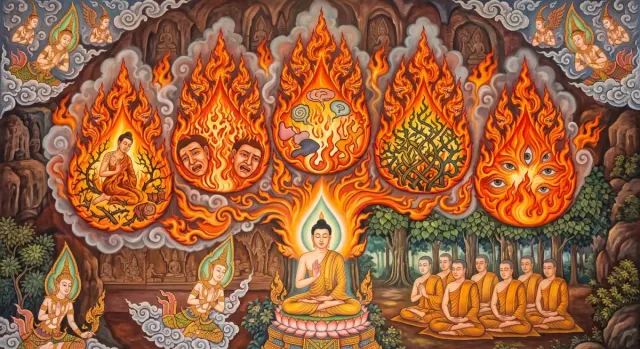
The five aggregates are burning embers. Seeing this, one grows disenchanted, dispassionate and liberated. At t…