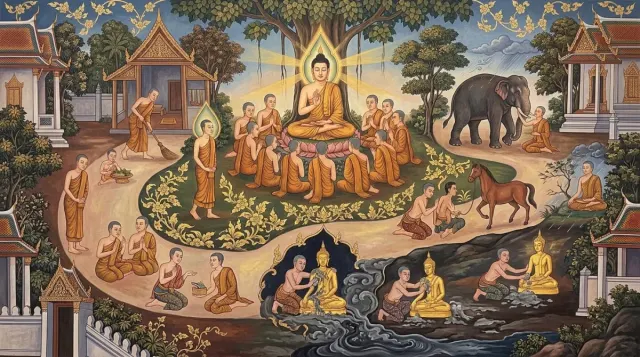
The Discourse on Effacement
SallekhasuttaṃJhāna is only pleasant abiding here and now, not yet effacement of defilements. True effacement is resolving, …


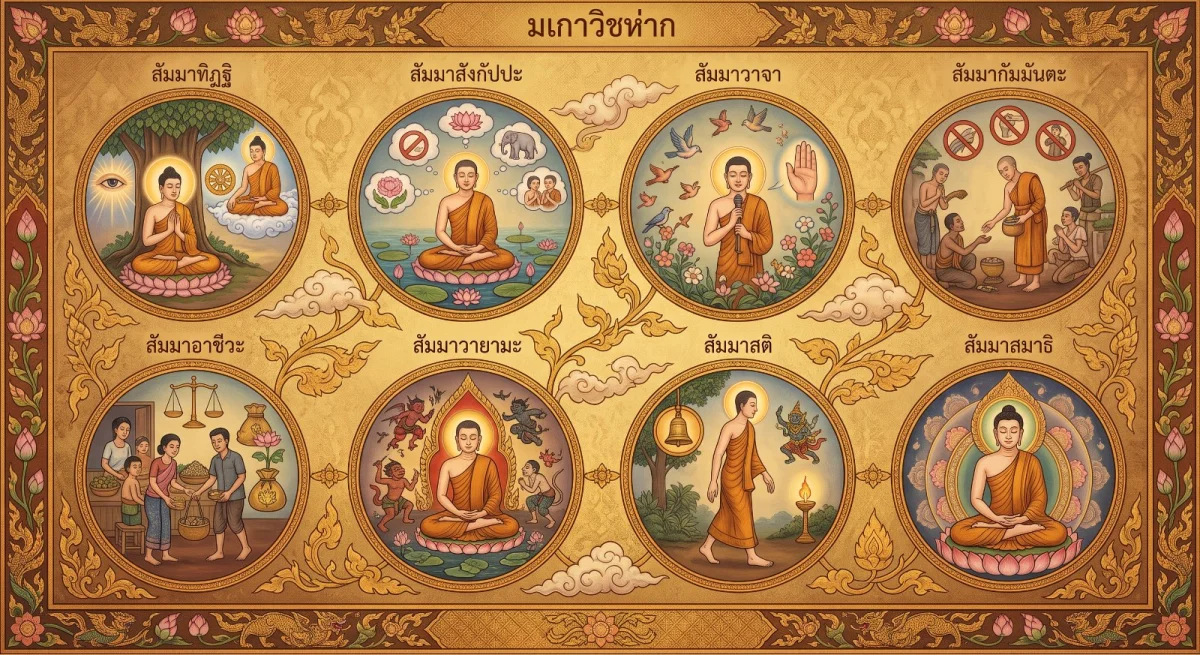
Maggavibhaṅgo
The eleventh Vibhaṅga gives short, direct definitions of all eight path factors, then a second method that says to develop the path dependent on seclusion, dispassion and cessation, before an Abhidhamma round that reduces the path to five factors.
In the Maggavibhaṅga, the eleventh chapter of the Vibhaṅga of the Abhidhamma Piṭaka, the noble eightfold path is set out and each factor is answered with the same question: what is this factor? The answers are short definitions matching those found in the suttas.
A second method follows. It does not define what each factor is but how to develop it: develop right view and the rest dependent on seclusion, dependent on dispassion, dependent on cessation, ripening in letting go.
Then comes the Abhidhamma section, which speaks of the moment when the mind is supramundane. It is divided into a section on the eight-factored path and a section on the five-factored path. This page reports only what this chapter says; the path as a whole is covered on another page.
The answer is very short: knowledge of suffering, knowledge of the origin of suffering, knowledge of the cessation of suffering, knowledge of the way leading to the cessation of suffering. Nothing further is added.
When facing a problem, run through those four boxes as a form: what is the problem, what causes it, what would it look like resolved, and what must be done to resolve it.
The intention of renunciation, the intention of non-ill-will, and the intention of non-cruelty. These concern the direction of thinking rather than its content.
Before sending a message written while angry, ask whether it comes out of a wish to get even. If so, keep it overnight.
Right speech is abstaining from false speech, divisive speech, harsh speech and idle chatter. Right action is abstaining from killing, from taking what is not given, and from sexual misconduct. Both are defined by what is not done rather than by what is done.
Set a measurable daily aim, such as: today I will not speak about anyone in a way that pushes two people apart. One item like that changes the tone of a whole conversation.
The definition runs: a noble disciple, having abandoned wrong livelihood, makes a living by right livelihood. The emphasis falls on abandoning what is wrong first; right livelihood then follows.
If you know there is a part of your job that requires misleading customers or hiding key information, start by dropping that part. You do not have to change the whole job first.
One set of words is repeated four times: one arouses desire, endeavours, arouses energy, exerts the mind and strives — to prevent unarisen unwholesome states, to abandon arisen ones, to arouse unarisen wholesome states, and to maintain and bring to fullness those already arisen.
"Exerts the mind" matters more than it sounds. Sustainable effort is not squeezing yourself; it is steadily holding the mind up so it neither sinks nor scatters.
Right mindfulness is defined by the four establishments of mindfulness in full: contemplating body in the body, feelings in feelings, mind in mind, and phenomena in phenomena — ardent, clearly comprehending, mindful, having removed covetousness and displeasure in regard to the world. Right concentration is defined by the four jhānas.
Notice that "ardent" always accompanies mindfulness here. Developing mindfulness is not letting yourself drift; there is a supporting effort in it.
The second method does not say what each factor is. It says to develop right view through to right concentration dependent on seclusion, dependent on dispassion, dependent on cessation, ripening in letting go.
Use it as a test of your own practice. If it leaves you clinging more, or showing off more, it is not yet heading the way described.
The Abhidhamma section speaks of the moment of developing supramundane jhāna, and divides into a section counting eight path factors and a section counting only five: right view, right intention, right effort, right mindfulness and right concentration — the three factors of virtue not being counted in that moment. This point is for overall understanding.
This does not make virtue unimportant. It means that in any single moment of mind, not every factor is actually at work.
What this chapter gives is precision. Many people use "right view" loosely to mean positive thinking, but the Vibhaṅga defines it flatly as knowledge of suffering, of its origin, of its cessation, and of the way leading to its cessation.
Right intention is equally checkable: the intention of renunciation, of non-ill-will, and of non-cruelty. Before speaking or acting you can hold those three up against your own thinking.
The second method suits people who have practised a long time and feel stuck. "Ripening in letting go" is a compass: practice on the right track should leave you holding less, not accumulating more.
Tap to read the actual passage on the page cited.
Jhāna is only pleasant abiding here and now, not yet effacement of defilements. True effacement is resolving, …
Mahāpajāpatī Gotamī asked that women be allowed to go forth and was refused. She shaved her head, put on ochre…

Short Dhamma riddles between devas and the Buddha: what stays good until old age, who is a friend at home and …

As a Bodhisatta, the Buddha divided his thoughts into two classes — sensual desire, ill will and cruelty on on…