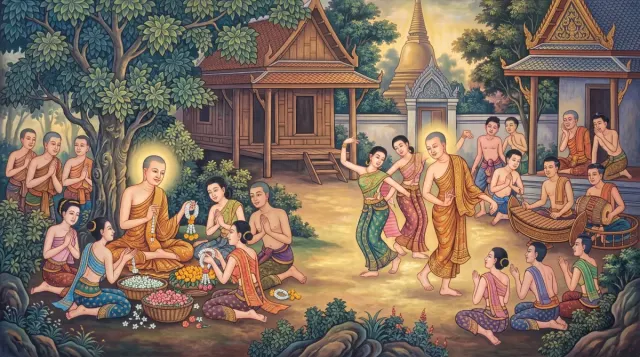
The Monks Led by Assaji and Punabbasuka: Currying Favour Until Faith Collapsed
Kuladūsako pāpasamācāroResident monks at Kīṭāgiri grow flowers, make garlands for women of local families and behave improperly in ma…


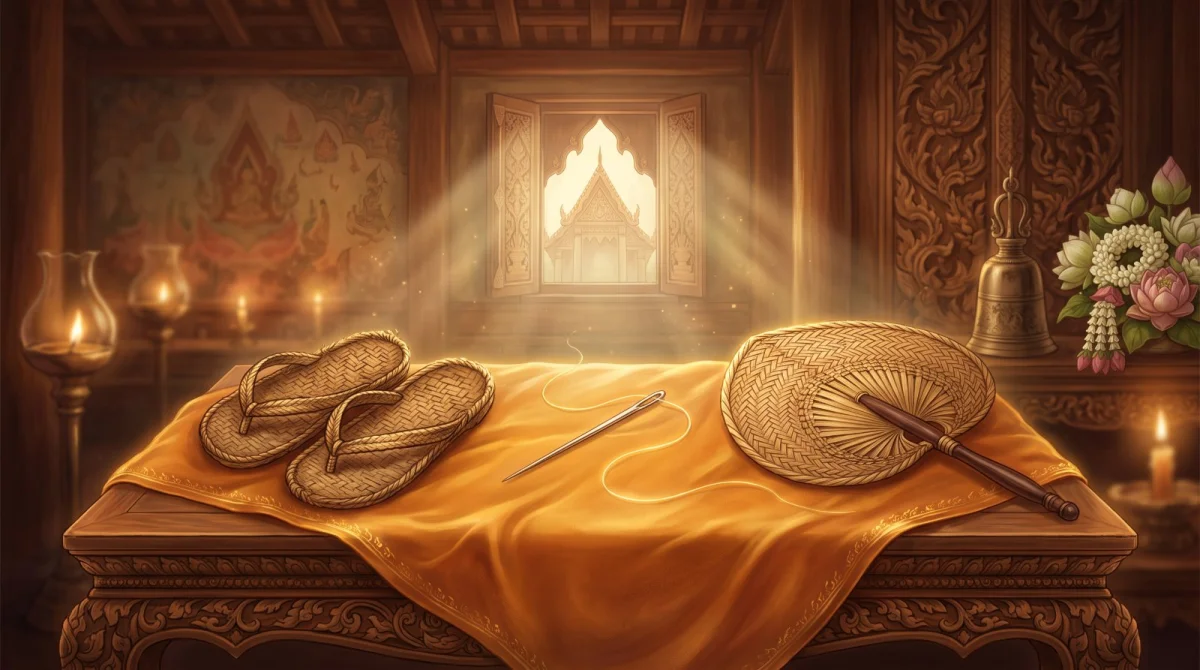
Gimhaṃ nibbāpanatthāya
Apadānas of people who gave small everyday things that met a real need: needles for sewing robes, a clay bowl a potter made himself, sandals taken off his own feet on seeing the Buddha walking barefoot, a palm-leaf fan in the hot season, and a pillow offered with both hands.
In the Apadāna of the Khuddaka Nikāya most offerings are flowers, fruit and lamps. But one group of elders' verses tells of ordinary utensils: a needle, a bowl, sandals, a fan and a pillow. Some say clearly what the gift was for — needles for sewing robes, a fan to relieve the heat of the hot season, which gives this page its title.
This page reads from the Nāgasamāla Vagga (8th), Sudhā Vagga (10th), Hatthi Vagga (22nd), Suvaṇṇabibbohana Vagga (28th), Naḷamāli Vagga (48th) and Kaṇikāra Vagga (51st). Some of the speakers were craftsmen who gave something from their own trade.
Some verses describe the results this way: the giver of sandals enjoyed divine vehicles, the giver of a bowl ate from dishes of gold and silver. This is the idiom of praise in this collection; it should not be read backwards to mean that people who lack things today are people who never gave. What is worth taking is the giver's eye, which could see what the other person was missing.
Sūcidāyaka Thera (Nāgasamāla Vagga, 8th) says he gave five needles to the Buddha Sumedha, for sewing robes. The verse links the needles with wisdom in an interesting way: through that gift of needles, knowledge that sees subtle meanings — sharp, quick and easy — arose in him. This is the verse's imagery, not a claim that needles make you clever.
Small things that let others mend their own belongings — a sewing kit, a screwdriver, a first-aid kit — are gifts that last longer than things used up at once.
Another Sūcidāyaka Thera (Sudhā Vagga, 10th) says he was a goldsmith in the city of Bandhumā and gave a needle to the Buddha Vipassī. The verse compares his knowledge to a diamond — the same kind of image as in the previous story, where something sharp is compared to sharp wisdom. A goldsmith who made precious things for a living chose to give a small thing of real use.
People who work with expensive things don't always need to give expensive things. Ask what the other person will use every day, and give that.
Ekapattadāyaka Thera (Kaṇikāra Vagga, 51st) was a potter in the city of Haṃsavatī. He saw the Buddha, free of the dust of defilement, and offered a well-made clay bowl. The verse compares it to a small seed sown in a good field when the rain falls in due season. The potter didn't go and buy something to give; he gave something from his own craft and made it as well as he could.
If you have a skill, give the work of that skill rather than buying something ready-made — and do it as well as you would for a paying customer.
Pānadhidāyaka Thera (Naḷamāli Vagga, 48th) had put on well-made sandals and set out on a journey when he saw the Blessed One Anomadassī walking barefoot on the road. He made his mind confident, took off his sandals, placed them at the Buddha's feet and invited him to put them on. The Buddha did so and said that this man had given him sandals with his own two hands, with a confident mind. In the Hatthi Vagga (22nd) there is another Pānadhidāyaka Thera who gave sandals to the Blessed One meditating in the forest.
Notice people who lack what you are holding right now — an umbrella on a rainy day, a jacket in a freezing air-conditioned room. The thing you can give immediately is the thing you are using there and then.
Tālavaṇṭadāyaka Thera (Hatthi Vagga, 22nd) gave a palm-leaf fan to the Buddha Tissa to relieve the heat of the hot season and allay its fever. The verse continues with an image: he fully extinguished the fire of lust, the fire of hatred and the fire of delusion, hotter than that heat. A small gift for cooling off is set beside the quenching of the fires within.
Turn on a fan, hand over cold water, or invite someone standing in the sun into the shade. In fierce heat, helping someone cool down is one of the gifts that most exactly meets a need.
Suvaṇṇabibbohaniya Thera (Suvaṇṇabibbohana Vagga, 28th) says briefly that with a confident mind he offered a seat and gave a pillow with both his own hands. The phrase "with my own two hands" appears in many apadānas, including the sandals story above. The verses care not only about what was given but how it was given.
When handing something to an elder or a guest, use both hands and put it into their hands rather than leaving it on the table. The manner of giving shows respect as much as the thing itself.
The most useful gift is usually not the most expensive one, but the one that meets the need of the moment. Someone walking barefoot needs sandals; someone sitting in the sun needs a fan. Before giving anything, look or ask what the person actually lacks.
The stories of the goldsmith and the potter show that the skill we have is what we can give best. A repairer gives repairs, a cook gives food, someone who writes well helps draft a document for someone who can't.
And the story of the sandals reminds us that sometimes the most fitting gift is to give up the very thing we are using — offering the chair you are sitting on to someone who can't stand any longer.
Tap to read the actual passage on the page cited.
Resident monks at Kīṭāgiri grow flowers, make garlands for women of local families and behave improperly in ma…

An elephant who looks after his blind mother is captured to be a royal elephant, but will not take food becaus…
At the end of the Chapter on Medicines, monks were unsure what the Buddha had allowed and what he had not, so …

Exchanging robes and then snatching one back, blocking the community's robe distribution to wait for one's own…