
Designation of Persons: Seven Kinds Who Travel Differently to the Same Place
EkakaniddesoThe section on single persons sorts noble individuals by two criteria: whether they touch the eight liberation…



Phalaṃ sammajjanāyidaṃ
Apadānas of elders who gave no object at all, only labour: sweeping a Bodhi tree courtyard, clearing fallen leaves, loosening soil, fanning a seat, treading a massage, building a latrine, and cutting bamboo staffs for the Saṅgha.
In the Apadāna of the Khuddaka Nikāya there is a group of elders' verses that tell of no gift, only of work done. Their names are usually taken from the work itself: Sakiṃsammajjaka means "he who swept once", Bodhisammajjaka means "he who swept the Bodhi courtyard", and Jagatidāyaka means "he who gave the levelled ground".
This page reads three chapters not covered elsewhere on the site — the Sakiṃsammajjaka Vagga (43rd), the Jagatidāyaka Vagga (46th) and the Tiṇadāyaka Vagga (53rd) — together with one story from the Bhaddāli Vagga (42nd). These verses are very short, some under ten lines, and they repeat the same closing: this is the fruit of sweeping, or this is the fruit of the ground.
What the verses emphasise is not the value of the work but the state of mind while doing it. The recurring phrases are "made the mind confident" and "with a joyful heart". The lavishly described results — rebirth as a deity or a wheel-turning monarch — are the idiom of praise used throughout this collection, not a bargain struck.
Sakiṃsammajjaka Thera (Sakiṃsammajjaka Vagga, 43rd) saw the Bodhi tree of the Buddha Vipassī, made his mind confident, took a broom and swept the courtyard, then paid respect and set off home. The verse says he died on the way, crushed by a python, and that the deed done near the time of death gladdened him with its fruit. The refrain repeated many times is: this is the fruit of sweeping.
Five minutes of cleaning still counts. You don't have to wait for a day when you have hours free to help with communal work.
Bodhisammajjaka Thera (Tiṇadāyaka Vagga, 53rd) says his work was to gather up the Bodhi leaves left lying in the shrine courtyard and take them away. The verse lists twenty qualities he received — health, freedom from enemies, freedom from want — and closes each time with: this is the result of removing the Bodhi leaves. The task that looks least important gets one of the longest descriptions in the chapter.
Pick up one piece of litter that isn't yours as you pass. No one thanks you and no one sees, which is exactly what makes it good training.
Jagatidāyaka Thera (Jagatidāyaka Vagga, 46th), with a confident and joyful mind, had the soil loosened at the Bodhi tree of the great sage Dhammadassī. The verse repeats: this is the fruit of the ground. Here he did not do the work himself but arranged for it to happen, and the text counts that as his deed all the same.
If you can't do the work yourself, paying for it, organising people or coordinating so that communal work happens is still your share.
Sīhāsanabījaniya Thera (Jagatidāyaka Vagga, 46th) paid respect at the Bodhi tree of the Buddha Tissa and then took a fan and fanned the seat there. The verse runs only a few lines and ends: this is the fruit of fanning. All he did was make that spot more bearable to sit in.
Turn the fan towards whoever is hotter than you; shift the umbrella so it covers someone else too. Small acts the doer rarely counts as giving.
Akkamanadāyaka Thera (Jagatidāyaka Vagga, 46th) says he offered a treading massage to the Buddha Kakusandha as he was walking to his midday rest, and closes: this is the fruit of the treading offered. It is a gift requiring no object at all, only the giver's time and strength.
Rub your parents' shoulders for five minutes, or carry something heavy for someone who can't. Your own body is something you can give any day.
Veccakadāyaka Thera (Tiṇadāyaka Vagga, 53rd) says that with a confident mind he gave a latrine to the Buddha Vipassī with his own hands. The verse makes no attempt to dignify this; it simply records it alongside offerings of flowers and lamps, on equal terms.
Take on the job nobody wants — cleaning the shared bathroom, emptying the bins — at least once. It is the work that genuinely cannot be skipped.
Daṇḍadāyaka Thera (Tiṇadāyaka Vagga, 53rd) went into the great forest, cut bamboo, made it into walking staffs and offered them to the Saṅgha, then bowed to those of good conduct with that same confident mind. What he gave was something genuinely needed, together with the labour that made it.
Fix what's broken at work or at the temple without waiting to be asked. It meets the actual need better than buying something new.
Bhaddāli Thera (Bhaddāli Vagga, 42nd) says the Buddha Sumedha sat cross-legged in the forest for seven nights and days. Carrying his load into the forest, he came upon him, took up a broom and swept the hermitage, planted four poles to make a pavilion and roofed it with sāl flowers. Two tasks in sequence: first clean, then build.
Before hosting anything or welcoming anyone, tidying the place is part of the welcome, not a separate chore.
Many people feel they cannot make merit because they have no money. This group of apadānas answers that directly: work that is nothing but effort counts as giving. Sweeping a temple yard, picking up litter in a park, washing up after an event, setting out chairs before a meeting, driving someone where they need to go.
Notice how much of the work in these verses is work no one sees: gathering fallen Bodhi leaves and taking them away, providing a latrine, whittling a staff. None of it is the kind of thing anyone photographs. Choosing that kind of work is a better test of intention than work that is visible.
Also, several of these were done once, not as a daily observance. Sakiṃsammajjaka swept the Bodhi courtyard a single time. So you needn't first become a consistently diligent person before starting.
Tap to read the actual passage on the page cited.
The section on single persons sorts noble individuals by two criteria: whether they touch the eight liberation…

A family intends to give robe-cloth to the Saṅgha of nuns, but Thullanandā tells them they are too busy; later…
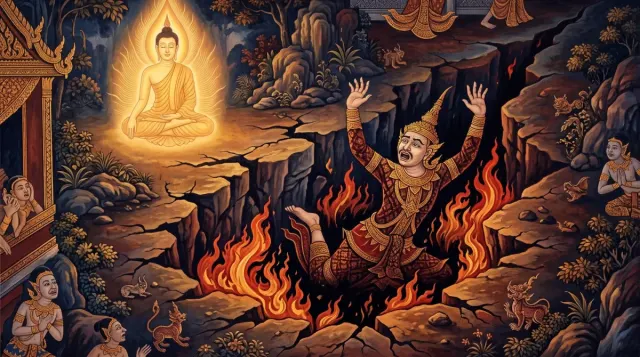
Devadatta gains lavish support from Prince Ajātasattu and then wants to lead the Saṅgha. Refused, he nurses a …

A monk should not teach the Dhamma to someone who is not ill and is holding an umbrella, staff or weapon, wear…