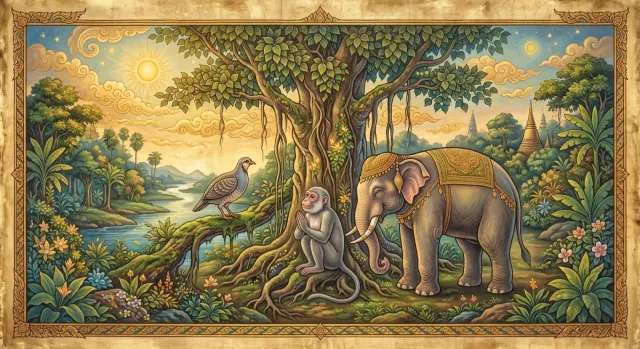
The Tittira Jātaka: The Partridge, the Monkey and the Elephant Who Learned Respect
TittirajātakaṃThose skilled in the Dhamma honour their elders; they are praised here and now and have a good destination her…


Aṭṭhakanāgarasuttaṃ
The householder Dasama asks Ānanda for one thing that leads to liberation. Ānanda shows eleven: the four jhānas, the four divine abidings and three formless attainments, each contemplated as conditioned and impermanent. The householder likens it to finding eleven doors to the deathless at once.
In the Aṭṭhakanāgara Sutta of the Majjhima Nikāya, the householder Dasama of Aṭṭhakanagara goes to Pāṭaliputta on business and then deliberately seeks out Ānanda at Beluvagāma near Vesālī. He asks whether the Buddha declared one thing by which, when a monk dwells diligent, ardent and resolute, his unliberated mind is liberated and his undestroyed taints are destroyed.
Ānanda says there is, and sets out eleven ways: the first, second, third and fourth jhānas; liberation of mind through loving-kindness, compassion, altruistic joy and equanimity; and the base of infinite space, the base of infinite consciousness and the base of nothingness. In each case the monk understands: even this is conditioned; whatever is conditioned is impermanent and subject to cessation. Steady in that, he attains the destruction of the taints. If he does not, because of delight in that very state, he becomes a non-returner.
Dasama says he was seeking one door to the deathless and, just by listening, found eleven at once. He then invites the Saṅgha of Pāṭaliputta and Vesālī to a meal, gives cloth to every monk, presents a set of three robes to Ānanda, and has a dwelling built for him.
Dasama didn't ask for many teachings, but for one thing declared by the Buddha by which a diligent monk's mind is liberated, the taints are destroyed, and freedom from bondage is reached. After finishing his business in Pāṭaliputta, he travelled specifically to Ānanda to ask it.
When the Dhamma seems so vast you don't know where to start, ask someone knowledgeable: "If I were to practise just one thing seriously, what should it be?" A clear question gets a usable answer.
A monk attains the first jhāna, with applied and sustained thought and rapture and happiness born of seclusion, then understands: even this first jhāna is conditioned and volitionally produced. The same applies to the second, third and fourth jhānas — the first four ways.
This point is for overall understanding. At a level anyone can practise: when your mind is calm after sitting, also know that this calm came from causes, such as enough sleep or a quiet place, and won't stay with you forever.
The heart of all eleven ways is the same contemplation: whatever is conditioned is impermanent and subject to cessation. Steady in that, the monk attains the destruction of the taints. The ways differ in their starting state, but are alike in seeing the impermanence of that state.
When something very good comes your way — a new job, a good relationship — appreciate it fully while knowing inwardly that it arose from causes and can change. The mind won't cling so tightly that it fears loss.
A monk pervades one direction with a mind of loving-kindness, then the second, third and fourth, above, below, across and everywhere, with a mind abundant, exalted, immeasurable, without hostility or ill will, then contemplates that even this liberation of mind through loving-kindness is conditioned and impermanent. The same applies to compassion, altruistic joy and equanimity.
If you feel warm after practising loving-kindness, know that the good feeling can change too. If the next day you feel nothing, don't assume you did it wrong.
Transcending perceptions of form, a monk enters the base of infinite space, attending to space as infinite; then the base of infinite consciousness and the base of nothingness. Each is likewise contemplated as conditioned and impermanent. This discourse does not mention the base of neither-perception-nor-non-perception, which is how the count comes to eleven.
This point is for overall understanding. The message for everyone is that even the subtlest state you have ever experienced is not yet the end of the path.
A monk who contemplates this but does not attain the destruction of the taints, because of desire and delight for that very state, becomes spontaneously reborn with the destruction of the five lower fetters, attains final nibbāna there, and does not return from that world. Delight in a good state is thus still a subtle thing to be let go of in the end.
Even pride in your own goodness is worth noticing and setting down from time to time. You needn't abandon goodness, but you needn't make it your identity.
Dasama says it is like a man seeking one treasure who finds eleven at once, and like a house with eleven doors: when it catches fire, the owner can escape through any one of them. So he can make himself safe through any one of these eleven doors to the deathless. He adds that if even followers of other sects seek wealth to honour their teachers, how could he not honour Ānanda?
Don't worry that your practice differs from others'. If it is a sound path, the one door that suits you is enough to lead out — as long as you actually walk through it.
This discourse shows that even the most peaceful and beautiful states — deep concentration, boundless loving-kindness — are still conditioned and not to be clung to as a permanent resting place. The happiness of practice is there to be contemplated, not to be infatuated with.
In daily life, the calm after meditation or the gladness after a generous act can be contemplated the same way: it arose from causes and will cease when they end. Seeing this doesn't diminish the calm; it keeps you from disappointment when it changes.
Jhāna and the formless attainments are advanced; you don't need experience of every one to grasp the principle. And eleven doors doesn't mean passing through all of them — Dasama himself says one escapes a burning house through any single door.
Tap to read the actual passage on the page cited.
Those skilled in the Dhamma honour their elders; they are praised here and now and have a good destination her…

A step-by-step question and answer on where quarrels come from: from what is dear; what is dear comes from des…
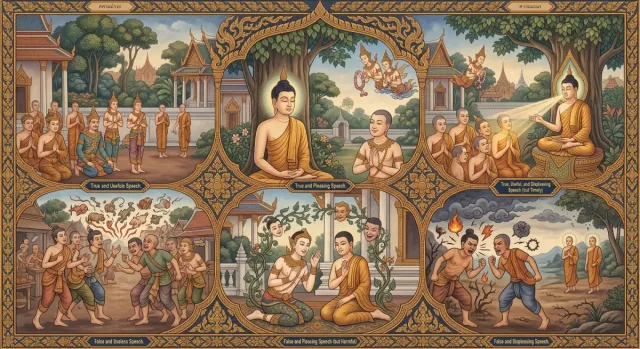
Does the Buddha say things people don't want to hear? He speaks only what is true and beneficial, and knows th…

A skilled cook watches which flavours his master prefers; a skilled meditator watches his own mind. And when t…