
The Discourse to Samaṇamuṇḍikā's Son: Not Doing Evil Is Not Enough
SamaṇamuṇḍikasuttaṃThe wanderer Uggāhamāna says one who does no evil by body, speech, thought or livelihood is an accomplished as…



Lohiccasuttaṃ
The brahmin Lohicca holds that one who attains the Dhamma should not teach anyone, for what can one person do for another? The Buddha compares this to a lord keeping all the revenue for himself, then describes three kinds of teacher who deserve reproach and the teacher who does not.
In the Lohicca Sutta of the Dīgha Nikāya, Sīlakkhandha Vagga, the brahmin Lohicca, who governs the village of Sālavatikā, comes to hold the view that an ascetic or brahmin who attains a wholesome state should not tell others, for what can one person do for another? Teaching others would be like cutting through an old bond only to make a new one, a kind of greed.
He invites the Buddha for a meal. On the way, Rosika the barber, walking behind the Buddha, asks him to free Lohicca from this wrong view. After the meal the Buddha asks Lohicca: if someone said Lohicca should enjoy the revenue of Sālavatikā alone and share it with no one, would that person wish well or ill for those who depend on him for their living?
He then describes three kinds of teacher who deserve reproach, and the teacher who does not: one through whose teaching disciples truly attain excellent distinction. In the end Lohicca admits his error and goes for refuge, and the Buddha accepts his confession.
Lohicca holds that one who attains a wholesome state should not tell others, for what can one person do for another? It is like someone who has cut an old bond making a new one, and he calls teaching others a form of greed. The discourse calls this a harmful view.
When you catch yourself thinking "There's no point telling them", check whether it is a real reason or an excuse for not wanting to spend time or share.
The Buddha asks: if someone said Lohicca should enjoy the revenue of Sālavatikā alone and give none to others, would that person be creating an obstacle for those who depend on him for their living? Lohicca says yes. The Buddha extends the comparison to King Pasenadi, who rules Kāsi and Kosala, on whom Lohicca himself depends.
If we don't want those above us to keep everything for themselves, we shouldn't keep our knowledge or opportunities to ourselves either.
The Buddha reasons step by step: one who creates obstacles for others does not wish them well; one who does not wish them well has a hostile mind; one with a hostile mind has wrong view. One who forbids teaching the Dhamma obstructs those who, relying on the teaching, realise stream-entry and on up to arahantship.
Before deciding not to share information that would help a colleague, ask yourself plainly: do I want them to do better?
The first has not reached the goal of the ascetic life himself, yet teaches disciples, "This is for your welfare, this is for your happiness," and the disciples do not listen. The second has not reached the goal, but his disciples listen and follow. The third has reached the goal, but his disciples do not listen. The Buddha says reproaching such teachers is true, rightful and blameless.
Before teaching or advising anyone, look at both sides: do I really know and practise this, and is the listener ready to listen?
For the second kind of teacher, who has not reached the goal but whose disciples listen, the Buddha gives the simile of someone who neglects their own field and thinks another's field is the one they should weed.
Before advising others about money, health or relationships, first look at how well "your own field" is tended in that area.
Lohicca asks whether there is a teacher who does not deserve reproach. The Buddha describes the training from virtue and concentration to the ending of the taints, and says that a teacher under whom disciples attain such excellent distinction does not deserve reproach; reproaching such a teacher is untrue, unrightful and blameworthy.
When choosing a teacher or source of knowledge, look at the results in students who genuinely learn, rather than at the teacher's fame.
Lohicca says it is as if someone had grabbed by the hair a man about to fall into a pit and set him on firm ground. He goes for refuge and admits he was wrong to reproach the Buddha falsely. The Buddha accepts his confession and says that seeing a fault as a fault, making amends according to the Dhamma and restraining oneself in future is growth in the noble discipline.
When you find a view you once insisted on was wrong, admit it plainly and say how you will change. That is not losing face; it is growth.
Lohicca's way of thinking survives in new forms: "If they want to know, let them find out themselves", "Teaching is pointless", or hoarding knowledge at work to stay important. The discourse points out that keeping others from benefits they should receive comes, deep down, from a mind that does not wish them well.
But the discourse does not say anyone should teach anything. A teacher who has not reached the goal but rushes to teach others also deserves reproach. The key message is to do your own work well, and share what you truly know with goodwill.
Rosika the barber is also worth noticing: an ordinary man sees that his employer is mistaken and finds a gentle way to help.
Tap to read the actual passage on the page cited.
The wanderer Uggāhamāna says one who does no evil by body, speech, thought or livelihood is an accomplished as…

A king fails to keep the duty of a wheel-turning monarch to give wealth to the destitute. Poverty spreads, fol…
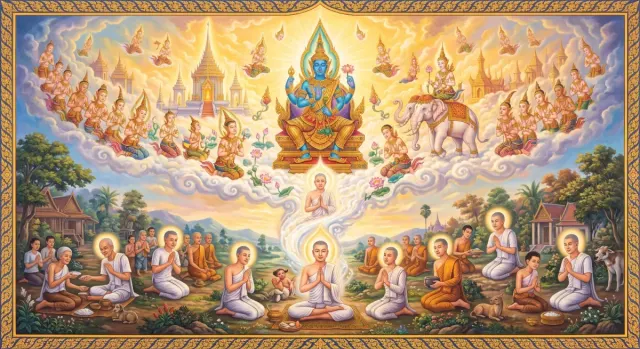
As a human, Sakka undertook seven lifelong practices: supporting his parents, respecting family elders, speaki…

The twelve links by which suffering is produced — see any one link clearly and the chain can be cut right ther…