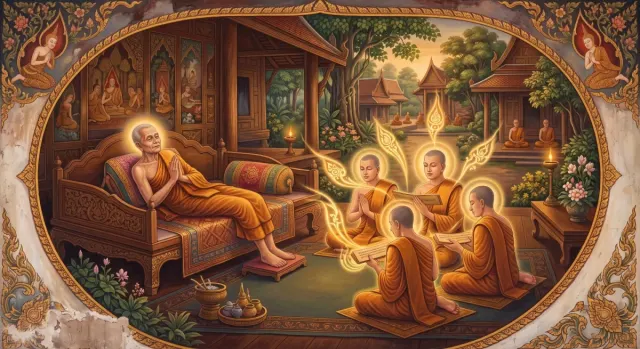
The Discourses on Illness: Recovering on Hearing the Factors of Awakening
GilānasuttaṃMahākassapa, Mahāmoggallāna and the Buddha himself were once gravely ill. On hearing the seven factors of awak…


Dhammānudhammapaṭipanno
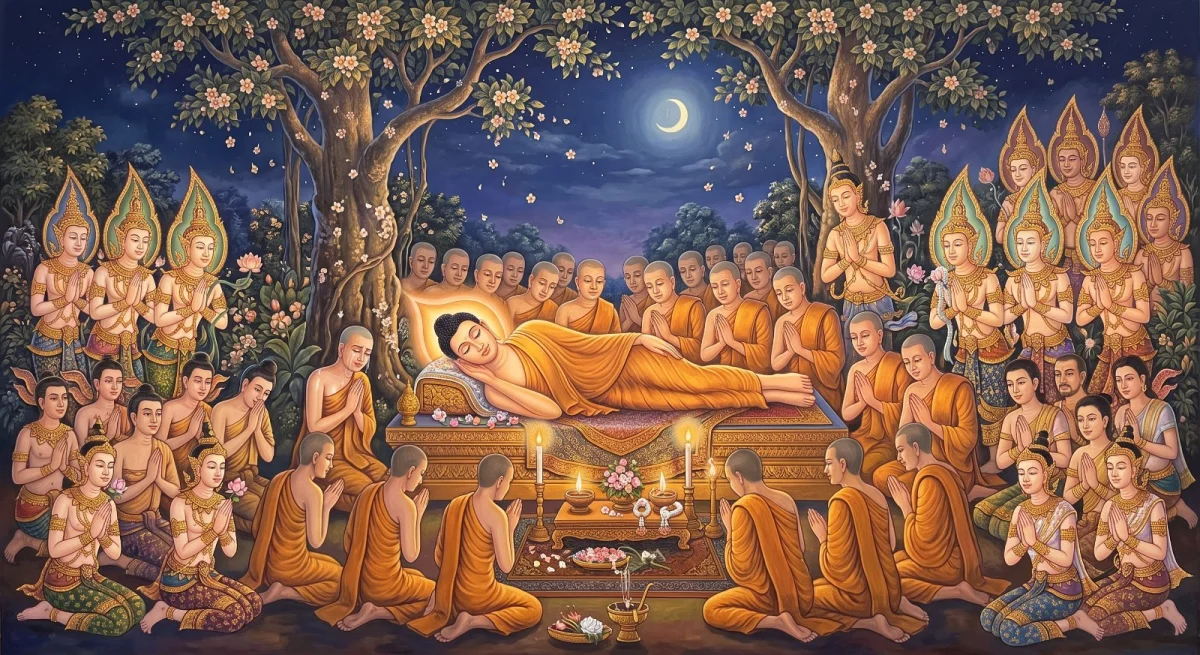
On his last night between the twin sāla trees, the Buddha says the highest homage is practising the Dhamma in line with the Dhamma. He comforts and praises the weeping Ānanda, tells him not to turn away the wanderer Subhadda, teaches that where the noble eightfold path is found there are true ascetics, and says the Dhamma and Vinaya will be the teacher after he is gone.
In the Mahāparinibbāna Sutta of the Dīgha Nikāya (Mahāvagga), as the Buddha lies between the twin sāla trees in the Mallas' sāla grove at Kusinārā, the trees blossom out of season and heavenly flowers rain down in homage. But the Buddha says this is not how the Tathāgata is truly honoured.
Much happens that night. Ānanda goes off to weep because he is still in training while his teacher is about to pass away; the Mallas come to pay homage; and the wanderer Subhadda asks to see the Buddha about his doubts, and ends up ordained as the last personal disciple.
This page gathers the teachings of that night, from honouring through practice to the Dhamma and Vinaya as teacher. The four places of pilgrimage and the last words on heedfulness, from the same part of the discourse, are not repeated here.
The Buddha said that the sāla blossoms and heavenly flowers raining down are not true honour. Whatever monk, nun, laywoman or layman practises the Dhamma in line with the Dhamma, practises properly and lives according to the Dhamma, honours the Tathāgata with the highest homage.
Besides bowing to the Buddha today, choose one teaching to actually carry out, such as speaking only the truth all day, or not retaliating in anger.
Learning that Ānanda was leaning on a door-post weeping, the Buddha had him called, then said: enough, Ānanda, don't grieve. Haven't I told you that there is separation from all that is dear? Whatever is born, come to be, conditioned, is subject to breaking up; it is impossible to wish that it not break up.
When someone close to you is grieving, have them sit near you first. Being together matters as much as words of comfort.
The Buddha said Ānanda had long attended to him with bodily, verbal and mental acts of loving-kindness; he had made merit, and if he applied himself to effort he would soon be free of the taints. He then praised him before the monks as wise, one who knows the right time for people to come and see the Tathāgata.
When parting from someone who has helped you for a long time, tell them specifically what good they did, and encourage them on the road ahead.
When the Mallas came in great numbers with their families to pay homage, Ānanda realised that if they bowed one by one it would not be finished before dawn. So he had them pay homage family by family, announcing the name of each head of family and those with him, and it was done within the first watch of the night.
When managing many people in limited time, such as at a funeral or merit-making ceremony, organise them in family groups and announce names clearly. Everyone can take part without chaos.
The wanderer Subhadda asked three times to see the Buddha, and Ānanda refused each time because the Buddha was weary. Hearing this, the Buddha said: don't stop Subhadda; let him come. He will ask wanting to understand, not to trouble me, and he will quickly understand what I answer.
Even when tired or busy, if someone comes with a genuine wish to learn, give them a little time. A door opened at that moment may change their life.
Subhadda asked whether the six famous teachers of other sects had truly awakened. The Buddha told him to set that question aside, and taught: in any teaching and discipline where the noble eightfold path is not found, there is no first, second, third or fourth ascetic; where it is found, there are. If the monks live rightly, the world will not be empty of arahants.
When choosing a teacher or path, don't start from anyone's fame. See whether the teaching leads to right view, right speech, right action and right mindfulness.
When told that someone formerly of another sect must undergo four months' probation before ordination, Subhadda said he would gladly undergo four years. The Buddha had him ordained. Subhadda lived alone, heedful, ardent and resolute, and before long attained arahantship, the last personal disciple of the Buddha.
When starting to learn something new, being willing to wait and follow the steps for longer than required is a sign of real commitment. Then follow it with steady effort.
The Buddha told Ānanda not to think the teaching had lost its teacher: the Dhamma and Vinaya he had taught and laid down would be their teacher after he was gone. He then invited the monks three times: if anyone has doubt about the Buddha, the Dhamma, the Saṅgha, the path or the practice, ask now, so as not to regret it later; and if they were too respectful to ask, a friend could tell a friend.
Before an important leader or teacher leaves, ask about what still puzzles you now, and write down key principles so the team can carry on without depending on one person.
The Buddha's last night was not filled with ceremony but with caring for people: comforting a grieving disciple, acknowledging years of service, making time for a stranger who came to ask, and preparing the community to carry on without him.
For ordinary Buddhists, the teaching on honouring through practice applies every day. Bowing, offering flowers and visiting the temple are good, but what the Buddha praised most is putting the teaching into practice.
The story of Ānanda weeping is also an encouragement for anyone facing loss. Grief is natural, and the Buddha didn't scold him, but reminded him that separation must come and pointed to the good he had already done.
Tap to read the actual passage on the page cited.
Mahākassapa, Mahāmoggallāna and the Buddha himself were once gravely ill. On hearing the seven factors of awak…
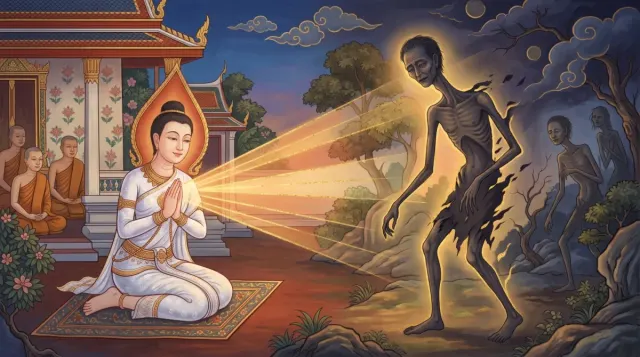
Venerable Sāriputta offers a mouthful of rice, a palm-sized cloth and a bowl of water and dedicates the merit,…

One side holds that dependent origination and the four noble truths are unconditioned, since a discourse says …

Sāma cares for his blind parents in the forest. King Piliyakkha shoots him with a poisoned arrow as he carries…