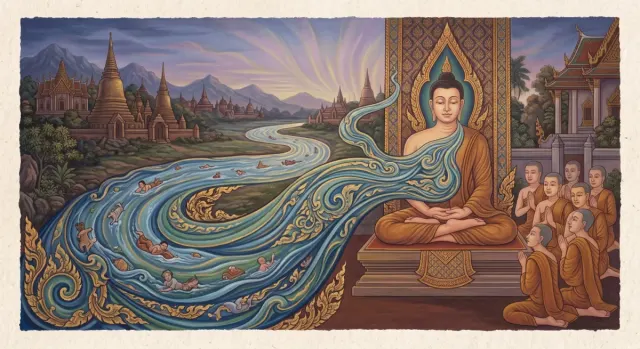
The Salaḷāgāra Discourse and the Anuruddha Collection: A Mind That Slopes Like the Ganges
Vivekaninnaṃ vivekapoṇaṃ vivekapabbhāraṃVenerable Anuruddha compares it to a crowd with hoes and baskets trying to make the Ganges flow backwards: jus…


Jāṇussoṇisuttaṃ
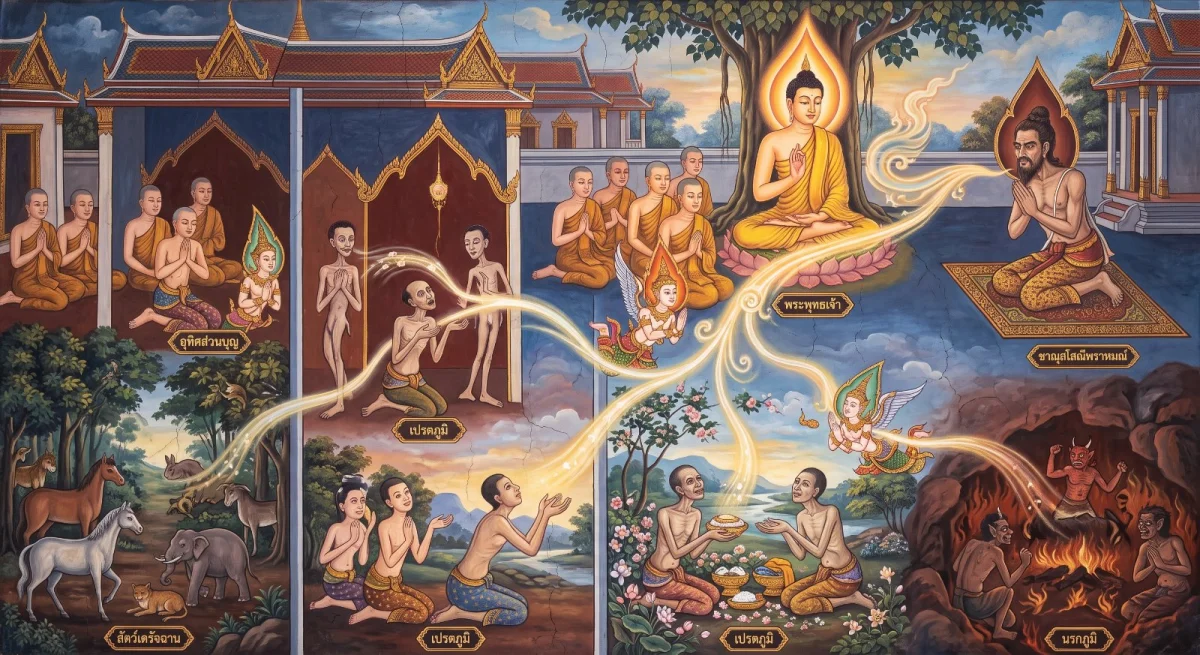
The brahmin Jāṇussoṇi asks whether gifts given for dead relatives reach them. The Buddha says they reach only those reborn among the ghosts (petas), yet the giver never goes without fruit. In the same chapter he teaches that the true rite of descent from evil is abandoning ten kinds of wrong action.
The Jāṇussoṇi Chapter of the Book of Tens, Aṅguttara Nikāya, contains two discourses prompted by the brahmin Jāṇussoṇi. The first is the Paccorohaṇī Sutta. On an uposatha day the brahmin has washed his head, put on a new pair of linen cloths and holds a bunch of fresh kusa grass, because it is the brahmins' rite of descent from evil, which involves lying on ground smeared with cow dung, worshipping the fire and feeding brahmins. The Buddha says the descent in the noble one's discipline is different: seeing the harm of each kind of wrong action and abandoning it.
The second is the Jāṇussoṇi Sutta at the end of the chapter. The brahmin asks whether gifts given with the wish "may our departed relatives partake of this" actually reach them. The Buddha says they succeed in a suitable place, not in an unsuitable one. Those reborn in hell, as animals, among humans or among gods live on the food of that realm, and the gift doesn't reach them. Those reborn in the realm of ghosts can live on what friends and relatives dedicate to them.
What this page says about rebirth after death is presented as the discourse teaches it; readers may see it differently. The point that applies to everyone is that giving in remembrance of the departed is never wasted for the giver.
Jāṇussoṇi explains that on the uposatha day brahmins wash their heads, wear new linen, smear the ground with fresh cow dung, spread kusa grass and lie between a sand bank and the fire house. In the night they rise and salute the fire three times, saying they descend from evil, feed the fire with ghee, oil and butter, and in the morning feed brahmins. The Buddha doesn't mock this, but says the noble one's discipline has a different way.
Look at the rituals you perform to feel free of wrongdoing, and ask whether they have really changed how you act.
The noble disciple reflects that the results of killing, stealing, sexual misconduct, lying, divisive speech, harsh speech, idle chatter, covetousness, ill will and wrong view are bad both in this life and the next, and abandons them. This is descending from each of them. Jāṇussoṇi says the brahmins' rite isn't worth a sixteenth part of this one.
Pick one bad habit, write down the harm it does now and in the long run, and make a clear resolution to stop. That is a descent from evil that actually works.
Asked whether a gift meant for departed relatives reaches them, the Buddha doesn't say it always does or never does. He says it succeeds in a suitable place and doesn't in an unsuitable one.
When a question seems to demand a simple yes or no, first sort out in which cases the answer is yes and in which it is no.
One who does evil and is reborn in hell or as an animal lives on the food of that realm. One who does good and is reborn as a human or a god lives on human or divine food. In these four cases the place is unsuitable, and the dedicated gift doesn't reach them.
Missing someone who has died needn't come with worry that they are going hungry. Remember the good they did, and keep doing good in their name.
One reborn in the realm of ghosts lives not only on ghosts' food but also on what friends, colleagues or relatives dedicate from the human world. This is the suitable place where the gift succeeds.
When you dedicate merit, do it with genuine remembrance of the departed, not just to complete a ceremony. That intention is the heart of dedication.
The brahmin asks who partakes of the gift if the intended relative isn't reborn there. The Buddha says other departed relatives of the giver are there and partake of it, and it is impossible for that place to be empty of the giver's relatives for such a long time.
When pouring water to dedicate merit, widen the dedication beyond one loved one to all relatives and all the departed. Your heart will widen too.
The Buddha gives examples: even someone who does evil and is reborn as an elephant, horse, cow or dog, if they gave food, drink, cloth, lodging and lamps to ascetics and brahmins, receives food, drink, garlands and ornaments in that birth. Someone who does good and also gives receives human or divine sensual pleasures. Jāṇussoṇi says that since the giver is not without fruit, it is truly worth giving and having faith.
Give without worrying about whom the results will reach. Giving always changes the giver's heart: less stinginess, more warmth.
Making merit and dedicating it to the departed is a familiar Thai custom. This discourse helps us do it with understanding: there's no need to worry that an incomplete ceremony means nothing arrives, nor to think the gift is wasted if it doesn't reach the intended person, since the Buddha affirms that the giver never goes without fruit.
On the other side, the Paccorohaṇī Sutta invites us to reconsider rituals performed to wash away wrongdoing. Asking forgiveness at a shrine or a rite to ward off bad luck may bring comfort for a while, but the real descent from evil in this discourse is seeing that what you did wrong causes harm, and actually stopping.
Tap to read the actual passage on the page cited.
Venerable Anuruddha compares it to a crowd with hoes and baskets trying to make the Ganges flow backwards: jus…

Four things rarely obtained — human birth, staying alive, hearing the true Dhamma, and the arising of a Buddha…

Can someone who cheats to support their family plead that excuse before the wardens of hell? Sāriputta goes th…

Four things people wish for but rarely gain, the four qualities that lead to them, the fitting uses of wealth,…