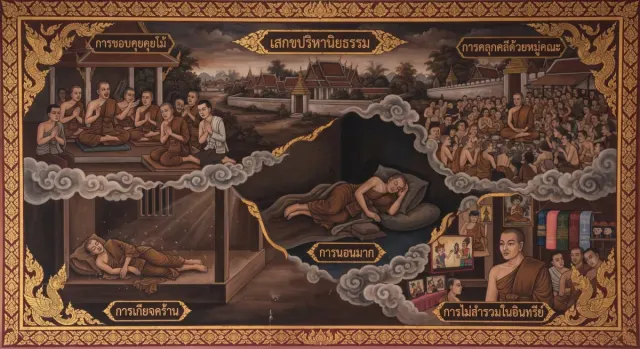
Things That Lead a Trainee to Decline
Sekhassa bhikkhuno parihānāya saṃvattantiDelight in work, in talk, in sleep, and in company, unguarded senses, and immoderate eating — six things that …


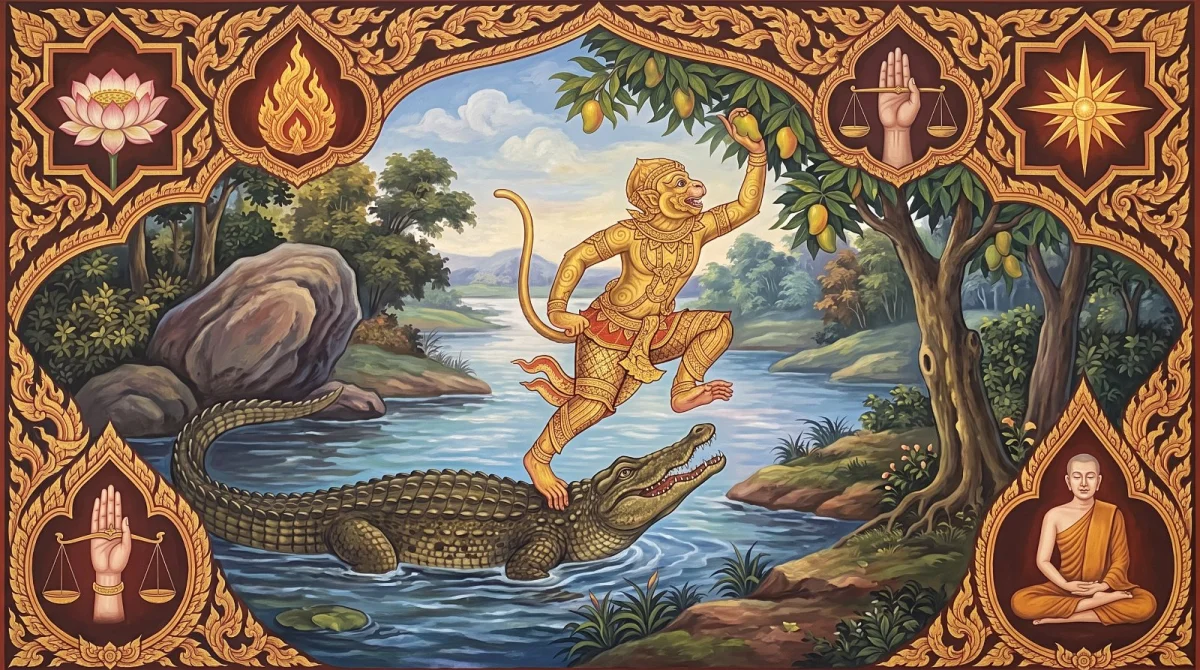
Saccaṃ dhammo dhiti cāgo
A crocodile lies in wait to catch the monkey king, but the monkey notices something is wrong and escapes. The verse concludes that one with truthfulness, discernment, persistence and the courage to give up overcomes an enemy.
The Vānarinda Jātaka in the Ekanipāta of the Jātaka, Khuddaka Nikāya, has a single verse: whoever has these four qualities — truthfulness, dhamma (discernment), dhiti (persistence) and cāga — like the monkey king, overcomes an enemy. The Kumbhīla Jātaka in the Dukanipāta contains the same verse and adds another: one who lacks these four qualities does not overcome an enemy.
In the Tipiṭaka the Jātaka consists only of verses; the story comes from the commentary. The monkey king used to leap from the riverbank to an island in mid-stream to eat fruit, resting on a flat rock in the middle of the river. A female crocodile craved the monkey's heart, so her mate lay in wait on that rock. In the evening the monkey saw that the rock looked higher than usual though the water level had not changed, so he called out to the rock. The crocodile foolishly answered. The monkey then told the crocodile to open its mouth and wait; when a crocodile opens its mouth its eyes close, so the monkey leapt onto its head and across to the bank. Seeing this, the crocodile spoke the verse in praise.
The Suṃsumāra Jātaka in the Dukanipāta tells another monkey-and-crocodile story. Its verses say that this fig tree of mine is better than the fruit on the far shore, and that your body is large, but your wisdom does not match it. The commentary tells how the crocodile tricked the monkey into riding on its back across the river, then began to dive to take his heart. The monkey said he had left his heart hanging on the fig tree; the crocodile carried him back to the bank, and the monkey leapt up the tree to safety.
The commentary says the monkey king had carefully noted the water level and the size of the rock. That evening the water had neither risen nor fallen, yet the rock looked higher, so he suspected a crocodile might be lying in wait.
When a message, link or offer looks slightly different from usual — say, a changed bank account number — stop and check before acting on it.
The commentary says the monkey did not jump down at once. He stayed where he was and called out to the rock several times until the crocodile foolishly answered, and then he knew danger really was waiting.
If you suspect a scam, verify through your own channel — for example, call your bank's official number rather than calling back the number that rang you.
The verse puts truthfulness first. The commentary explains it as truthfulness in speech: the monkey said he would come, and he really came as he said.
Keep your word in small things. People who do what they say are trusted and helped when trouble comes.
The Thai Royal edition renders dhamma in this verse as discerning wisdom. The commentary explains it as knowing how to consider, "If I do this, this will result" — such as knowing that a crocodile's eyes close when it opens its mouth.
Before an important decision, ask yourself: if I do this, what follows — and if it doesn't go as expected, do I have a way out?
Dhiti in the verse means persistence. The commentary explains it as effort that does not slacken or break off. Even in a tight spot, the monkey did not give up but found a way through.
When facing a heavy problem such as debt or a legal dispute, don't stop just because the first route is blocked. Try a second and a third, and seek advice.
The commentary explains cāga here as giving up oneself: the monkey dared to risk his life by approaching the crocodile rather than freezing in fear. The verse in the Kumbhīla Jātaka adds that one who lacks these four qualities does not overcome an enemy.
Sometimes escaping a bad situation means giving something up — for example, forfeiting a deposit to get out of a dubious contract.
In the Suṃsumāra Jātaka the monkey tells the crocodile: your body is large indeed, but your wisdom does not match it; you have been fooled by me, now go as you please. The stronger party does not always win if the other side has mindfulness and wisdom.
When dealing with a person or organisation more powerful than you, don't give in at once. Stay calm, gather information, and use proper channels wisely.
This story does not teach us to outwit people for sport. It teaches us to stay mindful and keep our footing when we are in danger. The monkey's trick was a way to survive someone set on harming him, not an excuse for lying in ordinary life.
The four qualities in the verse apply to modern "enemies" too — scammers, debt, or situations where someone is out to take advantage of us. People who speak truthfully, think before acting, don't give up, and are willing to let go of what must be let go usually come through.
Tap to read the actual passage on the page cited.
Delight in work, in talk, in sleep, and in company, unguarded senses, and immoderate eating — six things that …

Māgha earns wealth honestly and shares it with many people. He asks whether this brings much merit, to whom on…

A merchant of Rājagaha saw monks living in forests and at the roots of trees, with graceful deportment, and of…

Waste tipped over the wall onto a passer-by's head, waste dumped into a neighbour's rice field, and relieving …