
Before You Admonish Anyone: Qualities to Establish in Yourself
Codakena pañcasu dhammesu patiṭṭhāya paro codetabboUpāli asks what a monk who wants to reprove another should first have in himself. The Buddha tells him to exam…


Laḍukikopamasuttaṃ
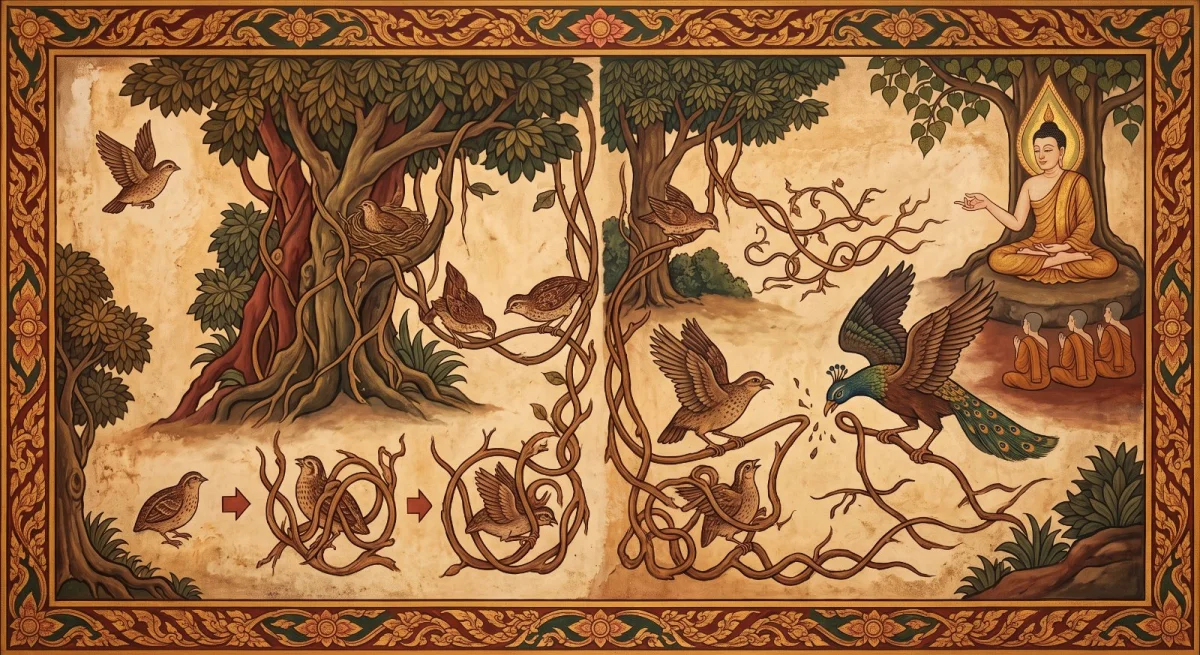
A small thing the mind refuses to release can bind as tightly as the rotten creeper that holds a quail, while for one ready to let go even strong thongs cannot hold, like a royal elephant. And even the happiness of jhāna is to be abandoned.
In the Laṭukikopama Sutta of the Majjhima Nikāya, Venerable Udāyī, resting for the day, reflects that the Buddha has removed many causes of suffering and brought many causes of happiness. He recalls that when the Buddha had them give up eating at the wrong time in the day, and later eating at night, he was at first resentful but complied out of love and respect. Later he saw the dangers of going for alms in the dark: falling into pits, stepping on a sleeping cow, meeting thieves; and once a woman washing a pot saw him by a flash of lightning and screamed that a demon had come.
The Buddha says some people, told to give something up, reply "such a trifle; this ascetic is too exacting" and don't give it up. For them that trifle becomes a strong bond, like a quail caught by a rotten creeper that cannot escape. For those who do give it up, even strong thongs cannot hold, like a royal elephant that snaps its bonds with a mere twist of its body. He compares a poor man who cannot leave his broken-down hut with a rich householder who can leave great wealth to go forth.
He then describes four kinds of people by how quickly they abandon thoughts bound up with attachment, distinguishes sensual happiness from the happiness of jhāna, and says that each jhāna in turn is not enough: it should be abandoned and surmounted, up to the cessation of perception and feeling.
Udāyī was resentful when told to give up eating at the wrong time, since the evening meal was the finest, but he complied out of love, respect, shame and fear of wrongdoing toward the Buddha. Later he recalled the dangers monks had faced going for alms in the dark, and saw that the Buddha had removed many causes of suffering.
When starting a new discipline, such as no phone before bed, keep at it for a while before judging. Some benefits show only in hindsight.
Some people, told to give something up, say "why fuss over such a trifle?" and don't give it up. For them that trifle becomes a strong, firm bond, like a thick log. It is like a quail bound by a rotten creeper that must await its death right there; no one could rightly say that creeper is a weak bond.
Notice the phrase "it's only this" that you use to defend certain habits. If you won't give something up even though it's small, it binds you more tightly than you think.
Some clansmen, told to give something up, do so and show respect for the teaching. They live at ease, unruffled, subsisting on what others give, with minds like wild deer. For them it is a rotten, pithless bond, like a royal elephant with fine tusks, a veteran of battle, bound with strong thongs, which with a slight twist of its body snaps them and goes where it likes.
Real strength is readiness to let go. When someone points out a reasonable fault, try accepting it and adjusting right away without bargaining.
A poor man has one hut with a leaky roof where crows must be chased off, a broken bed, a single pot of grain. Seeing a monk living peacefully, he wishes to go forth but cannot leave these things. A wealthy householder with hundreds of gold bars, fields, land and many dependants can leave them all and go forth. A bond's strength depends not on the value of what binds but on the mind's grasping.
The hardest things to throw out at home are often not expensive ones but old things tied to memories or a feeling of security. See what you hold on to purely out of habit.
There are four kinds of people practising to abandon attachment (upadhi). The first, when thoughts bound up with attachment arise, tolerates them and doesn't abandon them. The second abandons them. The third sometimes has slow mindfulness, but once it arises abandons them at once, like two or three drops of water falling on an iron pan heated all day: they fall slowly but vanish quickly. All three are still said to be fettered. The fourth knows attachment is the root of suffering and is released from attachment.
Don't despair that unwholesome thoughts still arise. Train mindfulness to catch them faster and let go at once, so they are like drops on a hot pan.
Happiness dependent on the five cords of sensual pleasure is called sensual happiness, a filthy happiness, the happiness of ordinary people, not of the noble ones; it should not be pursued much and should be feared. The happiness of the four jhānas is called the happiness of renunciation, of seclusion, of peace and of enlightenment; it should be pursued and developed, not feared.
In free time, choose happiness from calm sometimes, such as sitting quietly or walking in a garden, instead of always seeking entertainment on a screen.
The Buddha says the first to third jhānas are still perturbable, because of applied and sustained thought, rapture and pleasure, or equanimity and pleasure; the fourth is imperturbable. Yet each stage from the first jhāna up to the base of neither-perception-nor-non-perception he calls not enough: abandon it, surmount it, up to the cessation of perception and feeling. He asks Udāyī whether he sees any fetter, subtle or gross, whose abandoning he has not taught. Udāyī says he sees none.
When you gain some peace or success, appreciate it, but don't stop there in excessive contentment. Even good happiness can become a place to get stuck.
The heart of this discourse is not the size of what is held but the attitude of the mind. A small habit we defend with "it's only this" may bind us more tightly than a big thing we are ready to release.
The rule on meal times is part of the monastic discipline; lay people need not follow it, except those observing the eight precepts. But Udāyī's story shows that some training rules seem strict at first and their benefit becomes clear only with time.
The instruction to abandon even the happiness of jhāna does not mean that wholesome happiness is bad. In the same discourse the Buddha says this happiness should be pursued and developed, not feared. The point is not to get stuck even in refined happiness.
Tap to read the actual passage on the page cited.
Upāli asks what a monk who wants to reprove another should first have in himself. The Buddha tells him to exam…

Every work requiring strength depends on the earth, and every plant grows on the earth; so developing the path…

Three verse discourses of the Aṭṭhakavagga on clinging to views: don't boast of your own virtue, don't declare…

The first of the seventy-three knowledges in the Paṭisambhidāmagga is not about remembering many words. It is …