
The Pañcuposathika Jātaka: Five Who Knew What Made Them Suffer
PañcuposathikajātakaṃA pigeon, a snake, a jackal, a bear and an ascetic each keep the uposatha for their own reason: so that attach…


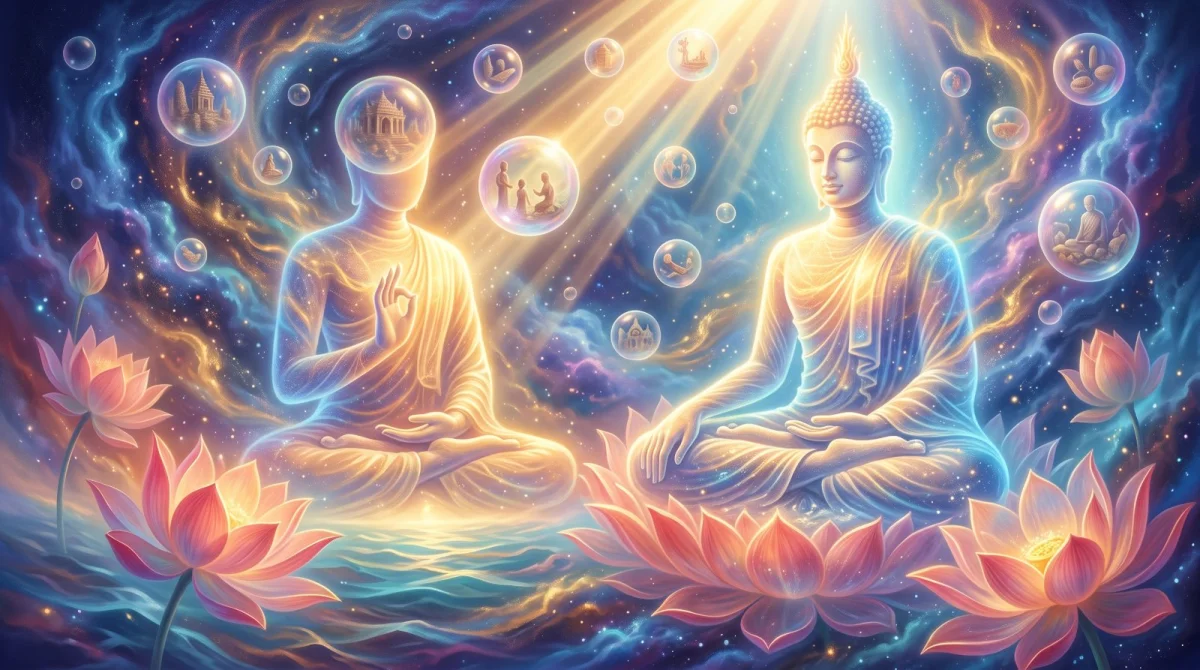
Suññato lokaṃ avekkhassu
The Cūḷaniddesa's explanation of Mogharāja's question: what seeing the world as empty means, the ways it can be done, and why one who has uprooted the view of self escapes the sight of the King of Death.
The Niddesa is a canonical text in the Khuddaka Nikāya of the Sutta Piṭaka that explains discourses of the Sutta Nipāta word by word. In the Mogharāja Question Niddesa of the Cūḷaniddesa, the question of the young brahmin Mogharāja in the Pārāyana Vagga is explained. Mogharāja says he has asked twice and the Buddha has not answered, and he has heard that the Buddha answers when asked a third time. He then asks: how should one look upon the world so that the King of Death does not see?
The Buddha answers: be always mindful, look upon the world as empty, uproot the view of self, and so cross beyond death. The Niddesa explains that the Buddha did not answer the first two times because he saw that the brahmin's faculties would ripen, and explains 'the one with vision' through the Buddha's five kinds of eye.
The heart of this Niddesa is its explanation of the words 'world' and 'empty', drawing on many of the Buddha's sayings from elsewhere.
Mogharāja had asked twice without an answer. The Niddesa explains the Buddha waited because he saw the brahmin's faculties would ripen, and explains that the Buddha has five kinds of eye: the physical eye, the divine eye, the eye of wisdom, the Buddha-eye and the all-seeing eye. This point is for overall understanding.
Sometimes a good answer must wait until the listener is ready. As a parent, teacher or manager, waiting for the right moment may help more than answering at once.
The Niddesa quotes the Buddha: it is called 'the world' because it breaks apart. The eye, forms, eye-consciousness, eye-contact and the feeling born of eye-contact break apart; the ear, nose, tongue, body, mind and what arises through them break apart as well.
When you hear the word 'world', think of the world you experience through eye, ear, nose, tongue, body and mind each second, constantly arising and breaking apart.
The first way of seeing the world as empty is noting that no one has power over form, feeling, perception, formations or consciousness. The Niddesa quotes the Buddha: if form were self, it would not lead to affliction, and one could say 'let my form be thus, let it not be thus'; but because form is not self, it cannot be commanded. The same holds for the other aggregates.
When the body hurts or feelings don't go as you wish, notice that you really cannot command them, and look after them as something entrusted to you.
The second way is seeing that the five aggregates have no core of permanence, happiness or self, like a reed, a castor-oil plant, a banana trunk, a bubble or a mirage.
When you take a thought or mood to be the whole of who you are, try seeing it like a bubble that forms and bursts.
The Niddesa gives several more sets of contemplation, such as seeing the aggregates as void, hollow, empty, not self, coreless and conditioned, and twelve further aspects such as not a being, not a life, not a person, not a woman, not a man, not self, not belonging to self, not I and not mine. This point is for overall understanding.
In a short meditation session, choose just one aspect, such as 'this feeling is not mine', and see whether the mind grows lighter.
The Niddesa quotes the Buddha: form, feeling, perception, formations and consciousness are not yours; let go of them, and it will be for your long-lasting welfare and happiness. When people carry off the grass and sticks in Jeta's Grove and burn them, the monks do not feel that they themselves are being burned, because those things are not self or belonging to self.
When you lose something or your work is criticised, distinguish that what was lost is not you. The pain shrinks from being attacked to merely losing something.
When Ānanda asks in what sense the world is empty, the Buddha says it is because it is empty of self and of what belongs to self: the eye, forms, seeing, contact and the feelings that arise are all empty of self and what belongs to self. The Niddesa quotes this saying in its explanation.
This emptiness doesn't make the world disappear. Everything still functions according to causes and conditions; there is simply no owner who has to carry it all.
The Niddesa explains the view of self as the twenty kinds of identity view, such as regarding form as self, self as possessing form, form in self, or self in form. Uprooting it, one crosses beyond ageing and death. It quotes the Buddha's words that a monk who enters the jhānas in sequence until the taints are destroyed is like a deer in the forest that does not walk the hunter's path, so Māra cannot see his way.
On days when you cannot uproot it all, begin by noticing what you most take to be yourself, such as your looks, position or opinions, and loosen them one at a time.
'The world is empty' here does not mean nothing exists or that life is meaningless. It means that what makes up our life, the body, feelings, perceptions, thoughts and awareness, is empty of a self that can command it or truly own it.
In daily life, this understanding eases suffering when the body or feelings don't turn out as we want, because we stop expecting them to obey us.
This is an in-depth teaching and is best studied alongside mindfulness practice. If contemplating emptiness leaves you feeling adrift or that nothing matters, go back and begin with virtue and loving-kindness first.
Tap to read the actual passage on the page cited.
A pigeon, a snake, a jackal, a bear and an ascetic each keep the uposatha for their own reason: so that attach…

King Ajātasattu asks whether going forth yields any fruit visible in this life. The Buddha answers step by ste…
One of the shortest teachings to bring its listener to awakening on the spot — in the seen, only the seen; in …

Seven inner treasures no thief can steal and no fire can burn — faith, virtue, moral shame, moral dread, learn…