
The Pairs on Sense Bases and Elements: The Same Word, Different Scope
ĀyatanayamakaṃThe Yamaka asks both ways round: is form the form base, and is the form base form? The answers differ, because…


Ānāpānakathā
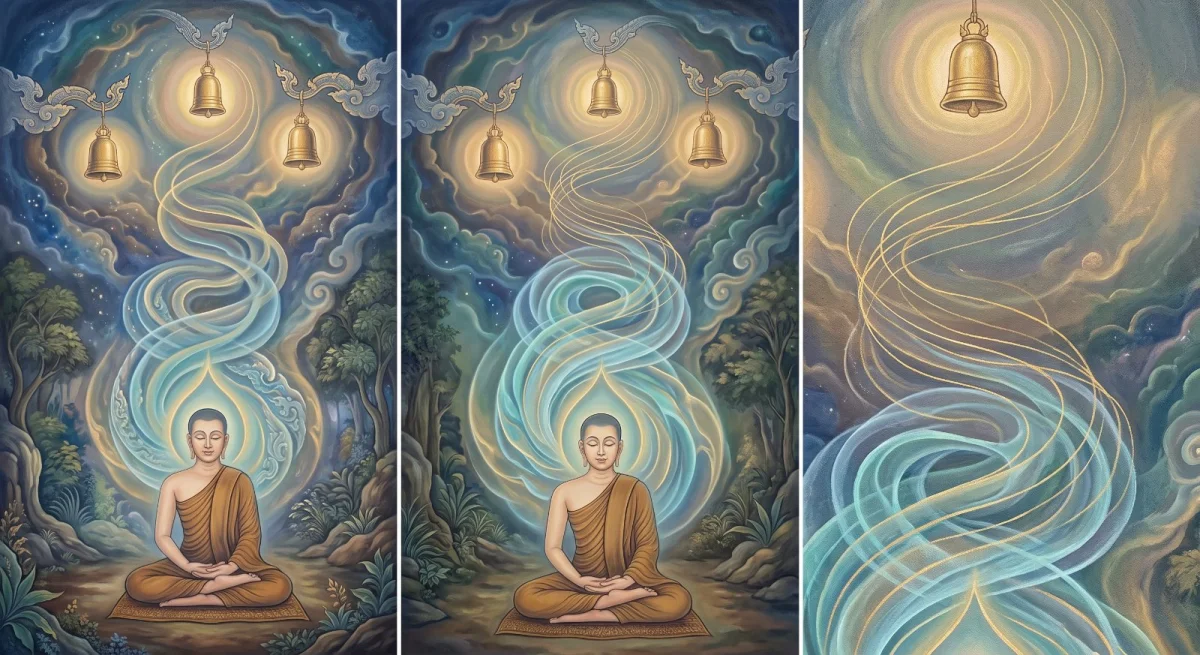
The Paṭisambhidāmagga explains in detail that as you know the long and short breath, desire and gladness make the breath subtler until the mind rests in equanimity; and when calming the breath it may become so faint it hardly appears — like a gong whose loud sound fades, while the mind can still follow the sign of the faint sound.
In the Treatise on Breathing (Ānāpānakathā) of the Great Chapter of the Paṭisambhidāmagga, Khuddaka Nikāya, Venerable Sāriputta explains the early steps of mindfulness of breathing one by one, from "breathing out long, one knows 'I breathe out long'" to experiencing rapture and happiness and calming the mental formation, describing what appears at each step, what mindfulness is doing, and how the mind changes.
This section stands out for its practical detail: the long and short breath appear in nine ways; the object observed is distinguished from mindfulness itself; and it answers a question meditators often ask — if you calm the breath until it is very faint, is there anything left to observe? — with the simile of a gong.
This page focuses only on the detail of the body and feeling sections. The overall sixteen steps and the imperfections that disturb breath meditation are explained on other pages in this collection.
He explains that a long breath is one breathed out or in over a stretch counted as long, and a short breath one over a stretch counted as brief. The meditator simply knows the breath as it is, without forcing it to be long or short.
Sit comfortably and watch five breaths without adjusting anything, just noting "long" or "short" silently. You'll see the breath changes with your mood.
As one knows the long breath, desire (chanda) arises, and through desire the breath becomes subtler. Then gladness arises, and through gladness it becomes subtler still. Then the mind turns away from the coarser breath and equanimity settles. He counts these as nine aspects in which the body, the breath, appears.
If watching the breath feels stressful, first make it pleasant: choose a quiet time and a comfortable posture. That small contentment is the starting point the text itself names.
He makes a clear distinction: the body, the breath, is what appears, but it is not mindfulness; mindfulness is both what appears and mindfulness itself. The meditator contemplates that body with that mindfulness and that knowledge, and so it is called contemplating the body in the body.
When the mind drifts from the breath into other thoughts, don't blame yourself. Noticing that you drifted is mindfulness coming back to work; then gently bring it back to the breath.
When the mind is unified on the breath, feelings are known as they arise, stay and pass away, and so are perceptions and thoughts. He explains that the arising of feeling is known by seeing its conditions, such as contact, and its ending by seeing its change.
While watching the breath, if a loud noise or an itch arises, watch it arise, stay a moment and fade, without getting up to deal with it at once. You'll see most sensations pass by themselves.
He explains there are two bodies: the mental body — feeling, perception, intention, contact and attention — and the physical body — the four great elements, form derived from them, the in- and out-breath, and the sign. These bodies appear when mindfulness is established on the breath.
After watching the breath for a while, widen your awareness to know the breath, the sensations of the whole body and the state of mind together, like switching on the room light instead of shining a torch on one spot.
The bodily formation is the breath, which is bound up with the body. If the body is bending, swaying, trembling or restless, one trains to calm it. Someone objects that if it is calmed like this, the breath won't appear and mindfulness has nothing to rest on. He answers with a simile: when a gong is struck, loud sounds occur first; when they die down, faint sounds follow; and when the faint sounds cease, the mind still continues because it has grasped the sign of the faint sound well. So it is with coarse and subtle breathing.
If the breath feels too faint to catch, don't breathe harder to find it. Rest the mind lightly where the breath touches, like listening to a bell about to fall silent.
Rapture is the gladness and elation of mind that arise when the mind is undistracted through the breath. Happiness is of two kinds: bodily and mental. He explains the mental formation as perception and feeling bound up with the mind, and one trains to experience and calm it. These steps are counted as contemplating feelings in feelings.
When practice feels good, know "this is happiness" rather than trying to hold on to it. Happiness known without clinging won't turn into disappointment when it fades.
Many people give up breath meditation because they think they must force the breath to be long or still. The Paṭisambhidāmagga says the opposite: know the breath as it is — long, know it is long; short, know it is short — and the breath grows subtler by itself as the mind begins to feel content and glad.
The gong simile helps a great deal when you feel "the breath has disappeared". There's no need to be alarmed or to breathe harder. The breath is still there, only subtler. Let the mind follow that subtlety like listening to a sound gently fading.
Practising just five to ten minutes a day, before sleep or before work, is enough to see how breath and mind are connected. If you have a respiratory condition or feel uncomfortable focusing on the breath, switch to noticing sensations in your hands or feet instead.
Tap to read the actual passage on the page cited.
The Yamaka asks both ways round: is form the form base, and is the form base form? The answers differ, because…

Prince Temiya pretends to be mute and crippled so he will not have to become a king who orders punishments, un…

The wise Mahosatha warns King Videha that going to receive King Cūḷanī's daughter is a trap. Though insulted a…
Short verse accounts of the Buddha's past lives: the ascetic Akitti gives away all his food, the brahmin Saṅkh…