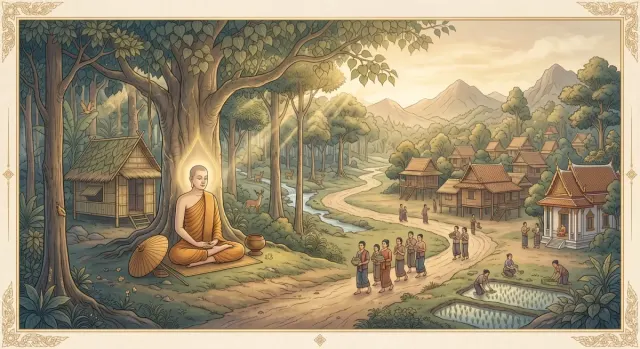
The Discourse to Gulissāni: When a Forest Monk Joins the Community
GolissānisuttaṃSāriputta teaches that a forest-dwelling monk who comes to stay in the Saṅgha should be respectful, know his s…


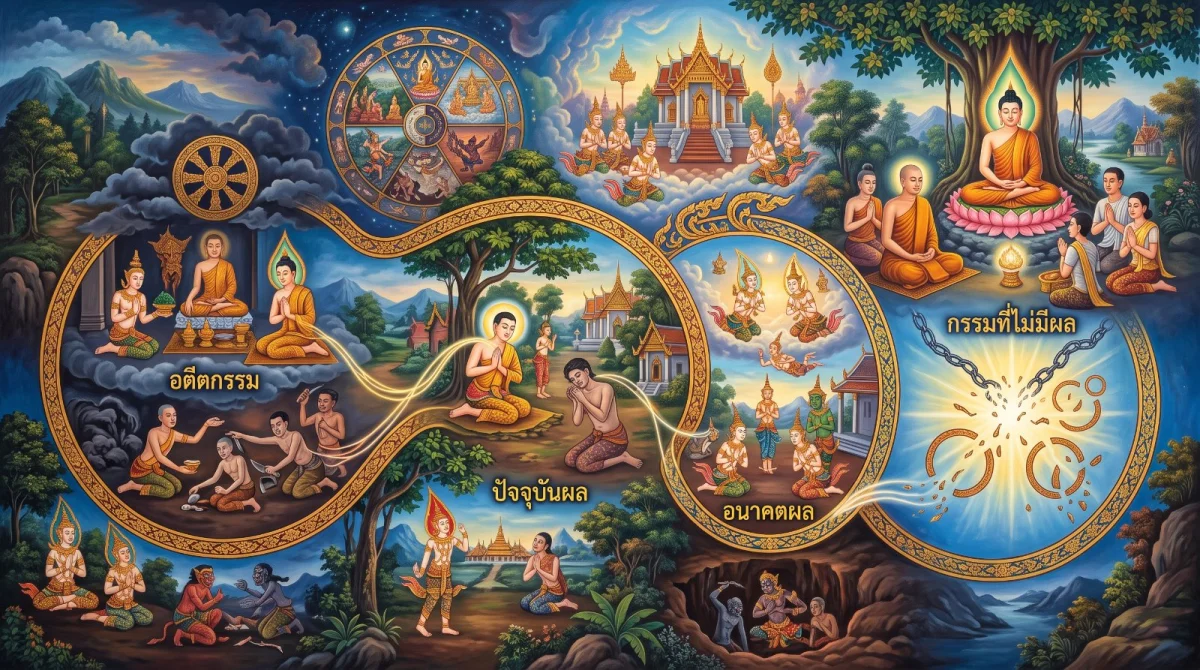
Kammakathā
The Paṭisambhidāmagga sets out the patterns of kamma and its result in past, present and future: kamma whose result has come, kamma whose result did not come, kamma whose result is coming, and kamma whose result will never come — evidence that kamma is not a rigid formula that explains everything in life.
The Kamma Kathā, in the Mahāvagga of the Paṭisambhidāmagga of the Khuddaka Nikāya, is very short. Its whole content is a run through the patterns: "there was kamma, there was kamma-result", "there was kamma, there was no kamma-result", and so on through every pairing of past, present and future.
It then repeats the same pattern for wholesome and unwholesome kamma, and in abbreviated form for other pairs: blameworthy and blameless kamma, dark and bright kamma, kamma yielding pleasure and yielding pain, kamma with pleasant result and with painful result.
The treatise adds no explanation or simile, but its structure says something important: kamma already done may have given its result, may be giving it, may give it in future, or may never give it at all.
The first pair of the treatise: there was kamma, and there was the result of that kamma — past kamma that has already given its result in the past.
What is past and whose consequences have already been met needn't be carried further. Keep the lesson; repeated guilt helps nothing.
The treatise states that there is kamma done whose result did not come, and kamma done whose result will not come. Later texts call kamma that has lost its chance to ripen ahosi-kamma. Kamma is not an account that must be paid in full, item by item.
Don't let fear of old kamma make you hopeless. What you can do is stop creating new unwholesome causes and deliberately create wholesome ones.
The treatise shows that kamma existing now may have its result now, or in future, or no result at all. The results of kamma don't always wait for a future life.
Notice the immediate results of what you do today: harsh words spoil the atmosphere, forgiveness lightens the heart. That is seeing kamma and its result with your own eyes.
The last pair of each set concerns kamma that will be, whose result may or may not come. Future kamma has not yet happened and still depends on what we do.
When life feels already decided, remember that the part not yet done is always open, and start with the next small decision.
The treatise repeats the same pattern for wholesome and unwholesome kamma: both good and bad kamma may have given their result, be giving it, give it later, or give none.
Do good because you see its value now, not by counting how much it will pay back, since the results of good kamma don't come on the schedule we expect either.
The treatise abbreviates the same pattern for several pairs: blameworthy and blameless kamma, dark and bright kamma, kamma yielding pleasure and yielding pain, and kamma with pleasant and with painful result. This point is for overall understanding.
Before an important decision, ask three questions: does it harm anyone, does it darken or clear the mind, and does it tend toward happiness or suffering?
A common misunderstanding is that everything happening to us now is the result of past kamma. The Kamma Kathā shows that some kamma never gives a result, and kamma done in the present can bear fruit in the present. In the Sīvaka Sutta of the Saṃyutta Nikāya, the Buddha also rejects the view that all pleasure and pain comes from past deeds, since feelings can arise from other causes too, such as bodily illness, change of season or being attacked.
So when you or someone else meets misfortune, don't rush to conclude "it's their kamma". Those words often stop us from helping and heap guilt on someone already suffering. What is really in our hands is the kamma we are doing now.
Tap to read the actual passage on the page cited.
Sāriputta teaches that a forest-dwelling monk who comes to stay in the Saṅgha should be respectful, know his s…
A king who once enjoyed every pleasure is thrown by an enemy into a place of hardship, yet his complexion and …

A king fails to keep the duty of a wheel-turning monarch to give wealth to the destitute. Poverty spreads, fol…
The rules on monks' sandals and leather goods. Every time the Buddha prohibited something, the group of six mo…