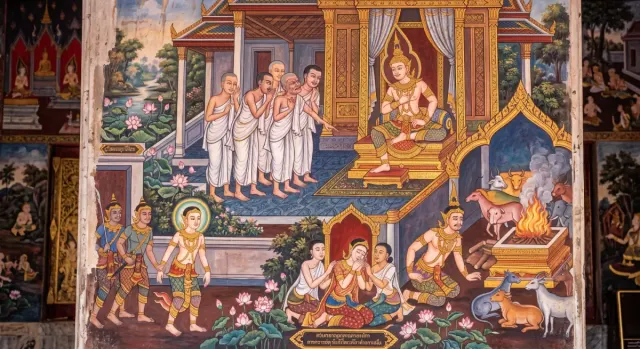
The Candakumāra Jātaka: When a Leader Trusts the Wrong Adviser
CandakumārajātakaṃThe chaplain Khaṇḍahāla tells King Ekarāja that a sacrifice of his sons, queens and all kinds of beings will t…


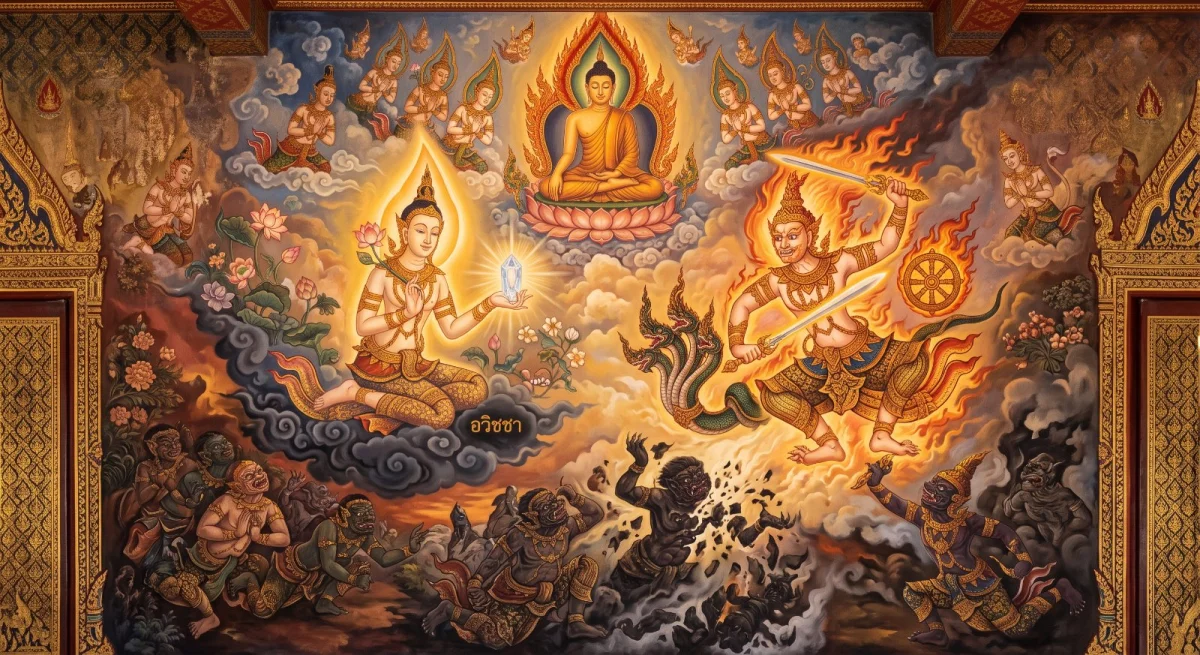
Samasīsakathā
The Paṭisambhidāmagga pairs each defilement with what cuts it off: renunciation cuts sensual desire, non-ill will cuts ill will, perception of light cuts sloth and torpor, non-distraction cuts restlessness, defining of states cuts doubt, gladness cuts discontent — and then lists thirteen heads, the states that lead in each domain.
The Samasīsa Kathā, in the Paññāvagga of the Paṭisambhidāmagga of the Khuddaka Nikāya, is a short treatise defining one kind of knowledge: "understanding of the non-appearance of all states through right cutting off and through cessation is knowledge of the meaning of the even and the head."
It explains each term. "Right cutting off" and "cessation" mean that renunciation cuts off and ends sensual desire, non-ill will ends ill will, perception of light ends sloth and torpor, non-distraction ends restlessness, defining of states ends doubt, knowledge ends ignorance, gladness ends discontent, the first jhāna ends the hindrances, and so on up to the path of arahantship, which ends all defilements. "Non-appearance" means that once the wholesome state is gained, its opposing defilement does not appear. These wholesome states are called "even" because their opposites have been abandoned.
"Head" means the leader. It lists thirteen, from craving as the head of impediment to cessation as the head of formations.
Renunciation cuts off and ends sensual desire. Once renunciation is gained, sensual desire does not appear, and because sensual desire has been abandoned, renunciation is called "even".
When your mind keeps circling around wanting some object or experience, deliberately give up something small, such as skipping one unnecessary purchase for a day, and notice how the mind lightens.
Non-ill will cuts off and ends ill will. Once non-ill will is gained, ill will does not appear.
When you start replaying thoughts about someone who angered you, deliberately wish that they be free of whatever makes them act that way. Even half-hearted, it beats replaying the anger.
Perception of light cuts off and ends sloth and torpor, dullness and drowsiness. Once perception of light is gained, sloth and torpor do not appear.
When you grow drowsy while working or meditating, turn on the light, step into daylight, or picture brightness clearly for a moment, instead of forcing yourself to sit on with a dim mind.
Non-distraction cuts off and ends restlessness. Once non-distraction is gained, restlessness does not appear.
When your head is full of unfinished matters, finish just one thing, or return to the breath for ten breaths, before thinking about the next.
Defining of states, clearly distinguishing things, cuts off and ends doubt. Once defining of states is gained, doubt does not appear. The same treatise adds that knowledge cuts off ignorance.
When you cannot decide, write out separately what is fact, what is worry, and what still needs checking. Indecision often eases once things are clearly separated.
Gladness cuts off and ends discontent, weariness with practice. Once gladness is gained, discontent does not appear. The treatise then adds that the first jhāna cuts off the hindrances, and so on up to the path of arahantship, which cuts off all defilements.
When you are tired of practice or of doing good, look back at small, real progress you have made. That small gladness is the fuel to keep going.
It lists thirteen heads, the leading states: craving is the head of impediment, conceit of bondage, views of misapprehension, restlessness of distraction, ignorance of defilement, faith of resolution, energy of exertion, mindfulness of establishment, concentration of non-distraction, wisdom of seeing, the life faculty of occurrence, liberation of the domain, and cessation of formations.
When a problem in your mind seems tangled, look for its head. Many worries may have a single craving behind them; deal with that first.
The immediately useful point is that each defilement has its own counterpart, and knowing what problem the mind has helps you choose the right remedy. Sloth isn't cured by pleasant thoughts but by making the mind bright; restlessness isn't cured by thinking more but by settling on one thing.
The word "non-appearance" is encouraging too. You needn't fight defilements head-on all the time. When the wholesome state arises, its opposite has nowhere to stand, like darkness vanishing when the light is switched on.
If drowsiness, boredom or loss of motivation persists for weeks, also consult a doctor or professional, since it may be a physical or mental health matter that needs more care than mind training alone.
Tap to read the actual passage on the page cited.
The chaplain Khaṇḍahāla tells King Ekarāja that a sacrifice of his sons, queens and all kinds of beings will t…

Three sets from the section on fours: those who praise or blame, trust or distrust without reflecting; those w…

The first Jātaka in the Tipiṭaka. Its verse teaches that the wise should hold to what is sure, not to the way …
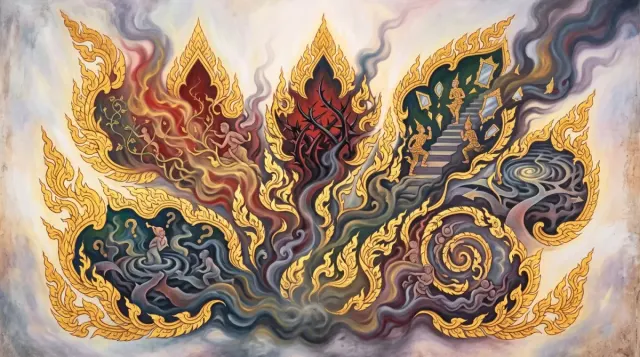
Seven defilements lying dormant in the mind — they stay hidden until something triggers them, like seeds waiti…