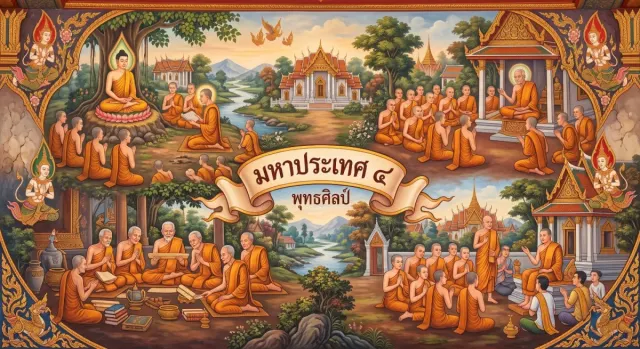
The Four Great Standards: When Nothing Is Written, Compare with the Principle
Yaṃ bhikkhave mayā idaṃ na kappatīti appaṭikkhittaṃAt the end of the Chapter on Medicines, monks were unsure what the Buddha had allowed and what he had not, so …



Ārammaṇaṃ paṭisaṅkhā bhaṅgānupassane paññā vipassane ñāṇaṃ
The middle sequence of knowledges in the Paṭisambhidāmagga: seeing the very mind that took an object break up, seeing it as fearful, wanting release and then becoming equanimous, change of lineage, emerging from defilement by the path, and finally reviewing what came together in that moment.
In the Paṭisambhidāmagga of the Khuddaka Nikāya, the treatise on knowledge lists seventy-three knowledges. The stretch after contemplation of rise and fall is where insight moves at full stride. It begins with insight knowledge, defined as the wisdom in reviewing the object and contemplating dissolution.
The explanation is very concrete. A mind with form as its object arises and breaks up; having reviewed that object, one contemplates the dissolution of that mind. One contemplates it as impermanent, not as permanent; as suffering, as non-self; one becomes disenchanted, dispassionate, brings to cessation, relinquishes. Contemplating impermanence, one abandons the perception of permanence; becoming disenchanted, one abandons delight; becoming dispassionate, one abandons lust.
Then come knowledge of danger, knowledge of equanimity about formations, change-of-lineage knowledge, path knowledge, fruition knowledge, knowledge of release and reviewing knowledge. This page follows the order the canon sets out; it is not a checklist for grading your own stage. Grading yourself usually causes more confusion than benefit. If strong states arise in practice, consult an experienced teacher.
A mind with form as its object arises and breaks up; having reviewed that object, one contemplates the dissolution of that mind — as impermanent, as suffering, as non-self, with disenchantment, dispassion, cessation and relinquishment. Each contemplation abandons its opposite perception: contemplating impermanence abandons the perception of permanence.
Notice how long one line of thought stays before the mind moves on, and see whether it feels lighter once you watch it go by itself.
This is wisdom that sees arising, occurrence, the sign of formations and accumulated kamma as fearful, as suffering, as formations. Paired with it is knowledge of the state of peace: that non-arising is safe, is happiness, is nibbāna. The text always presents the two together.
When you see the harm in something you are attached to, also picture the life that does not need it. Seeing only the harm usually turns into gloom.
Wisdom that is desire for deliverance, reviewing for a way, and composure. The text then adds that even that equanimity is itself a formation, so the knowledge is equanimous towards those formations too — which is why it is called equanimity about formations.
When you want out of a pressured situation, do all three beats: admit you want out, look for a workable way, then settle the mind about what cannot be changed.
The text distinguishes eight kinds of equanimity about formations arising through serenity and ten arising through insight, then compares three people. The ordinary person reviews in order to abandon the three fetters and gain the path of stream-entry; the trainee reviews for the higher paths; the one free of lust reviews in order to abide happily here and now, having already abandoned all defilement. This point is for overall understanding.
Don't compare your calm with someone else's. States that look alike from outside can come from quite different causes.
It is called change of lineage because it overcomes arising, occurrence, the sign, accumulated kamma, rebirth-linking, destination, birth, ageing, sickness, death, sorrow and the external sign of formations, in order to gain the path of stream-entry. Eight such states arise through serenity and ten through insight.
Smaller matters have their own crossing point — the first day you actually drop a habit. Remember how that day felt.
At the moment of the path of stream-entry, the knowledge called right view, in the sense of seeing, emerges from wrong view, from the defilements that follow it, from the aggregates, and from all external signs. Every path factor emerges from its own opposite in this way, up to the path of arahantship, which emerges from lust for form, lust for the formless, conceit, restlessness and ignorance.
To drop a wrong view you have to drop both the view and the habits that grew up with it, not just change the words you use.
When the effort of emerging from defilement has been tranquillised, right view and the other path factors arise; this is the fruit of the path. Knowledge of release is the wisdom that contemplates which corruptions have been cut off by which noble path.
After finishing something difficult, give yourself a short space in the quiet that follows instead of starting the next task at once.
Having emerged from the attainment, one sees that these states — path factors, factors of awakening, faculties, powers — came together at that moment. The wisdom that sees the states that came together at that moment is called reviewing knowledge.
After an important event, take two or three minutes to review what in your mind carried you through, and write it down briefly.
These knowledges belong to intensive practice, but the principle behind them applies to anyone. Once you see that something arises and passes, the mind stops demanding that it stay, and when it stops demanding, the weight drops by itself.
Equanimity about formations carries a lesson you can use today. The text says the wisdom comes from wanting to be released, then reviewing for a way, and then standing back. That order says real equanimity does not come from forcing yourself to feel calm; it comes from looking until you genuinely see there is nothing there to hold.
Reviewing knowledge is worth borrowing too. Looking back at what the mind went through after an event is what keeps the lesson from evaporating.
Tap to read the actual passage on the page cited.
At the end of the Chapter on Medicines, monks were unsure what the Buddha had allowed and what he had not, so …

Visākhā asked to give the Saṅgha eight things for life: rains bathing cloths, food for arriving monks, departi…
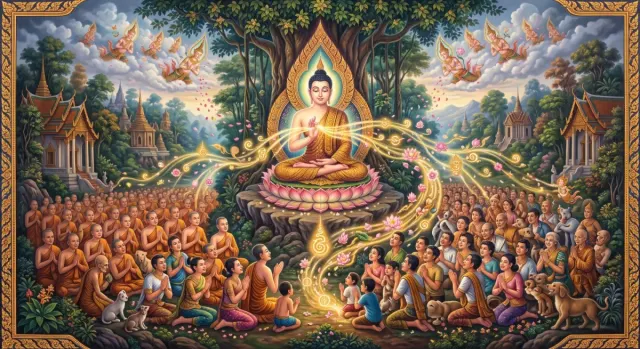
Seven short passages in the Book of Ones: the Tathāgata arises for the welfare and happiness of many people, i…
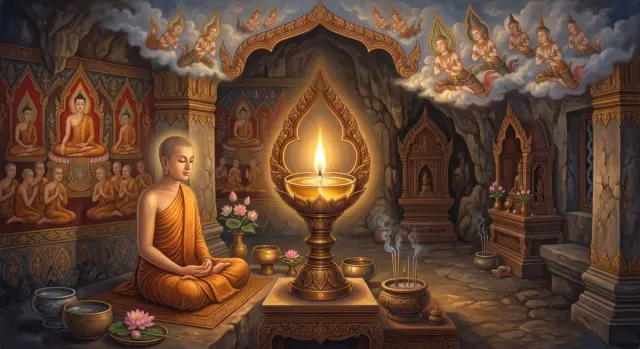
A busy carpenter asks Venerable Anuruddha whether the limitless mind and the exalted mind are different. The a…