
The Nanda Sutta: Raising Motivation from Lower to Higher
NandasuttaṃNanda wants to disrobe because he keeps thinking of a beautiful woman who asked him to come back soon. The Bud…


Ekapuggalo bhikkhave loke uppajjamāno
Seven short passages in the Book of Ones: the Tathāgata arises for the welfare and happiness of many people, is rare, and his passing grieves many. The chapter closes with Sāriputta, who rightly keeps turning the wheel of Dhamma.
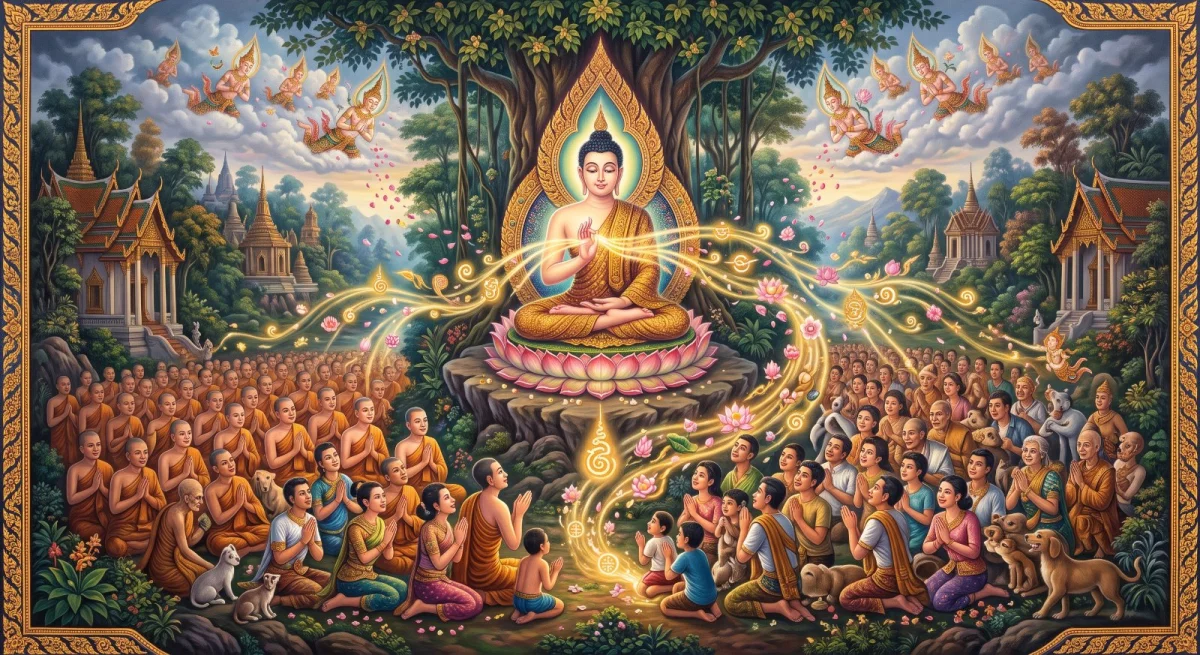
In the Ekapuggala Vagga of the Book of Ones in the Aṅguttara Nikāya (the Thai Royal Edition heads the section "Ekapuggala Pāḷi"), the Buddha speaks of "one person" with special qualities, and each time answers that this person is the Tathāgata, the Arahant, the fully awakened Buddha.
The passages are very short. Six are about the Tathāgata: he arises for the welfare and happiness of many; his appearance is rare in the world; he arises as a wondrous human being; his passing brings grief to many; he arises without equal; and his appearance is the appearance of a great eye and a great light.
The last passage turns from the Buddha to a disciple: the Buddha says he sees no one else who rightly keeps turning the wheel of Dhamma that the Tathāgata set rolling as Sāriputta does.
When the one person arises in the world, he arises for the welfare and happiness of many people, out of compassion for the world, for the good, welfare and happiness of gods and humans. That person is the Tathāgata.
Ask the same question of your own work: does anyone besides you benefit from what you do, even just a few people?
The appearance of the one person is rare in the world.
When you meet good teaching or a good teacher, don't assume you can find it any time. Listen carefully and put it into practice while you have the chance.
When the one person arises in the world, he arises as a wondrous human being.
The wonder here doesn't come from supernatural power but from a human being who became free of suffering and could teach others. It is encouragement that training oneself is a human matter.
The death of the one person brings grief to many people.
Grief at losing a teacher or respected elder is natural; the passage itself acknowledges it. A good way to honour them is to keep what they taught in use.
The one person arises without a second, without a peer, incomparable, without equal, the foremost of beings.
When people in the media claim to teach something better or quicker, go back and compare it with the original teaching in the Tipiṭaka rather than trusting the speaker's fame.
The appearance of the one person is the appearance of a great eye, a great light, a great radiance, of the six unsurpassable things; it is the realisation of the four analytical knowledges, the penetration of many elements, and the realisation of knowledge and freedom, from the fruit of stream-entry to the fruit of arahantship.
Good teaching works like a light in a dark room: it doesn't change what is in the room but shows where things are. Notice which teaching helps you see your own problems more clearly.
The Buddha says he sees no other single person who rightly keeps turning the supreme wheel of Dhamma set rolling by the Tathāgata as Sāriputta does.
When you learn something good, passing it on accurately matters more than passing it on quickly. Before explaining a teaching to others, check that your understanding matches the source.
This chapter is not only for reciting praise of the Buddha. What we can use is this: a teacher's worth is measured by how much they arise for the good of many, and good teaching is not easy to find. Once we meet it, we should make full use of it.
The passage on Sāriputta shows that a teacher's work continues only through disciples who understand correctly and pass it on correctly, not through reverence alone.
Faith in the Buddha need not come with looking down on others. The passages speak of the Tathāgata's qualities; they do not teach us to use them to compete with anyone.
Tap to read the actual passage on the page cited.
Nanda wants to disrobe because he keeps thinking of a beautiful woman who asked him to come back soon. The Bud…

A family that has become wealthy won't last long for four reasons: not looking for what is lost, not repairing…
The wanderer Sabhiya brings questions that famous teachers couldn't answer to the Buddha: what makes one a bhi…

A way of deciding whether to stay in or leave a forest, village, town or person, by looking at two things: whe…