
The Analysis of the Path: The Eight Factors Defined One by One
MaggavibhaṅgoThe eleventh Vibhaṅga gives short, direct definitions of all eight path factors, then a second method that say…


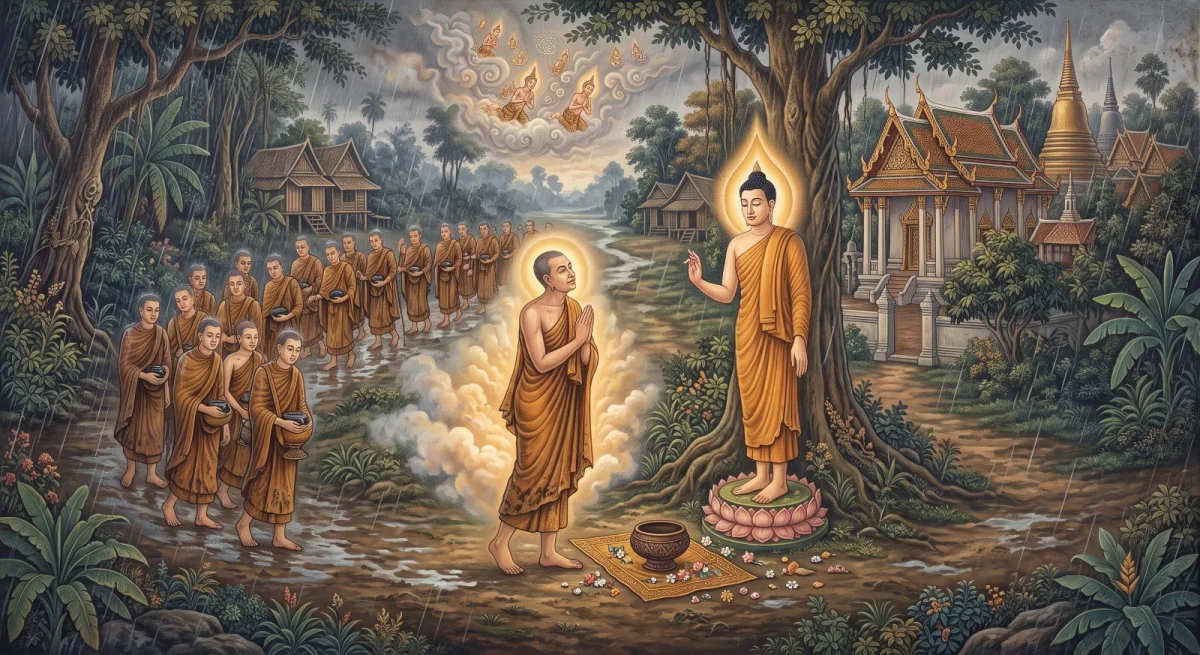
Na bhikkhave gihīnaṃ uttarimanussadhammaṃ iddhipāṭihāriyaṃ dassetabbaṃ
A Rājagaha merchant hung a sandalwood bowl atop a tall bamboo pole and challenged any arahant with psychic power to take it down. Piṇḍola Bhāradvāja rose into the air and took it. The Buddha rebuked him for displaying psychic power to laypeople for the sake of a worthless wooden bowl, forbade monks to display such powers to laypeople, and had the bowl broken up.
In the Khuddakavatthu Khandhaka of the Cullavagga, Vinaya Piṭaka, is the origin story of the training rule forbidding monks to display psychic powers to laypeople. This khandhaka collects minor observances concerning monks' requisites and way of life, and each rule usually has a real incident behind it.
The story begins when a Rājagaha merchant obtained a costly block of sandalwood heartwood. He had it turned into a bowl, placed it in a sling, and hung it at the top of bamboo poles tied end to end, announcing that any ascetic or brahmin who was an arahant with psychic power should take the bowl down. The six sectarian teachers came one after another claiming to be arahants and asking for the bowl, but the merchant told each one that if that were true, he should take it down himself.
Piṇḍola Bhāradvāja rose into the air and carried the bowl three times around the city, and people followed him with a great uproar. The Buddha questioned him, rebuked him and laid down a training rule. The rule is monastic discipline, but the principle behind it applies to everyone: don't use special abilities as a display for gain or to win a dare.
The merchant set the condition that an arahant with psychic power should take the bowl down himself. Pūraṇa Kassapa, Makkhali Gosāla, Ajita Kesakambala, Pakudha Kaccāyana, Sañjaya Belaṭṭhaputta and Nigaṇṭha Nātaputta each came saying they were arahants with psychic power and asking for the bowl. The merchant gave each the same answer: if that is true, take it down yourself.
When someone claims to be highly skilled or knowledgeable, there's no need to argue or believe at once. Look at what they can actually do in useful work.
Piṇḍola Bhāradvāja and Mahāmoggallāna were both arahants with psychic power, and each told the other to go and take down the bowl. In the end Piṇḍola rose into the air and carried the bowl three times around Rājagaha. The merchant, with his wife and children, raised joined palms and invited him to alight at the house, filled the bowl with costly food, and Piṇḍola took the bowl back to the monastery.
Before using a special ability, ask whose benefit it serves. If the answer is to win or to get something, stop first.
People heard that Piṇḍola had taken down the merchant's bowl and followed close behind him with a great uproar. The Buddha heard the noise and asked Ānanda about it. Having learned what happened, he had the Saṅgha convened and first asked Piṇḍola whether it was true. Piṇḍola admitted that it was.
When something you've done causes a big stir, treat it as a moment to review why you did it, not as proof that you did right.
The Buddha rebuked him: this was unsuitable, not the work of an ascetic. How could he display a superhuman psychic power to laypeople for the sake of a wooden bowl, as worthless as a corpse? He compared it to exposing one's private parts for a paltry coin, and said such conduct does not inspire confidence in those who lack it.
Don't trade knowledge, trust or a reputation built over years for small immediate gains like a discount, a freebie or more followers.
After a Dhamma talk he laid down the rule that a monk should not display a superhuman psychic power to laypeople, and whoever does so commits an offence of wrongdoing. He did not end the matter by rebuking one person; he set a standard for all monks to observe.
When a problem arises in a team, address both the person and the rules, so the same thing doesn't happen again with someone else.
He had the monks break the wooden bowl into small pieces and grind it for the monks' eye ointment, and ruled that monks should not use wooden bowls. The object that had provoked the display was not kept as a trophy but turned into useful medicine.
Trophies or things won by showing off can be turned into something everyone uses, rather than kept as proof that we are better.
Later the group of six monks used gold and silver bowls, and people criticised them as being like laypeople enjoying sensual pleasures. The Buddha forbade bowls of gold, silver, gems and other precious materials, and allowed only two kinds: iron bowls and clay bowls.
Choose things that do their job well and don't draw attention. Things you have to show off or constantly guard take up more of the mind than you might think.
Sandalwood-bowl challenges are everywhere today: online dares, contests to flaunt knowledge, wealth or achievements, all for a prize, likes or recognition. This story invites us to ask, before accepting a challenge, whether what we gain is worth what we give up.
The Buddha did not fault Piṇḍola's ability. He faulted trading something of great value for something trivial in front of a gawking crowd. Real abilities belong where they do some good, not as a way to attract gain or applause.
Ordering the bowl destroyed is a lesson too. Sometimes it is better to remove the thing that provokes rivalry altogether than to keep it around as a trophy of showing off.
Tap to read the actual passage on the page cited.
The eleventh Vibhaṅga gives short, direct definitions of all eight path factors, then a second method that say…
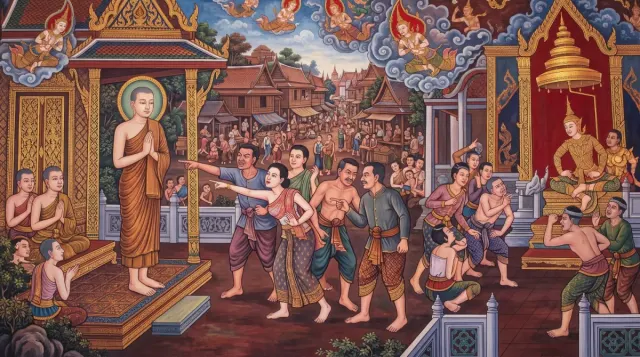
Mettiya and Bhummajaka resented getting poor lodgings and poor food, guessed on their own that Dabba Mallaputt…

Ten subjects the Buddha recommended talking about instead of the trivia that eats up the day — few wishes, con…
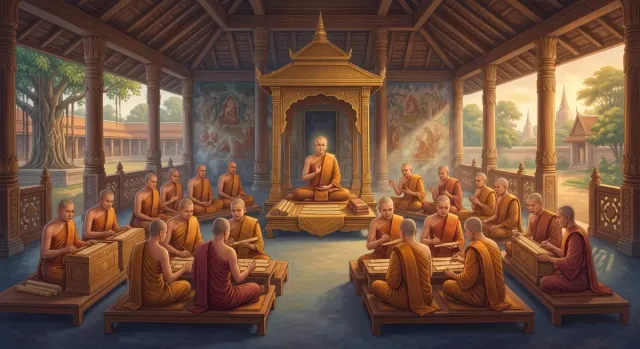
A hundred years after the Buddha's final passing, the Vajjian monks of Vesālī declared ten points allowable, i…