
Māra's Daughters: Craving, Discontent and Lust Come to Tempt
MāradhītusuttaṃMāra's three daughters, Taṇhā, Arati and Ragā, take the forms of women of many ages and try again and again to…


Pāṭaliyo gāmaṇī
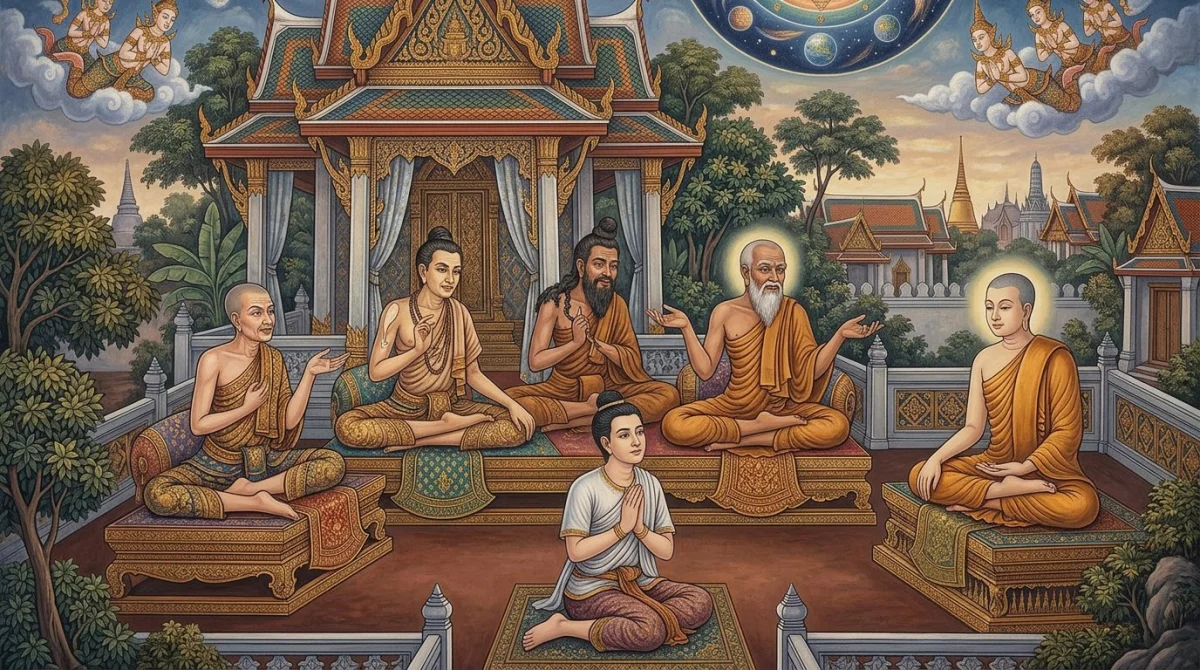
The headman Pāṭaliya tells how four teachers with utterly opposed views stayed in his rest house, leaving him in doubt about who spoke truly. The Buddha does not say whom to believe; he sets out the composure of the Dhamma — a way that is not mistaken whichever of them is right.
In the Pāṭaliya Sutta of the Gāmaṇi Saṃyutta, Saṃyutta Nikāya, the headman Pāṭaliya asks whether it is true that the ascetic Gotama knows magic. The Buddha says that those who say so are saying what he has said and do not misrepresent him, but he distinguishes knowing magic from being a magician. He does this with an example: Pāṭaliya knows the long-haired officials of the Koliyans to be immoral, yet that does not make Pāṭaliya immoral.
He then shows that a sweeping claim, such as that everyone who commits sexual misconduct must experience pain and distress here and now, is false — since in that very society people could see one man rewarded for such an act and another executed for it. The discourse does not conclude that action has no result; it only cuts off the claim that results must always appear immediately in this life.
Pāṭaliya then tells his own story. He keeps a rest house furnished with a bed, a seat, a water pot and an oil lamp for ascetics and brahmins. One day four teachers of different views stayed there: one holding that giving bears no fruit and there is no world beyond; one that giving does bear fruit and there is a world beyond; one that no evil is done however one acts; one that evil is done and merit is made. He was left wondering who spoke truly and who falsely.
The Buddha tells him it is fitting that he should doubt, since doubt has arisen in him about a doubtful matter. Then, instead of naming who is right, he sets out what he calls the composure of the Dhamma.
When Pāṭaliya hears that the Buddha knows magic and is ready to conclude that he is therefore a magician, the Buddha asks in return: if someone said that Pāṭaliya knows the long-haired Koliyan officials to be immoral and is therefore immoral himself, would that be rightly said? Pāṭaliya answers that it would not.
Do not assume that someone who studies a subject must be an example of it. The person who reads most about scams may be the one warning everyone else.
He says that he knows magic and the result of magic, and knows how one who practises it fares after death. He then goes through each case in turn: killing, taking what is not given, sexual misconduct, false speech, and on to wrong view.
When warning someone about risky behaviour, speak on all three levels — what is being done, what follows, and where it leads — rather than only saying do not do it.
He raises what people in that society could actually see: one man rewarded by the king for an offence, another executed for the same kind of offence. He then asks whether those ascetics and brahmins who say that all who act wrongly experience pain here and now speak truly or falsely, and Pāṭaliya says falsely. The discourse cuts only the claim of immediate result, not the fruit of action itself.
Do not use the fact that someone prospers after acting badly as a licence for yourself — and do not promise anyone that doing good always pays off visibly and soon.
When Pāṭaliya describes the four teachers who stayed in his rest house and says he is uncertain who speaks truly, the Buddha replies that it is fitting for him to doubt, fitting for him to be uncertain, since uncertainty has arisen in him about a matter that warrants it.
When teachings or sources conflict and you feel unsure, admit the uncertainty rather than picking a side quickly just to be rid of the discomfort.
Instead of naming who is right, he says there is a composure of the Dhamma; if you establish yourself in it and gain composure of mind, you can abandon this doubt. It begins with giving up killing, stealing, sexual misconduct, lying, divisive speech, harsh speech, idle chatter, covetousness, ill will and wrong view.
While you cannot settle the question in thought, act on what you are sure of: do not lie, do not take what is not yours, do not say what sets people against each other.
The noble disciple, free of covetousness and ill will, unconfused, clearly comprehending, mindful, dwells pervading one direction with a mind of loving kindness, then the second, third and fourth, above, below and across, to all beings everywhere, boundless, without enmity, without affliction.
Before sleep, call to mind the people you met today in groups, from those closest to strangers, and wish that there be no enmity between you.
The noble disciple reflects on each teacher in turn: if what that teacher says is true, then my restraint of body, speech and mind is one thing, and my going to a good destination after death is another — both are a victory here, since I harm no one and practise rightly. He is to reflect in this way about every one of the views raised.
When deciding among conflicting claims, ask which option still holds up if the other side is right, and take that one for now.
Reflecting in this way, gladness arises; from gladness, rapture; with rapture in the mind, the body becomes tranquil; tranquil in body, one feels happiness; being happy, the mind becomes composed. At the end of the discourse the headman Pāṭaliya goes for refuge for life.
Notice whether choosing the harmless course makes your mind lighter or heavier. That lightness is better evidence than winning an argument.
Pāṭaliya's question is one people meet every day, whenever experts, scholars or teachers contradict one another and we cannot check everything ourselves.
What the discourse offers is not a quick choice of sides, but a question: is there a way of acting that does no harm whichever side turns out to be right? The answer given is harming no one, restraint of body, speech and mind, and the radiating of loving kindness. If there is a world beyond, one goes to a good destination; if there is not, one has still lived at enmity with no one. Either way one wins.
The caution is that this discourse does not say all views are equal, or that one should stop looking for the truth. It says that while you do not yet know, choose the action that is safe — and the confidence will come from the result you see in your own mind.
Tap to read the actual passage on the page cited.
Māra's three daughters, Taṇhā, Arati and Ragā, take the forms of women of many ages and try again and again to…

A king who has lost his kingdom, horses, earrings, jewels and family is asked why he does not grieve. He repli…

Two discourses side by side. The first explains why someone could not keep going and gave up the training; the…

King Pasenadi kisses the Buddha's feet, then describes what he has seen with his own eyes that gives him confi…