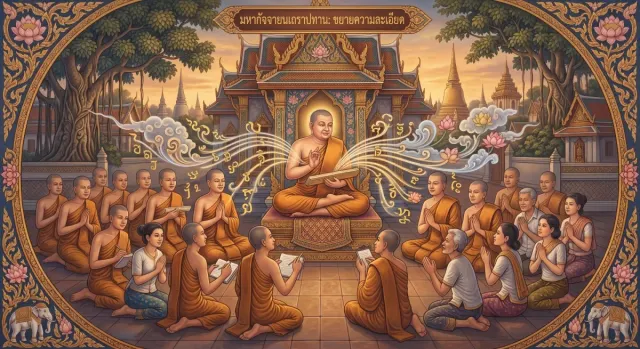
The Apadāna of Mahākaccāna: Expanding the Brief So People Understand
MahākaccāyanattherāpadānaṃThe past lives of Venerable Mahākaccāna in two Apadāna passages: a hermit who heard the Buddha praise a discip…


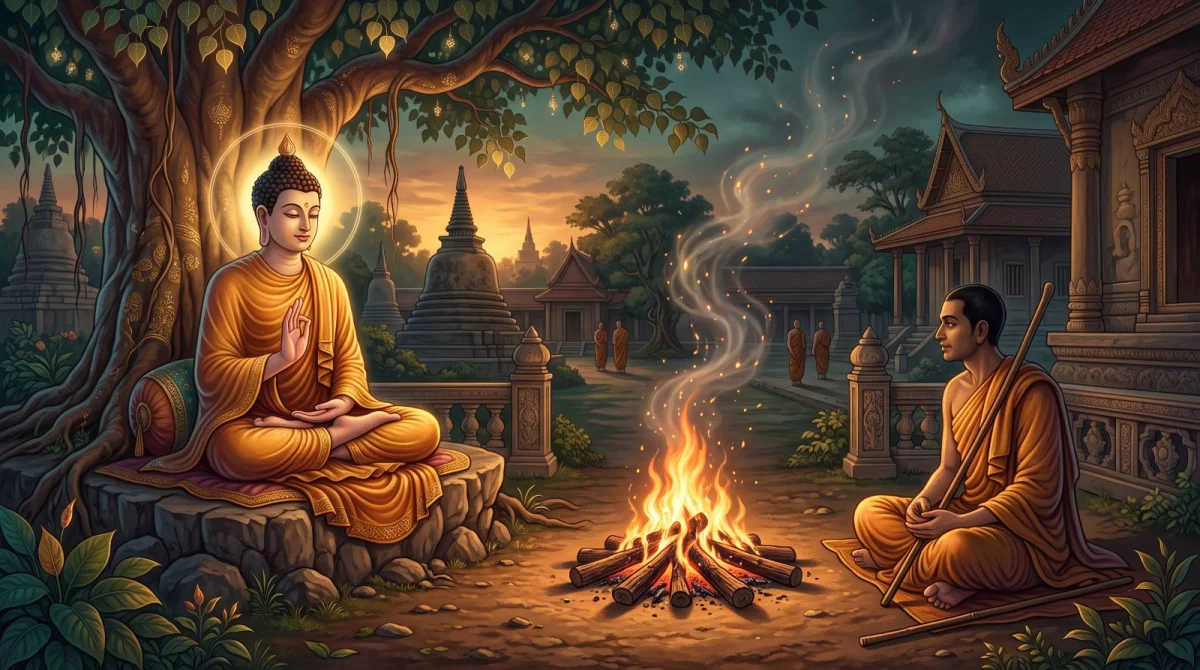
Abyākatasaṃyuttaṃ
The wanderer Vacchagotta questions the Buddha, Mahāmoggallāna and Sabhiya Kaccāna about the undeclared questions. He learns that others answer because they regard the aggregates as self, hears the simile of fire that burns with fuel, and the Buddha later explains to Ānanda why he stayed silent when asked whether there is a self.
Near the end of the Abyākata Saṃyutta of the Saṃyutta Nikāya are four discourses in which the wanderer Vacchagotta is the questioner. In the Vaccha Sutta he asks whether the world is eternal and whether a being exists after death. The Buddha says these questions are undeclared: teachers of other sects regard form, and so on up to consciousness, as self, and so they answer such questions, but the Tathāgata does not regard them so. Vaccha asks Mahāmoggallāna and receives the same answer, and marvels that the teacher and the disciple agree in meaning and in wording.
In the Kutūhalasālā Sutta, Vaccha relates that the sect leaders all declare where their dead disciples have been reborn, and the Buddha does too; but of his highest disciples he also says that they have cut off craving and made an end of suffering. This leaves Vaccha perplexed, and the Buddha answers with the simile of fire and fuel.
In the Ānanda Sutta, Vaccha asks whether there is a self or there is no self, and the Buddha stays silent both times. After Vaccha leaves, he explains his reasons to Ānanda. In the Sabhiya Sutta, Sabhiya Kaccāna, only three years ordained, answers Vaccha's questions about the Tathāgata after death, and Vaccha praises him.
The Buddha tells Vaccha that teachers of other sects regard form as self, self as possessing form, form as in self, or self as in form, and likewise up to consciousness, and so they answer whether the world is eternal or a being exists after death. The Tathāgata does not regard the aggregates in this way, so he does not answer within that framework. This point is for overall understanding.
When arguing over a question that forces you to pick a side, ask what assumption both sides share. Sometimes the problem lies there.
Vaccha asks Mahāmoggallāna the same question and receives an answer with the same reasoning and wording. He says it is wonderful that the meaning and phrasing of teacher and disciple coincide and do not diverge on the most important point.
To check whether you really understand a principle, explain it in your own words, then compare with the source to see whether the meaning matches.
When Vaccha voices his perplexity, the Buddha doesn't rebuke him but says it is fitting for him to be perplexed; the doubt has arisen in him about something that is indeed perplexing.
When a child or team member asks something genuinely hard, begin by acknowledging it's a question worth asking before you answer.
The Buddha says he declares rebirth for one who still has grasping, not for one without grasping — just as a fire burns when it has fuel, and does not burn without fuel.
When anger or worry spreads, ask what its fuel is, then gradually pull the fuel away instead of chasing the flames.
Vaccha asks what the fuel is when a flame is flung far by the wind. The Buddha says the wind is its fuel at that time. Vaccha asks further: when a being lays down this body but has not yet arisen in another, what is its fuel? The Buddha says that he declares craving to be its fuel. This point is for overall understanding.
Notice how small pulls of wanting carry you from one thing to the next — for example, from one app to another without meaning to.
Vaccha asks whether there is a self; the Buddha stays silent. He asks whether there is no self; again the Buddha stays silent. After he leaves, the Buddha explains to Ānanda: to say there is a self would side with the eternalists and would not help the knowledge that all things are not-self; to say there is no self would side with the annihilationists, and Vaccha, already confused, would be even more confused, thinking, "Formerly I surely had a self, but now it doesn't exist."
Before answering someone who is confused, consider whether your short answer will help them understand or confuse them further. Sometimes continuing the conversation is better than a flat verdict.
Sabhiya Kaccāna tells Vaccha that if the causes and conditions for designating one as having form, formless, percipient, non-percipient, or neither percipient nor non-percipient were to cease completely without remainder, by what could one be designated? Learning that he has been ordained only three years, Vaccha praises him for answering so well.
Deep understanding doesn't always depend on age or seniority. Listen to the substance of the answer before looking at who is speaking.
This is an in-depth page, but it holds a lesson for every day: not every question should be answered with yes or no. Some questions rest on a mistaken assumption from the start, and answering either way leads the questioner deeper into confusion.
The Buddha's silence in the Ānanda Sutta is not evasion or ignorance; he considers whether an answer would help or further confuse the person asking. In real life we too may face questions from children, friends or people who are confused, where a short answer could mislead them more than before.
The simile of fire and fuel invites us to see that what drives life onward is craving. Noticing the pull of wanting in daily life is a way to begin seeing the fuel of suffering with our own eyes.
Tap to read the actual passage on the page cited.
The past lives of Venerable Mahākaccāna in two Apadāna passages: a hermit who heard the Buddha praise a discip…
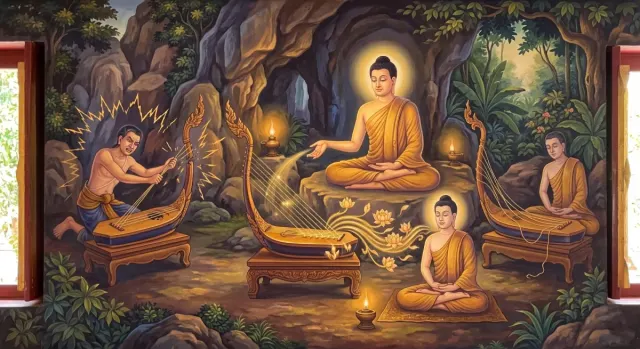
Effort that is too tight leads to restlessness; too slack leads to laziness — the Buddha's teaching to Soṇa, w…

A father lost in grief for the grandfather came to his senses on seeing his son offer grass to a dead ox. The …

Saccaka asks about developing body and mind. The Buddha tells how he tormented his body to the limit without f…