
The Nuns' Analysis: When Anger Curses Oneself, Others and the Whole Community
Nirayena vā brahmacariyena vā abhisapeyyaThree origin stories about anger: answering a simple question with a curse of hell, beating oneself and weepin…


Uyyuttaṃ senaṃ dassanāya
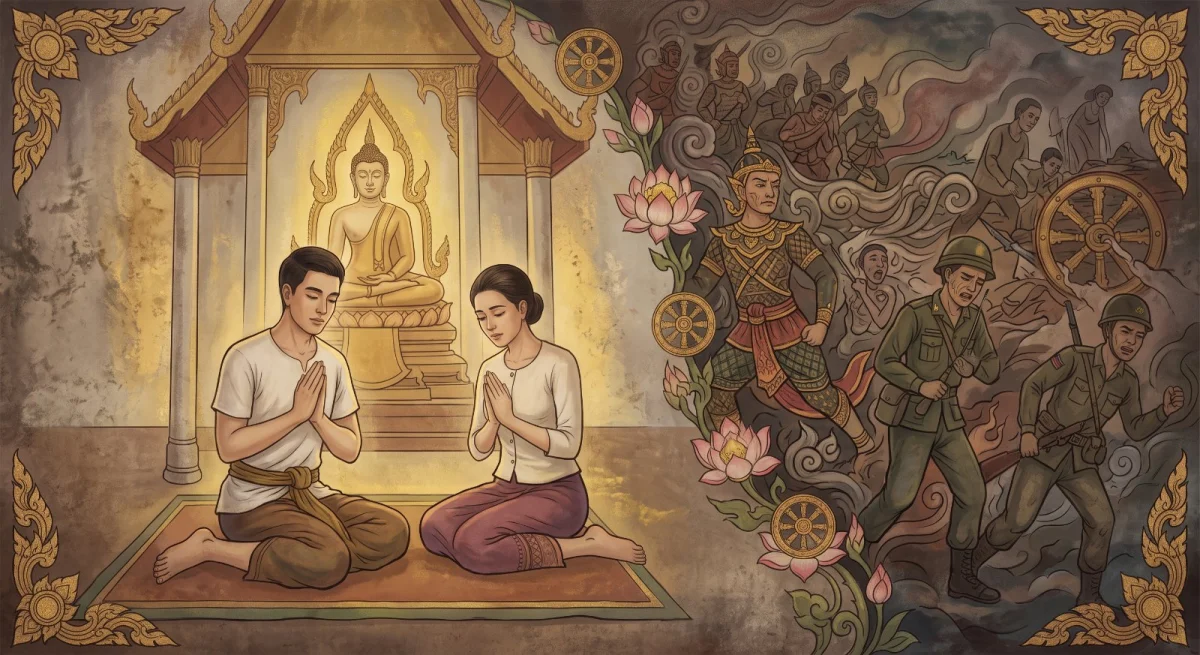
The group of six monks went to watch King Pasenadi's army on the march. The king asked what use it was to look at a man who delights in battle, and the people who were there for the sake of their livelihood and families objected — giving rise to three rules about watching and staying with an army.
In the Vinaya Piṭaka, Mahāvibhaṅga Part 2, Pācittiya section, Acelaka Vagga, rules 8 to 10 concern going to watch an army. The Buddha is staying at Jetavana near Sāvatthī when King Pasenadi of Kosala marches out with his army, and the group of six monks go to watch. Seeing them from a distance, the king has them called over and asks why they have come.
When they say they wished to see him, he replies, "What use is it to look at me, who delights in battle? Should you not rather be seeing the Blessed One?" The people also objected: they were there in the army for the sake of their livelihood and for their wives and children, not as a spectacle. The Buddha then prohibited going to watch an army on the march. Later a monk whose uncle lay ill in the army needed to go, so the Buddha allowed it when there is such a reason — but limited the stay to two or three nights, and prohibited going to look at the battle array or the battlefield.
These rules were laid down for monks, and the text contains a single brief violent scene. The point that applies to everyone is the gap between the onlooker's curiosity and the suffering of those actually living through the event.
When the monks said they wished to see him, the king replied: what use is it to look at me, who delights in battle — should you not be seeing the Blessed One? The rebuke came from the man in the army himself.
Before opening something violent or someone else's drama, ask briefly what you are watching it for, and whether there is something better to watch.
The people complained: we too are here in the army for the sake of our livelihood, for the sake of our wives and children, and it has gone badly for us. This voice is a reminder that what looks exciting to an onlooker is another person's hard daily life.
When you see a clip of people doing dangerous work or in trouble, remember that this is their job and their life, not content.
Later a monk heard that his uncle lay ill in the army and had asked for him, and he hesitated because of the prohibition. The Buddha then allowed going to an army for such a reason, adding the exemption to the rule itself.
Good rules make room for necessity. When setting household or team rules, state the exceptions too, so nobody has to choose between the rule and helping someone.
When the group of six had genuine business at the army and then stayed more than three nights, people objected again, so the Buddha allowed a stay of only two or three nights; beyond that it is a pācittiya. Necessity opens the door; it does not grant permission to settle in.
Enter a tense situation for as long as the business requires, then leave. Don't take up residence in other people's drama.
Rule 10 arose when the group of six, staying with the army, went about looking at the battlefield, the encampment and the array. One of them was injured and was then mocked — asked how well he had fought and what his score was — and was left embarrassed. The text tells this scene briefly, showing that whoever goes to look out of curiosity takes on what is there.
Don't stand close to a conflict that isn't yours. Onlookers often end up as parties to it without meaning to.
The exemptions say there is no offence if a monk sees the army while standing in the monastery, if it passes the place where he is standing, sitting or lying, or if he meets it while walking the other way. What is prohibited is going in order to look, not happening to see.
Bad news that crosses your path is not your doing; choosing to open it again and again is.
We no longer walk out to watch an army, but we carry screens that put us instantly in front of accidents, fires, street fights and the distress of strangers. King Pasenadi's question still lands: what good does looking at this do?
What the Vinaya highlights is the perspective of those inside the event. For the soldiers in the story it was their job and the burden of feeding a family, not a performance. The same is true of people filmed in their worst moment; it becomes a few seconds of entertainment for someone else.
The exemptions draw a practical line. Going because you have genuine business there is no offence, and seeing an army that passes where you already are is no offence. What is prohibited is deliberately going to look for the thrill of it, and staying longer than the need requires.
Tap to read the actual passage on the page cited.
Three origin stories about anger: answering a simple question with a curse of hell, beating oneself and weepin…

Sixteen stains that dull the mind, from the Vatthūpama Sutta — a dirty cloth won't take dye well, and a staine…
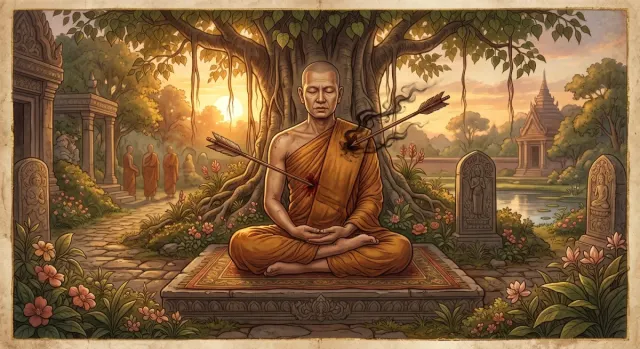
Physical pain cannot be avoided; the mental pain we add to it can. A simile that is usable every single day.

Noble right concentration has the other seven path factors as its supports. In every factor right view leads, …